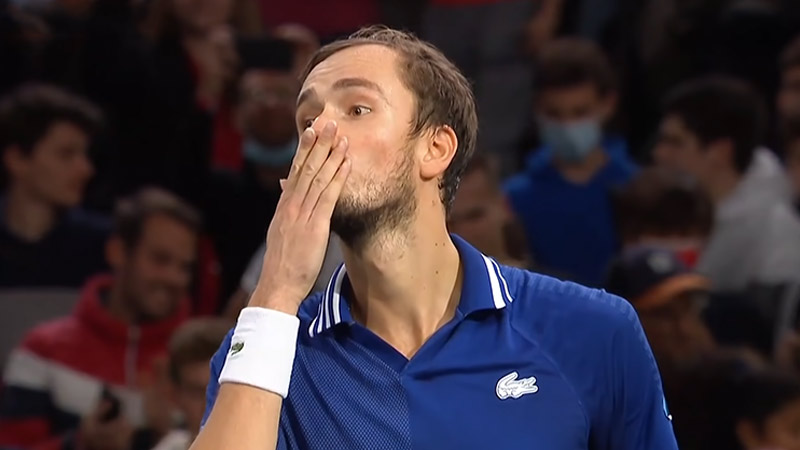
The trajectory of a professional tennis career is often defined by adaptability. For Daniil Medvedev, a former world number one and Grand Slam champion, that adaptability is tested to its absolute limit every spring.
While his dominance on hard courts is undisputed, his relationship with the red clay of Europe remains one of the most intriguing subplots in modern sports.
This analysis explores the technical, tactical, and psychological reasons why one of the world’s greatest players finds himself in a “survival test” the moment he steps onto the dirt.
The Technical Foundation: Why the Mechanics Fail
Tennis on clay is a different sport than tennis on hard courts. The friction of the surface slows the ball significantly and causes it to bounce higher.
For a player like Medvedev, whose game is optimized for the low-skidding, high-velocity environment of hard courts, these physical changes create a fundamental misalignment.
The Flat-Shot Conundrum
Medvedev is renowned for his incredibly flat groundstrokes. On hard courts, these shots stay low, forcing opponents to hit up on the ball and allowing Medvedev to dictate play with a relentless, machine-like rhythm. On clay, however, this technical advantage becomes a liability.
- Lack of Topspin: Clay requires heavy topspin to “dip” the ball into the court and make it jump off the surface. Medvedev’s flat shots lack the revolutions necessary to penetrate the slow surface, often sitting up at a comfortable height for his opponents to attack.
- Net Clearance: Because he hits with less margin, the unpredictable bounces of clay can lead to higher unforced error counts.
- Pace Absorption: Clay acts as a natural brake. The “heavy” balls Medvedev faces do not return with the same speed he provides, forcing him to generate more of his own power—a task that is physically draining over five sets.
Physical Mechanics and the 6’6″ Frame
At 6’6″, Medvedev possesses a massive wingspan that makes him nearly impossible to pass on hard courts.
However, clay demands a specific type of movement—sliding into shots and changing direction on loose footing—that does not naturally suit his tall, lanky build.
| Movement Metric | Hard Court Performance | Clay Court Performance |
|---|---|---|
| Traction | High; immediate stops and starts. | Low; requires sliding into the ball. |
| Change of Direction | Elite; leverages grip for quick recovery. | Below average; height makes low-center sliding difficult. |
| Defensive Reach | Maximized by court speed. | Compromised by the “loose dirt” effect. |
| Footwork Precision | Highly repeatable and rhythmic. | Subject to “bad bounces” and uneven footing. |
Tactical Geometry: The Deep-Court Liability
Tactics in tennis are about managing space and time. Medvedev is a master of using the depth of the court to his advantage, often standing nearly ten feet behind the baseline to return serves and start rallies.
While this strategy provides him with time to read the play on hard courts, it creates significant geometric gaps on clay.
- Exposure to Short Balls: By standing so deep, Medvedev invites his opponents to use the drop shot. On clay, the ball dies more quickly after the bounce, making it nearly impossible for a 6’6″ player to sprint forward and recover the point in time.
- Sharp Angles: The slower speed of the court allows opponents to pull Medvedev wider than they could on a faster surface. On clay, these wide angles are more effective because the sliding recovery takes longer, leaving the rest of the court open.
- The Power Gap: On faster surfaces, Medvedev uses his opponent’s power against them. On the slow, high-bouncing clay, that power is dissipated, meaning he must work twice as hard to end a point.
The Psychological Hurdle: Disdain vs. Acceptance
The mental game is perhaps the most documented aspect of the Medvedev clay paradox. He has historically been vocal about his frustration with the surface, famously describing it as “unnatural” and expressing a profound lack of comfort during the European swing.
Key Mental Challenges:
- Surface Disdain: Medvedev has previously stated that he hates the way the dirt gets on his clothes and shoes, a minor detail that speaks to a larger lack of harmony with the environment.
- The “Survival” Mindset: Rather than entering a tournament as a favorite, he often approaches the clay season as a period of survival, hoping to minimize ranking damage before the grass and hard-court seasons begin.
- Recent Evolution: In a notable shift, Medvedev has recently attempted to adopt a more “accepting” mindset, focusing on the process of improvement rather than just the results. This psychological pivot was a key factor in his unexpected success in 2023.
The Rome Anomaly: A Blueprint for Success
In 2023, the tennis world was shocked when Medvedev claimed the Italian Open title in Rome—a prestigious Masters 1000 event on clay.
This remains his only professional title on the surface and serves as a case study in how tactical resilience can overcome technical disadvantages.
How He Won Rome:
- Extreme Patience: He leaned into his identity as a “grinder,” willing to stay in rallies for 30+ shots to outlast opponents who tried to overhit on the slow surface.
- Serving Consistency: He used his height to maintain a high first-serve percentage, preventing opponents from attacking his second serve on the high-bouncing dirt.
- Acceptance of the Surface: By his own admission, he stopped fighting the “feeling” of the clay and focused on making the match as uncomfortable as possible for his opponent.
Hard Courts vs. Clay
To understand “how good” Medvedev is on clay, one must view it through the lens of his general elite status. While he is “below average” for a top-5 player on clay, he remains a dangerous opponent for anyone outside the top tier due to his tactical intelligence.
Success Drivers by Surface:
- Hard Court: Power, flat-shot penetration, court coverage, and serve-plus-one dominance.
- Clay Court: Tactical resilience, patience, physical endurance, and the ability to grind out wins against lower-ranked players.
The Competitive Outlook
The narrative that Daniil Medvedev cannot play on clay is an oversimplification. While it is true that he is significantly less effective on the dirt than on hard courts, his career remains defined by a relentless search for solutions.
He may never be a “clay-court specialist,” but his ability to transform a “survival test” into a Masters 1000 title in Rome suggests that his tactical mind is a weapon that transcends surface limitations.
For Medvedev, the goal is not to love the clay, but to find a way to win on it—and in that pursuit, he remains one of the most compelling figures in the sport.