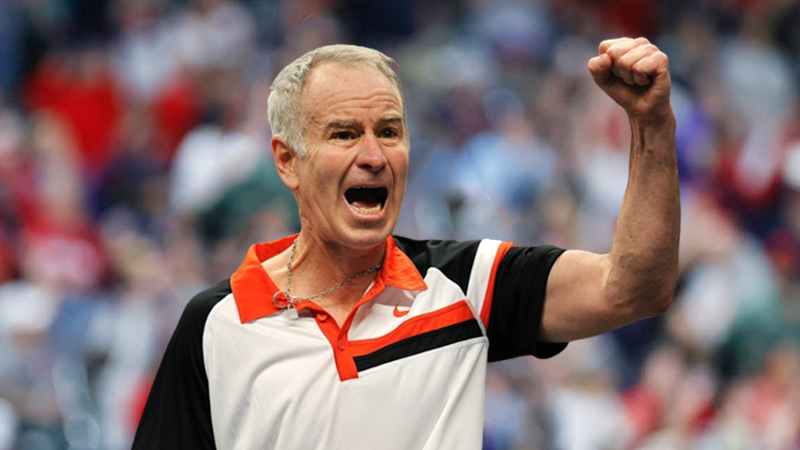
The transition of a sports icon from the center of the court to the center of the broadcast booth is rarely as seamless or as permanent as it has been for John McEnroe. For decades, his name was synonymous with on-court volatility and unparalleled finesse.
Today, he is the sport’s definitive voice, providing the analytical framework for the modern era. Understanding why he no longer competes professionally requires looking beyond a simple retirement date and examining the convergence of physical exhaustion, technological shifts, and a fundamental change in his personal priorities.
The Definitive Transition: From Competitor to Commentator
The most direct answer to why John McEnroe is not playing professional tennis today is that he formally retired from the ATP Tour in 1992.
While many athletes of his caliber attempt multiple comebacks or linger in the lower tiers of the circuit, McEnroe chose to pivot his career toward media.
He currently operates as a premier tennis television commentator and analyst, a role that has kept him at the forefront of every Grand Slam tournament for over thirty years.
His retirement was not a sudden decision but the culmination of a decade spent at the absolute pinnacle of a grueling global circuit.
By the early 1990s, the landscape of professional tennis had shifted, and the “Superbrat” persona of the late 70s and early 80s had evolved into a statesman-like figure who realized his greatest impact would henceforth be through the microphone rather than the racket.
The Physical and Mental Toll of Excellence
To understand the end of his playing career, one must analyze the burnout that characterized his final years on tour. Following a period of absolute dominance in the early 1980s, McEnroe began to suffer from profound physical and mental exhaustion.
The match load required to maintain a world No. 1 ranking is immense, involving year-round travel and a constant cycle of high-stakes pressure.
For a player like McEnroe, whose game relied on razor-sharp reflexes and intense emotional engagement, this exhaustion was particularly detrimental.
The mental energy required to sustain his “fire” on court began to wane, making it difficult to maintain the standard of excellence he had set for himself. This burnout was a primary driver in his decision to step away from the daily rigors of the professional tour.
The Technological Disruption: Wood to Graphite
One of the most overlooked aspects of McEnroe’s departure from professional play is the rapid evolution of tennis technology. McEnroe was perhaps the greatest practitioner of the wooden-racket-tailored style, characterized by finesse, touch, and delicate serve-and-volley tactics. His ability to manipulate the ball with a smaller, heavier wooden frame was unmatched.
However, the mid-to-late 1980s saw the rise of graphite technology and much larger racket heads. This shift favored a new generation of players who introduced a more powerful, baseline-heavy style of play.
The game moved away from the net and into a realm of high-velocity groundstrokes and extreme topspin. While McEnroe remained competitive, the sport’s fundamental mechanics changed in a way that neutralized his classic, finesse-based approach.
The game became faster and more power-oriented, making it increasingly difficult for a serve-and-volley artist to dominate the rankings as he once had.
Shifting Life Priorities and Personal Growth
As with many elite athletes, the desire for a balanced life eventually surpassed the hunger for trophies. By the time his career began to wind down, McEnroe’s personal life and outside interests were taking precedence over the intense training required to stay at the top.
The responsibilities of starting a family and pursuing diverse interests—ranging from art to music—offered a fulfillment that the repetitive nature of the ATP Tour could no longer provide.
The singular focus required to win Grand Slams is often incompatible with the desire to be a present parent and a well-rounded individual. For McEnroe, the decision to stop playing was as much about embracing his future as it was about leaving his past behind.
A History of Discipline: Notable Career Interruptions
While 1992 marked his official retirement, McEnroe’s career was also punctuated by several forced absences that defined his public image. These incidents highlight the volatile temperament that made him both a fan favorite and a frequent target for officials.
- The 1990 Australian Open Disqualification: In a landmark moment for professional tennis, McEnroe became the first player in 27 years to be disqualified from a Grand Slam event. During a fourth-round match against Mike Pernfors, he received three code violations for intimidation, racket abuse, and verbal abuse toward officials. This event served as a stark reminder of the emotional intensity he brought to the court, which was both his greatest strength and his most significant liability.
- The 1985 Stockholm Suspension: Earlier in his career, his conduct led to a 21-day suspension following an on-court outburst and exceeding fine limits. This suspension forced him to miss the Wembley Indoor tournament and underscored the ongoing tension between his competitive spirit and the governing bodies of the sport.
The Second Act: An Analytical Masterclass
Since his retirement, McEnroe has successfully redefined what it means to be a former champion. His work as an analyst for networks like ESPN has allowed him to remain a central figure in the sport.
His insights into modern stars, such as Carlos Alcaraz, demonstrate that his understanding of the game remains as sharp as ever.
He has managed to bridge the gap between generations, explaining the nuances of the modern power game while providing historical context that only a seven-time Grand Slam singles champion can offer.
His transition is often cited as the gold standard for athletes looking to build a sustainable and influential “second career.”
Conclusion
John McEnroe’s absence from the professional court is not a sign of his departure from the sport, but rather a testament to his successful evolution within it.
He traded the racket for the microphone because the game he mastered had changed, and his own priorities had matured.
By stepping away in 1992, he preserved his legacy as one of the greatest tacticians to ever play while carving out a new role that ensures his influence on tennis will be felt for generations to come.
Whether he is dissecting a championship point or reflecting on the history of the ATP Tour, McEnroe remains an essential, if no longer competing, part of the fabric of tennis.