
When watching a football game, the terminology used to describe offensive skill positions can often blur together.
Commentators frequently toss around phrases like “running back,” “halfback,” and “fullback” interchangeably, leaving casual fans—and even fantasy football enthusiasts—wondering if there is a real distinction.
The short answer is yes. While every halfback and fullback falls under the umbrella designation of a running back, their individual assignments, physical profiles, and roles within a playbook differ significantly.
Understanding these differences unlocks a deeper appreciation for the tactical chess match happening on every single snap.
The Master Umbrella: What Is a Running Back?
In contemporary gridiron terminology, Running Back (RB) serves as the overarching category for backfield players whose primary responsibilities involve taking handoffs, catching short passes, and executing blocks.
Historically, formations featured multiple players positioned behind the offensive line. As the sport evolved through the T-formation and into modern multi-receiver sets, the nomenclature shifted.
Today, when analysts or broadcast crews refer to a team’s “starting running back,” they are almost universally talking about the halfback.
However, looking at the position strictly as a monolith ignores the specialized architecture that makes an offense run efficiently.
To truly grasp how backfields function, we have to look closer at the two distinct roles living underneath that umbrella: the halfback and the fullback.
The Halfback (HB) / Tailback: The Engine of the Offense
If the quarterback is the brain of an offense, the halfback—frequently designated as the tailback depending on alignment—is often the primary engine.
Primary Responsibilities
The halfback takes the vast majority of handoffs from the quarterback. Whether running an outside zone scheme, slicing through an inside gap, or catching a screen pass in the flat, the halfback is designed to turn routine plays into high-yardage gains.
Key Skills and Traits
Explosive Acceleration: Halfbacks must instantly accelerate through small windows created by the offensive line.
Elusiveness and Open-Field Vision: Elite halfbacks possess exceptional vision, anticipating where blocks will develop before they happen. They rely on sharp cuts, jukes, and top-tier balance to make defenders miss in space.
Versatility as a Receiver: Modern halfbacks are expected to run sophisticated passing routes, turning short checkdowns into explosive catch-and-run opportunities.
In today’s pass-heavy tactical landscape, the halfback position has transformed into a multi-dimensional weapon. Teams invest heavily in halfbacks who can seamlessly transition from between-the-tackles runners into elite slot-style receiving threats.
The Fullback (FB): The Specialized Bulldozer
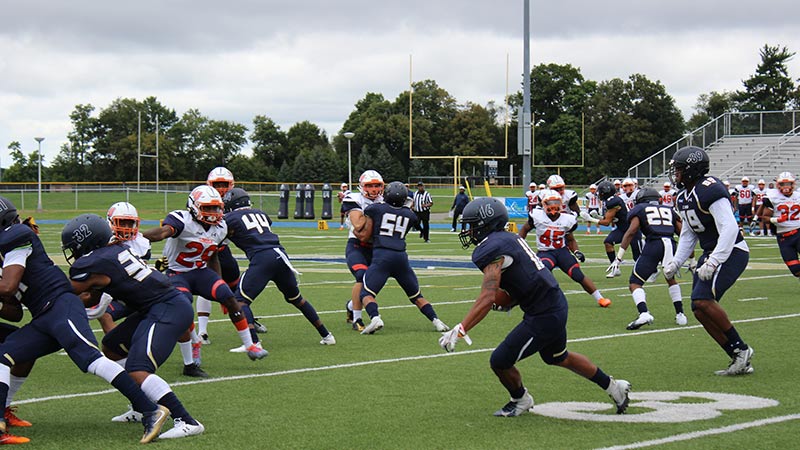
While the halfback grabs headlines and fantasy points, the fullback operates as the ultimate unheralded teammate.
Physical Profile and Mechanics
Fullbacks are built differently than halfbacks. Tends to be bigger, heavier, and more physically imposing, a traditional fullback resembles a linebacker playing on the offensive side of the ball.
In classic formations like the I-formation, the fullback lines up closer to the line of scrimmage than the halfback, sitting directly between the quarterback and the tailback.
The Evolution of Responsibilities
The Lead Blocker: This is the primary reason a fullback exists. On rushing plays, the fullback acts as a human shield, tracking down linebackers or scraping defensive backs to clear an open path for the halfback.
Short-Yardage Power: When an offense needs exactly one yard on third-and-short or at the goal line, the fullback is occasionally handed the ball to utilize sheer mass and forward momentum.
Pass Protection: In passing situations, fullbacks stay in the backfield to pick up blitzing linebackers or provide chip-blocks against aggressive edge rushers.
The Modern Shift: Why Fullbacks Are Becoming Rare
If you look across modern professional football rosters, you will notice a stark reality: traditional fullbacks are increasingly difficult to find.
Offensive coordinators have largely transitioned toward spread concepts, utilizing three or four wide receivers, extra tight ends, or hybrid “move” players instead of a dedicated blocking fullback. Spreading the defense horizontally creates space that a two-back set sometimes crowds out.
However, the position has not gone completely extinct. Innovative coaching staffs still utilize hybrid fullbacks—sometimes referred to as H-backs—who can line up in the backfield, motion out to the slot as a receiver, or put their hand down on the line of scrimmage as an extra tight end. When teams face short-yardage or goal-line dilemmas, the value of a true blocking specialist remains unmatched.
Summary: Key Takeaways for the Game
- Running Back is the grand umbrella term for all backfield runners and blockers.
- Halfbacks (Tailbacks) are the dynamic, fast, primary ball-carriers who handle the bulk of touches and catch passes in space.
- Fullbacks are heavy-duty, physical blockers whose main objective is clearing lanes for the running game.
Appreciating how these distinct positions operate allows fans to look past the basic box score and see the intricate blocking schemes, physical matchups, and tactical designs that dictate success on the gridiron.