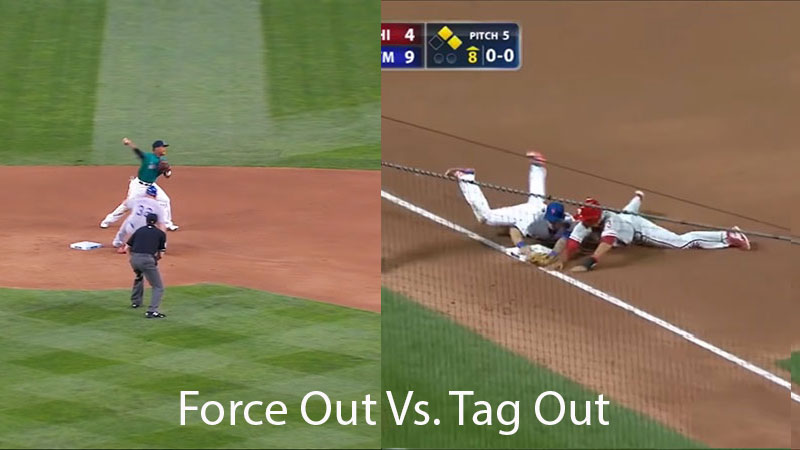
If you have ever watched a baseball game and wondered why a fielder simply stepped on first base instead of chasing down a runner, or why another play required a high-speed collision and a physical swipe tag, you have encountered the core difference between a force out and a tag out.
These two defensive plays form the bedrock of baseball strategy. Because both actions result in the exact same outcome—an out—players, parents, youth coaches, and new fans frequently confuse them. However, the rules governing each play are fundamentally distinct.
Whether you are a beginner stepping onto the diamond for the first time, a parent navigating youth league rules, or an avid fan wanting a deeper appreciation of the game, mastering these concepts will make every inning much easier to follow.
What Is a Force Out in Baseball?
A force out happens when a base runner is legally required to advance because the batter has become a runner and is forced to take first base.
Instead of chasing and tagging the runner, the defense only needs to accomplish two steps:
- Secure possession of the baseball (either in hand or securely trapped in the glove).
- Touch the correct base with any part of their body before the forced runner arrives.
If those conditions are met, the runner is automatically called out. The fielder does not need to touch the runner because the official rules of baseball already mandate that the runner must vacate their current base.
Simple Example of a Force Out
Imagine this classic game situation:
- There is a runner on first base.
- The batter hits a sharp ground ball to the shortstop.
- Because the batter is legally obligated to run toward first base, the runner currently on first base has no choice—they must advance to second base.
- The shortstop fields the ball cleanly and throws it to the second baseman stationed at second base.
- If the second baseman steps on second base before the runner arrives, it is a force out. No tag is needed.
Why Is It Called a “Force” Out?
The term “force” refers strictly to the runner being forced to leave their current station. The runner has no legal option to stay put.
Because the batter is entitled to first base upon putting a fair ball into play, a chain reaction ripples through the base paths. Every runner behind the batter may be forced to advance:
- The batter becomes a runner, forcing the runner on first to go to second.
- The runner on second may be forced to go to third.
- The runner on third may be forced to score home.
Whenever a runner is legally compelled to advance, a force play becomes possible.
Common Force Out Situations
Force outs occur constantly during ground ball situations across every level of baseball, from Little League to the Major Leagues.
Ground Ball to the Shortstop
- The Setup: A runner is on first base.
- The Play: The shortstop fields a grounder and fires across to second base. The second baseman touches the bag before the runner slides in.
- The Result: A routine force out at second base.
The Classic Double Play
- The Setup: A runner is on first base with less than two outs.
- The Play: A ground ball is hit directly to the second baseman. The second baseman steps on second base for the first force out, then immediately throws to the first baseman before the batter arrives for the second out.
- The Result: A twin killing, or double play—one of baseball’s most exciting defensive triumphs.
Bases Loaded at Home Plate
- The Setup: The bases are completely loaded with runners.
- The Play: A ground ball is hit to the third baseman. The third baseman throws directly to the catcher. The catcher steps firmly on home plate before the runner from third crosses the line.
- The Result: A force out at home plate. No tag is required because the runner from third was forced to score by the batter’s arrival at first.
What Is a Tag Out in Baseball?
A tag out occurs when a defensive player physically touches a runner with the ball or with the glove securely holding the ball before that runner reaches a safe base.
Unlike a force out, simply touching the base does nothing. The defense must make direct contact with the runner’s body unless a force situation is active.
Simple Example of a Tag Out
Picture this high-energy play:
- A batter hits a clean single into the outfield.
- Deciding to be aggressive, the runner tries to stretch the single into a double.
- The outfielder fires a relay throw to the second baseman.
- Before the sliding runner reaches second base, the second baseman applies a tag with the glove.
- The Result: A tag out. Stepping on the base alone would leave the runner safe because the runner was never forced to advance to second base; they chose to run there on their own accord.
Why Is a Tag Necessary?
A tag is required whenever a runner has the legal option to stay on their current base or safely return to it. Because the runner is not legally forced to move, the defense must physically apply a tag to record the out.
Tag outs are the defining mechanism for:
- Stolen base attempts.
- Pickoff plays executed by pitchers and infielders.
- Rundowns (or hotboxes) trapping a runner between bases.
- Extra-base hit attempts where the runner is trying to advance safely on their own merit.
- Runners returning to a base after a fly ball is caught.
Common Tag Out Situations
Stolen Base Attempt
- The Setup: A runner on first breaks for second base on the pitch.
- The Play: The catcher fields the pitch and fires an accurate throw down to second base. The shortstop catches the ball and applies a tag to the sliding runner.
- The Result: Tag out.
Pickoff Attempt
- The Setup: The pitcher notices a runner taking an overly aggressive lead off first base.
- The Play: The pitcher whips a throw over to the first baseman. The first baseman catches the ball and tags the runner before they can dive back safely.
- The Result: Tag out.
The Rundown
- The Setup: A runner is caught too far off the base and gets stranded between second and third base.
- The Play: Infielders toss the ball back and forth, closing the distance until one fielder successfully pursues and tags the trapped runner.
- The Result: Tag out.
Force Out vs. Tag Out: Side-by-Side Comparison
How to Know Which Rule Applies
When watching a fast-paced play, you can determine the correct rule by asking yourself one simple question:
Is the runner required to advance because of the batter?
- Yes: A force out is possible. The fielder only needs to touch the base.
- No: The defense must physically tag the runner.
This quick mental checklist works in nearly every game situation and is the easiest way for beginners to decode what the umpires are looking for.
Common Mistakes Beginners Make
Even seasoned sports fans occasionally stumble over the nuances of baseball rules. Keep these common misconceptions in mind:
- Mistake #1: Every out at a base is a force out. This is false. If a runner is not forced to advance, the defense must tag the runner, even if they are standing mere inches away from the bag.
- Mistake #2: Touching the base always records an out. Touching a base only works when a force play exists or when a runner is legally required to retouch a base after a caught fly ball. Otherwise, touching the empty base does nothing.
- Mistake #3: Force outs and tag outs are interchangeable. While both result in an out on the scoreboard, they are governed by completely different sections of the rulebook and require distinct defensive mechanics.
When Does a Force Out Become a Tag Out?
One of the most complex scenarios for beginners is recognizing the exact moment a force play disappears.
A force out only exists while the runner is required to advance. If that legal obligation is removed during the play, the defense must revert to a tag out. This most frequently happens after another runner is retired or when a chaotic play alters the base paths.
Real-World Example of a Changing Play
Imagine there are runners on first and second base with one out.
- The batter hits a sharp ground ball to the shortstop.
- The shortstop throws to second base, recording the force out on the runner coming from first.
- At that precise microsecond, the force on the runner originally on second base is removed. That runner is no longer required to advance to third.
- If that runner hesitates, stumbles, or tries to retreat toward second base, the third baseman cannot simply step on third base to get them out. The third baseman must tag the runner.
The Golden Rule: Once the force obligation is removed, the next play instantly becomes a tag play.
Force Out Examples at Every Base
To build complete mastery, let us look at how force plays manifest across all four bases on the diamond.
Force Out at First Base
- The Play: The batter hits a ground ball. The first baseman catches the throw and touches first base before the runner arrives.
- Result: Force out. No tag is necessary because the batter is legally obligated to run toward first base.
Force Out at Second Base
- The Play: A runner is on first. A ground ball is hit to the second baseman, who steps directly on second base before the lead runner arrives.
- Result: Force out. This is the foundational first half of the traditional double play.
Force Out at Third Base
- The Play: Runners occupy both first and second base. A ground ball is hit to the infield. The third baseman touches third base before the advancing runner from second arrives.
- Result: Force out at third.
Force Out at Home Plate
- The Play: The bases are completely loaded. A ground ball is hit to the pitcher, who fires home. The catcher steps firmly on home plate before the runner from third crosses.
- Result: Force out at home. Because the runner from third was forced to run home by the loaded bases, a tag is entirely unnecessary.
Real Game Scenario: Comparing Two Nearly Identical Plays
To solidify your understanding, let us compare two plays that look almost identical on television, yet require completely different defensive mechanics.
Scenario 1: The Force Out
- The Setup: A runner is on first base.
- The Play: A ground ball is hit to the shortstop, who flips the ball to the second baseman covering the bag. The second baseman steps on the base.
- The Verdict: Force Out. The runner had no choice but to leave first base, making the touch of the base sufficient.
Scenario 2: The Tag Out
- The Setup: A runner is safely standing on second base.
- The Play: A deep fly ball is hit to center field and caught out of the air by the fielder. The runner on second decides to tag up and attempt to advance to third base. The center fielder fires a strong throw across the diamond to the third baseman.
- The Verdict: Tag Out. The runner was never forced to run to third base; they chose to do so on their own judgment. If the third baseman simply catches the ball and steps on third base without touching the sliding runner, the runner is safe. The third baseman must physically tag the runner.
Frequently Asked Questions
Is first base always a force out?
No. While the vast majority of plays at first base are force plays involving the batter-runner, rare exceptions exist. For example, during a pickoff attempt where a runner is diving back to first base, a tag is required.
Can you tag a runner on a force play?
Yes, absolutely. A defensive player is legally permitted to tag the runner instead of touching the base. However, players almost always choose to touch the base because it is faster, safer, and minimizes the risk of a missed tag.
Can a runner retreat on a force play?
Generally, no. A forced runner is legally required to advance because the batter has taken their base. Once a force play is established, retreating is not an option unless the ball is hit into the air and caught (requiring the runner to tag up at their original base first).
What is easier to execute: a force out or a tag out?
Most players and coaches consider a force out much easier because the defense only needs to touch the base while in control of the ball. Tag plays require split-second timing, physical agility, and direct body contact with a moving runner.
Can home plate experience a force out?
Yes. When the bases are loaded, every runner is forced to advance, including the runner on third base who is forced to score. In this specific situation, the catcher can record an out by simply touching home plate before the runner arrives.
Final Verdict
Mastering the difference between a force out and a tag out is one of the most rewarding milestones in learning baseball.
While both actions end in an out on the scoreboard, they are governed by distinct rules and require completely different defensive approaches.
A force out occurs when a runner is legally required to advance, allowing the defense to record the out simply by touching the base with control of the ball.
In contrast, a tag out is necessary when a runner is not forced to move, requiring the fielder to physically apply a tag to the runner’s body.
Recognizing these dynamics transforms how you watch and play the game. Whether you are a beginner stepping onto the field for the first time, a parent supporting youth sports, or an enthusiastic fan, understanding these core defensive concepts will make every inning of America’s pastime clearer, more strategic, and infinitely more enjoyable.