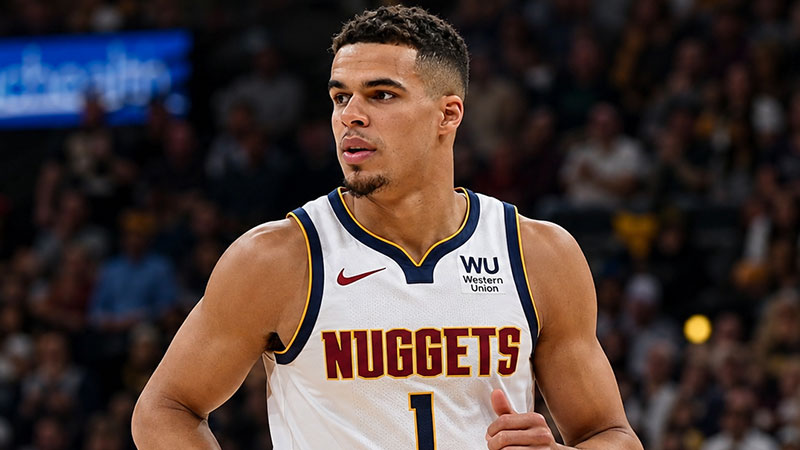
Michael Porter Jr. is an elite, high-volume scorer and 2023 NBA Champion who has evolved into a fringe All-Star.
Currently ranked as a top 50–60 player, he transitioned from a tertiary role in Denver to a primary offensive engine for the Brooklyn Nets, averaging a career-high 24.2 points in the 2025–26 season.
Despite managing chronic health issues, including multiple back surgeries and drop foot, he remains one of the league’s most efficient shooters with a career 39.8% mark from deep.
Ultimately, he is a premier second or third option capable of elevating any championship contender’s offensive ceiling.
Why Do Many Consider Michael Porter Jr. a Physical Miracle?
The conversation surrounding Michael Porter Jr. (MPJ) often begins with his medical charts rather than his box scores. To understand how good he is today, one must acknowledge the unprecedented nature of his availability.
His career trajectory is frequently described as a “miracle” by analysts and fans alike, given that he entered the league with significant red flags that would have ended most professional tenures before they began.
Overcoming Multiple Career-Threatening Back Surgeries
Before he ever wore a Denver Nuggets jersey, MPJ was the consensus number-one player in his high school class, projected to be a generational talent.
However, a series of three back surgeries transformed that “can’t-miss” prospect into one of the biggest “what-ifs” in modern basketball history.
The fact that he has maintained a high level of play—and even improved his efficiency at the rim—after having his mobility questioned for years is a testament to his recovery process and technical adaptation.
The Challenge of Playing with Permanent Nerve Damage
Perhaps the most overlooked aspect of MPJ’s game is that he currently competes with “drop foot,” a condition resulting from nerve damage that prevents him from properly lifting his foot.
He famously wears a specialized brace—often compared to those used by stroke victims—just to maintain stability on the court.
Despite these physical constraints, he continues to put up elite scoring numbers, proving that his shooting mechanics and basketball IQ can override significant physiological limitations.
Is Michael Porter Jr. a True Number One Offensive Option?
The debate over MPJ’s standing in the NBA hierarchy often centers on whether he is a “floor raiser” or a “ceiling raiser.” A floor raiser is a player who can take a bad team and make them competitive through sheer volume and playmaking.
A ceiling raiser, conversely, is an elite talent who fits into an existing system to push a good team into championship status.
The Transition from Tertiary Spacer to Offensive Engine
During his five seasons in Denver, MPJ was the ultimate ceiling raiser. He served as a 6’10” “flamethrower” who benefitted from the gravity of Nikola Jokic, punishing teams for doubling the MVP.
However, his move to the Brooklyn Nets for the 2025–26 season shifted this narrative. In Brooklyn, he was asked to be the focal point of the offense, and he responded by averaging 24.2 points per game.
This suggests he can scale his production significantly when given the volume, though many still believe his ideal role is as a high-end second or third option on a true contender.
Identifying the Playmaking and Creation Gaps
What prevents MPJ from being viewed in the same tier as players like Luka Doncic or Jayson Tatum is his limited “gravity” as a playmaker.
While his passing has improved to a career-high 3.0 assists per game, he is not a traditional primary creator who can manipulate a defense and find open teammates consistently.
His scoring is primarily derived from his unblockable jump shot and off-ball movement rather than elite pick-and-roll navigation. This lack of traditional creation “caps” his ceiling as a pure number-one option for a championship-level squad.
Decoding the 2025–26 Brooklyn Nets Breakout Stats
The 2025–26 season was a revelatory period for MPJ. It provided the first real evidence of what he looks like without the “Jokic effect.” Critics often suggested he was a “Jokic merchant”—a player whose efficiency was solely a byproduct of an elite teammate.
His performance in Brooklyn effectively debunked this, as he maintained high efficiency on a much more difficult “shot diet”.
The following table highlights his career-best production during his debut season in Brooklyn:
| Statistic | 2025–26 Season Average | Context / League Standing |
|---|---|---|
| Points Per Game | 24.2 PPG | Top 15 in the NBA |
| Rebounds Per Game | 7.1 RPG | Elite for small forwards |
| Assists Per Game | 3.0 APG | Career-high |
| 3-Point Percentage | 36.3% | High efficiency on increased volume |
| Free Throw % | 85.9% | Career-high |
| Effective FG% | 59.1% (Career) | Historic for high-volume wing scorers |
What Are the Elite Traits That Define MPJ’s Game?
Despite his injuries, MPJ possesses a “God-given” physical profile that makes him a mismatch against almost any defender in the league. His game has evolved from a raw, athletic scoring style to a refined, technical mastery of the perimeter.
- The Unblockable Jump Shot: Standing at 6’10” with a high release point, MPJ can comfortably shoot over nearly any defender. His ability to hit contested shots makes him a “bail-out” option when an offensive set breaks down.
- Off-Ball Movement and Handoff Mastery: He has become a specialist in movement shooting. During the 2025–26 season, he led the NBA in points per possession on handoffs, utilizing his size to curl off screens and fire before the defense could recover.
- Elite Rebounding for a Wing: Often underrated is his work on the glass. By averaging roughly 7 rebounds per game throughout his career, he helps his team secure possessions and allows him to ignite transition opportunities immediately.
- Defensive Length: While he can still be targeted by quicker, smaller guards in switch-heavy schemes, his 6’10” frame and “long” playstyle allow him to disrupt passing lanes and provide secondary rim protection.
How Does MPJ Compare to Other NBA Stars?
To place MPJ in a historical or contemporary context, analysts often look at players who provide similar offensive value but perhaps in different packages.
His unique blend of size and shooting makes him a difficult comparison, but several names frequently appear in the discussion.
The DeMar DeRozan Comparison with a Twist
Some analysts compare his scoring impact to DeMar DeRozan but with a drastically different shot profile. While DeRozan is a mid-range maestro, MPJ is described as a “3-point flamethrower”.
Both are high-level “tough shot makers” who can carry an offense for stretches, but MPJ’s ability to space the floor to the logo gives him a different type of tactical utility.
Standing Among the All-Time Nets Scorers
His scoring output in Brooklyn has already earned him high praise. Some longtime observers of the franchise rank him as the third-best pure scorer in Nets history, trailing only legends like Kevin Durant and Vince Carter.
While he has yet to reach their level of overall accolades, his “pure bucket” ability puts him in elite company within the organization’s history.
Common Questions About Michael Porter Jr.’s Performance
Was he simply a “Jokic merchant” in Denver?
No. His 2025–26 season in Brooklyn proved that while Jokic certainly helped create open looks, MPJ’s efficiency is a result of his own elite shooting mechanics. He maintained a 59.1% effective field goal percentage even as the primary focus of opposing defenses.
How much of an injury risk is he moving forward?
Health remains the primary hurdle for his career longevity. While he played 81 games in 2023–24, his 2025–26 campaign was cut short by a severe left hamstring strain.
His history of back issues means that any team employing him must manage his minutes and expectations carefully.
Is he a good enough defender for a championship team?
He has proven he can be a starter on a championship team, as seen in Denver’s 2023 title run. While not an All-Defensive talent, his length and rebounding make him a net positive when slotted into a disciplined defensive system.
What is his actual value in the current NBA market?
Analysts generally view him as a top 50–75 player who is worth a significant portion of the salary cap due to his rare combination of size and shooting. He is the type of player who makes any team better by simply being a threat that the defense cannot ignore.
The Verdict on MPJ’s Elite Evolution
Michael Porter Jr. has defied the medical odds to become one of the most lethal offensive weapons in professional basketball.
From a championship role player in Denver to a 24-point-per-game engine in Brooklyn, his journey reflects a player who has mastered the art of the jump shot to compensate for physical setbacks.
Whether you view him as a fringe All-Star or a high-end specialist, his efficiency metrics and “unblockable” release ensure that he will remain a cornerstone of NBA offensive strategies for years to come.