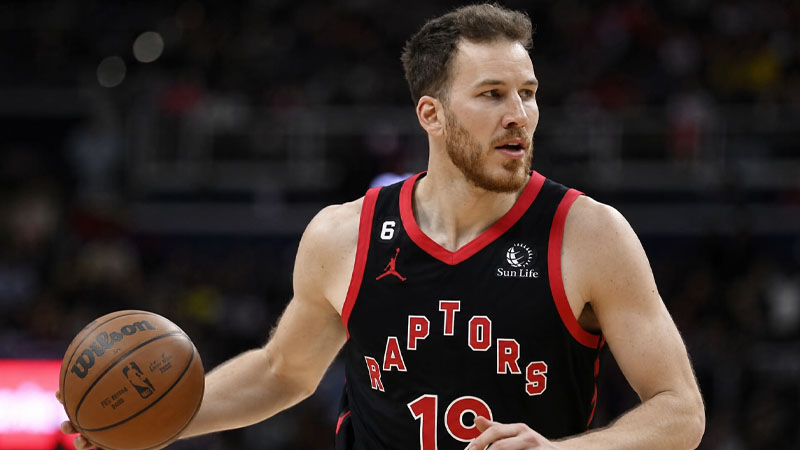
Jakob Poeltl is a highly serviceable, starting-caliber NBA center whose value lies in elite internal efficiency and high-level basketball intelligence.
While not an explosive superstar, he excels as a “luxury role player” by mastering traditional big-man duties like screen setting, rim protection, and high-post playmaking.
Poeltl maintains a career field goal percentage of 63.5%, ranking among the league’s most efficient finishers.
Although he lacks modern floor spacing and faces free-throw struggles, his ability to stabilize a team’s halfcourt offense and unlock guards makes him an essential asset for the Toronto Raptors’ overall structure.
What Makes Jakob Poeltl a Good NBA Player?
Jakob Poeltl’s effectiveness is defined by his mastery of the “dirty work” that often goes unnoticed in box scores but significantly impacts winning.
He is often categorized as an “old-school” big man because he does not rely on perimeter shooting or flashy athleticism to be effective.
Instead, his game is built on a foundation of physical toughness, high-level positioning, and an understanding of spatial dynamics on the floor.
By focusing on high-percentage opportunities, he has carved out a decade-long career as one of the most reliable interior presences in the league.
Elite Interior Efficiency and Scoring
One of Poeltl’s primary strengths is his historical scoring efficiency. He consistently ranks near the top of the NBA in field goal percentage, often converting shots at a clip between 63% and 70%.
This efficiency stems from his discipline; he rarely takes shots outside of his comfort zone, preferring layups, putbacks, and his signature “push shots” in the paint.
On November 15, 2024, he demonstrated his scoring ceiling by recording a career-high 35 points against the Detroit Pistons, proving he can be a focal point when necessary.
The Art of the Brick Wall Screen
Beyond scoring, Poeltl is widely recognized by analysts and peers as an elite pick-and-roll screen setter.
His physical frame and technical ability to set well-angled screens allow him to function as a “brick wall,” creating massive driving lanes for primary ball-handlers.
This skill is particularly vital for teammates like Immanuel Quickley and RJ Barrett, whose offensive numbers often improve significantly when Poeltl is on the court to clear space.
His presence essentially serves as a form of “gravity” that draws defenders inward, even without a jump shot.
Analyzing Jakob Poeltl’s Career Statistics and Metrics
To understand Poeltl’s impact, one must look at his consistent production over 10 seasons and 641 regular-season games. He has averaged 9.1 points, 7.0 rebounds, and 1.2 blocks per game while playing roughly 22 minutes per contest.
These numbers reflect his role as a low-usage, high-efficiency starter who maximizes his time on the floor without demanding high volume. The following table outlines his career-long statistical baseline and the context of his performance.
| Metric | All-Time Average | Performance Context |
|---|---|---|
| Points (PTS) | 9.1 | Efficient, low-usage inside scorer. |
| Rebounds (TRB) | 7.0 | Split between 2.7 offensive and 4.3 defensive. |
| Assists (AST) | 1.8 | High-level facilitator from the high post. |
| Blocks (BLK) | 1.2 | Solid rim protector through positional size. |
| FG% | 63.5% | One of the most efficient finishers in history. |
| FT% | 54.1% | Significant weakness and late-game liability. |
Is Jakob Poeltl Good on Defense?
Defensively, Poeltl is valued for his stability and positional soundness rather than highlight-reel athleticism. While he may not be the fastest or most nimble player on the court, he compensates with elite defensive instincts and communication skills.
He has been compared to former defensive anchors like Marc Gasol for his ability to be in the right position at the right time. This intelligence allows him to solidify defensive rotations and secure the rim without needing to chase every block.
Positional Intelligence Over Athleticism
Poeltl’s defensive value is rooted in his ability to “interpret space” and anticipate offensive movements. He is rarely out of position, which allows him to contest shots effectively and box out the opposing team’s biggest rebounding threats.
Analysts note that while he lacks the verticality of some elite rim protectors, his size and impeccable timing make him a formidable obstacle in the paint. This makes him a reliable “defensive quarterback” who helps organize his teammates on that end of the floor.
Active Hands and Rim Deterrence
Despite his reputation as a traditional big, Poeltl possesses surprisingly “good hands” for a player of his size. This is reflected in his average of 0.7 steals per game, as he is frequently active in passing lanes and capable of disrupting entry passes to the post.
His ability to catch difficult passes on the move and strip the ball from opposing bigs adds a layer of versatility to his defensive profile. This combination of size and dexterity ensures that he remains productive even when matched against more athletic centers.
Why Do Analysts Call Poeltl a “High IQ” Player?
Basketball intelligence is often cited as Poeltl’s most significant attribute. This intelligence manifests in his decision-making, whether he is deciding when to roll to the rim or identifying an open teammate from the high post.
He has a natural knack for being in the right position, a trait some attribute to his mentorship under legends like Tim Duncan earlier in his career.
This “BBIQ” allows him to remain effective even in high-speed modern offenses that might otherwise punish a slower-footed center.
Facilitating from the High Post
Poeltl functions beautifully as a high-post hub, using his vision to distribute the ball out of dribble-handoff actions. He is a highly capable passer who understands how to use his frame to shield the ball while finding cutting teammates.
This playmaking ability is a cornerstone of the Raptors’ offensive system, as it allows the team to run complex sets through the center position. His passing is considered a “luxury” for a player whose primary role is interior defense and rebounding.
The “Interpreter of Space”
The phrase “interpreter of space” is often used to describe Poeltl’s ability to find open spots in a crowded paint. He excels at putting himself in position for quick shots or putbacks before the defense can react.
This spatial awareness also applies to his screening, as he knows exactly where to stand to maximize the lane for his guards.
Because he understands the geometry of the court so well, he can provide floor spacing for his team through movement and positioning, even though he cannot shoot from the perimeter.
What are the Main Weaknesses in Jakob Poeltl’s Game?
While Poeltl is exceptionally good at his specific role, his limitations are well-documented and prevent him from reaching superstar status.
These weaknesses are largely a byproduct of his traditional playstyle, which can occasionally clash with modern NBA trends that prioritize versatility and range. Identifying these gaps is essential for any team looking to build a balanced roster around him.
The Lack of Perimeter Shooting
Perhaps the most glaring limitation in Poeltl’s game is his complete lack of shooting range. Throughout his decade-long career, he has attempted fewer than 10 total three-pointers.
This makes his offensive game entirely paint-bound, which can occasionally allow opposing defenses to sag off him and clog the lane for drivers.
In an era where many centers are expected to stretch the floor, Poeltl’s inability to do so makes him a unique outlier whose value must be made up in other areas like screening and passing.
Free-Throw Liability and Late-Game Usage
Poeltl’s struggles at the free-throw line remain a significant concern for coaching staffs. With a career average of 54.1%, he is often a target for “Hack-a-Shaq” strategies, where opponents intentionally foul him to exploit his poor shooting.
This liability can limit his minutes in late-game situations, as teams may be hesitant to keep him on the floor during close contests. Improving this aspect of his game has been a long-term challenge that directly impacts his overall utility in high-pressure moments.
Is the $104 Million Contract Extension Justified?
In 2025, Poeltl signed a lucrative 4-year, $104 million contract extension with the Toronto Raptors. This deal sparked significant debate among fans and analysts regarding his market value compared to his on-court impact.
While some view the contract as an overpayment for a non-All-Star center, others argue it is a necessary investment to secure a stabilizing force for a young, developing roster.
Comparing Market Value and Impact
The decision to pay Poeltl roughly $26 million per year reflects the high premium placed on starting-caliber centers who can anchor a defense and facilitate an offense.
When compared to other centers in his tier, such as Deandre Ayton, Poeltl is often viewed as more effective due to his superior basketball IQ and unselfishness.
His presence provides a level of veteran leadership and professional consistency that is difficult to replace, especially for a franchise like the Raptors that has a deep history with him.
Navigating Injury Concerns and Longevity
A major factor in evaluating Poeltl’s value is his recent health history, specifically a lingering back injury that hampered his most recent campaign.
During injury stretches, his mobility and productivity have seen a noticeable dip, leading to increased criticism of his contract. However, when healthy, he remains one of the most productive and efficient centers in the league.
For the Raptors, the gamble is that his positional intelligence and size will allow him to remain effective well into his 30s, even as his raw athleticism naturally declines.
Frequently Asked Questions About Jakob Poeltl
What is Jakob Poeltl’s highest-scoring game?
Jakob Poeltl scored a career-high 35 points on November 15, 2024, in a game against the Detroit Pistons.
Is Jakob Poeltl the first Austrian NBA player?
Yes, when the Toronto Raptors selected him 9th overall in the 2016 NBA Draft, he became the first Austrian-born player in league history.
How does Poeltl’s efficiency compare to other players?
Poeltl’s field goal percentage, which often hovers around 70%, ranks him among the most efficient interior finishers in NBA history.
What awards did Poeltl win in college?
During his time with the Utah Utes, he won the Kareem Abdul-Jabbar Award, the Pete Newell Big Man Award, and was named the Pac-12 Player of the Year in 2016.
Conclusion: The Verdict on Poeltl’s Impact
Ultimately, whether Jakob Poeltl is “good” depends entirely on the criteria used for evaluation. If judged by the standards of a modern, floor-spacing superstar, he falls short due to his lack of shooting and explosive verticality.
However, if he is judged on his ability to execute a specific role at an elite level—setting screens, finishing efficiently, and organizing a defense—he is exceptionally good.
He provides a floor of stability that allows his teammates to thrive, making him an invaluable asset for any team that values high-IQ basketball and interior dominance.