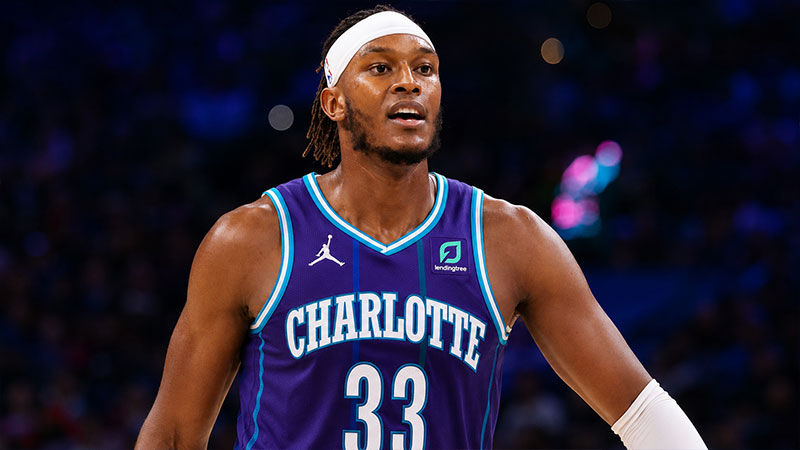
Myles Turner is widely considered one of the NBA’s most elite rim protectors, backed by two league-leading seasons in blocks per game.
While his rebounding totals often draw criticism, his primary defensive value lies in his ability to alter shots, deter paint entries, and provide scheme versatility.
With over 1,400 career blocks, he ranks among the top 40 in league history, serving as a defensive anchor for both the Indiana Pacers and Milwaukee Bucks.
To answer directly: yes, Turner is an exceptional defender whose impact is best measured by shot-tracking data rather than traditional box score rebounding.
The Statistical Foundation of an Elite Anchor
To understand Turner’s impact, one must look beyond basic blocks and examine the advanced metrics that define his eleven-year career. His consistency has provided a remarkably high floor for paint protection across multiple team structures, maintaining a career defensive rating of 108.7.
| Metric | Career Statistic | Historical Context |
|---|---|---|
| Total Blocks | 1,497 | Ranks in the top 40 in NBA history |
| Blocks Per Game | 2.1 BPG | Consistently among highest active averages |
| Defensive Win Shares | 25.1 | High estimate of wins contributed by defense |
| Defensive Box Plus/Minus | +1.4 | Significant impact over a league-average player |
| 2x NBA Blocks Leader | 2018-19 & 2020-21 | Led the league with 2.7 and 3.4 BPG respectively |
Can Myles Turner Anchor a Top 5 NBA Defense?
A recurring debate among analysts and fans is whether Turner can carry a defense to elite status single-handedly or if he requires a specific ecosystem to thrive.
While he has led the league in blocks, team defensive ratings have fluctuated during his tenure, leading to questions about his ceiling as a primary anchor.
The Importance of Perimeter Support
Evidence from his time in Indiana suggests that Turner is often used as a “cleanup crew” for struggling perimeter defenders.
Fans and analysts have noted that the Pacers’ strategy frequently involved funneling opposing players toward Turner because the guards were unable to keep their assignments in front of them.
When paired with league-average or plus perimeter defenders, Turner’s shot-blocking can propel a team into the top 5 defensively; however, without that support, even his elite rim protection has limits.
Comparisons to Rudy Gobert
The “Gobert Benchmark” is often applied to Turner to determine his true standing among defensive greats.
Unlike Gobert, who has historically anchored top-tier defenses regardless of his teammates’ defensive prowess, Turner is viewed by some as a tier below elite anchors like Gobert, Draymond Green, or Giannis Antetokounmpo.
While he is a premier shot-blocker, some argue he lacks the pure “defensive engine” quality that allows a single player to transform a bottom-tier unit into a top-five powerhouse without significant help.
Analyzing Core Strengths: Rim Protection and Versatility
Turner’s defensive architecture is built on a 7’4″ wingspan and elite instincts that make him a major deterrent in the paint.
This physical profile, combined with modern mobility, allows him to execute defensive schemes that traditional “drop-only” centers often struggle with.
Mastery of Shot Deterrence
One of the most significant aspects of Turner’s game is “invisible” defense—the shots that are never taken because he is on the floor. Tracking data consistently reveals that opponents shoot significantly lower percentages at the rim when Turner is patrolling the paint.
Teams often choose to avoid attacking the interior entirely when he is active, forced into taking lower-percentage mid-range jumpers or contested threes. This deterrence factor often outweighs the actual number of blocks recorded in the box score.
Pick-and-Roll Scheme Versatility
In the modern NBA, a center who can only play in a “drop” coverage is a liability. Turner distinguishes himself by possessing the footwork and athleticism to play multiple coverages.
He can effectively drop to protect the rim, hedge out on shooters, or occasionally switch onto smaller perimeter players during late-clock situations.
This flexibility was highlighted by fans who noted he is not a “lumbering big man” and can hold his own when switched onto guards in space.
Identifying Vulnerabilities in His Defensive Game
Despite his elite shot-blocking, Turner is not a flawless defender. His game has specific trade-offs and physical limitations that opponents often look to exploit, particularly in high-stakes playoff environments or against specific archetypes of offensive players.
The Rebounding and Block-Hunting Paradox
A common critique of Turner is his relatively low rebounding average for a 6’11” starting center, with a career mark of 5.2 defensive rebounds per game.
This is partly a strategic trade-off; because he frequently contests shots and “hunts” for blocks, he is often out of position to secure the defensive rebound on the backside.
This leaves his team vulnerable to second-chance points if his teammates do not aggressively box out and crash the boards in his stead.
Physicality Against Elite Post Bigs
While Turner excels in space and as a help-side protector, he can struggle against “bully-ball” centers who use pure strength to gain deep post position.
Elite, ultra-physical traditional big men like Joel Embiid or Nikola Jokic can occasionally move him under the basket with ease.
He relies more on his length and verticality to disrupt shots rather than lower-body strength to hold his ground. Furthermore, his aggressive style of play leads to “silly” fouls, which can limit his minutes and disrupt his defensive rhythm.
The Market Value of an Elite Defensive Specialist
The league-wide perception of Turner’s defensive value is perhaps best reflected in his trade market activity.
For years, teams like the Portland Trail Blazers, Los Angeles Lakers, and San Antonio Spurs have targeted him as a high-priority acquisition to bolster their interior defense.
- The “Price of Protection”: Reported asking prices for Turner have included multiple first-round picks, signaling that NBA front offices view him as a transformative piece for a defensive unit.
- Plug-and-Play Ability: His ability to fit into most defensive systems while providing elite rim protection and floor spacing on the other end makes him a unique “buy-low” candidate during transitional periods.
- Franchise Legacy: Before his move to Milwaukee, he left the Indiana Pacers as their all-time leader in blocks, surpassing franchise legends like Jermaine O’Neal and cementing his status as one of the best defenders in the history of the organization.
Is Myles Turner the Right Fit for Your Defense?
Deciding if Turner is a “good” defender depends on the specific needs of a roster. He is an elite specialist who can transform a defense that already has competent perimeter play into a championship-caliber unit.
However, he may not be the type of player who can cover for four poor defenders simultaneously.
- If your team lacks rim protection: Turner is an immediate, high-impact solution who will instantly lower the opponent’s shooting percentage in the paint.
- If your team struggles with rebounding: Turner may exacerbate the issue unless paired with high-volume rebounding wings or a physical power forward.
- If you need scheme flexibility: His ability to hedge and switch makes him far more valuable than traditional “plodding” centers in a playoff setting.
Frequently Asked Questions About Myles Turner’s Defense
How many times has Myles Turner led the NBA in blocks?
He led the league twice: in the 2018–19 season (2.7 BPG) and the 2020–21 season (3.4 BPG).
Is he better than Rudy Gobert?
Most analysts place him a tier below Gobert in terms of overall defensive impact, though Turner offers more offensive floor spacing and perimeter mobility.
What is his career defensive rating?
His career regular-season defensive rating is a strong 108.7.
Why are his rebounding numbers so low?
He often prioritizes shot-blocking and contesting at the rim, which frequently takes him out of traditional rebounding position.
Does he struggle against physical centers?
Yes, ultra-physical bigs can often move him under the basket due to his reliance on length over pure lower-body strength.
Final Verdict: An Elite Specialist with Clear Value
Myles Turner is undoubtedly a top-tier defender, particularly when evaluated through the lens of modern rim protection and shot deterrence.
While he may not possess the sheer physical dominance of some of his peers, his combination of a 7’4″ wingspan, elite shot-blocking instincts, and perimeter mobility makes him a rare asset in today’s NBA.
He is a defensive architect who can change the geometry of the court, forcing opponents to rethink their entire offensive strategy.