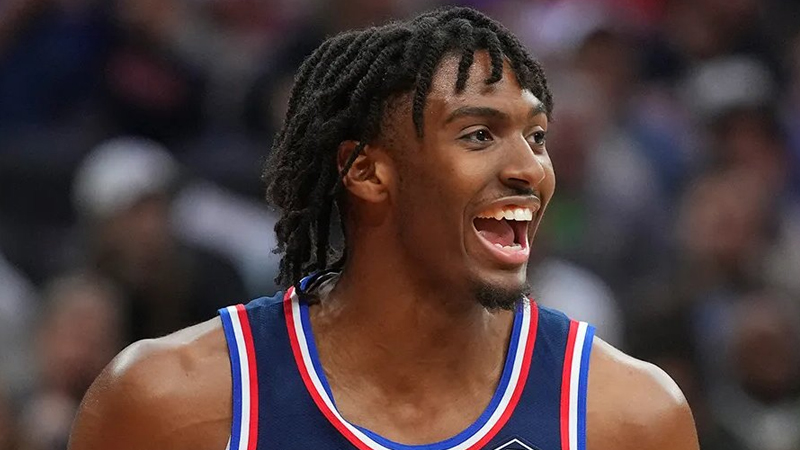
Tyrese Maxey is undeniably one of the fastest players in the NBA, reaching an elite on-court top sprint speed of 20.2 mph. This velocity, tracked via NBA CourtOptix, places him in the same “tier-one elite” category as speedsters like De’Aaron Fox and Ja Morant.
Beyond raw sprinting, Maxey maintains a relentless pace, averaging between 16.7 and 18.4 mph during fastbreaks.
His combination of a low center of gravity and rapid acceleration allows him to manipulate defenses and dominate the transition game, making him a cornerstone of modern professional basketball strategy.
What is Tyrese Maxey’s Top Speed on the Court?
To understand the sheer scale of Maxey’s velocity, one must look at the objective tracking data that separates perception from reality.
In the modern era of professional sports, every movement is logged, and the data suggests that Maxey operates at a level that very few humans can reach while dribbling a basketball.
Quantifying Peak Velocity via CourtOptix
The gold standard for measuring speed in the league is NBA CourtOptix, which has officially clocked Maxey at a top sprint speed of 20.2 mph.
This peak was famously recorded during a transition play where Maxey executed a legendary chasedown block, covering nearly 70 feet in mere seconds.
For context, this speed is comparable to world-class track athletes, but Maxey performs it on a hardwood floor, often while navigating around other elite athletes.
This specific milestone highlights not just his offensive threat, but a defensive hustle that is powered by raw physical gifts.
Consistency in Fastbreak Scenarios
While 20.2 mph represents his absolute ceiling, Maxey’s value lies in his high-speed consistency. The reports indicate that during standard fastbreak scenarios, he regularly clocks in between 16.7 mph and 18.4 mph.
This is particularly impressive because it is not a one-off burst; it is his standard operating procedure.
Whether he is chasing down loose balls or exploding into the open court after a turnover, his “hustle speed” remains significantly higher than the league average, forcing opponents into a state of constant high-alert.
The Biomechanics Behind Maxey’s Explosive Pace
Velocity in a professional athlete is rarely just about “running fast.” It is a complex interplay of physics, biology, and neurological efficiency.
Maxey’s ability to reach 20.2 mph is rooted in a specific physical profile that allows him to generate and maintain momentum more effectively than his peers.
Neuromuscular Power and Fast-Twitch Fibers
At the core of Maxey’s speed is an elite biological power-to-weight ratio. His neuromuscular system is highly optimized, featuring a high concentration of fast-twitch muscle fibers that allow for “instant acceleration”.
This means Maxey does not need a long runway to reach his top speed; he can go from a complete standstill to a full sprint in a single step.
This “first-step” explosion is often what leaves even the best perimeter defenders standing still as he glides past them toward the rim.
Center of Gravity and Hardwood Traction
Standing at 6’2″, Maxey possesses a tactical advantage regarding his low center of gravity. During his drives, he is able to dip his hips lower than taller defenders, which allows him to maintain full traction with the hardwood floor even while moving at extreme velocities.
While a taller player might lose balance or “wash out” on a sharp turn at 18 mph, Maxey’s aerodynamic driving stance keeps him grounded.
This biomechanical efficiency is the reason he can combine world-class acceleration with elite body control, shifting gears instantly without losing his handle on the ball.
Tactical Execution: How Maxey Weaponizes Speed
Raw speed is a tool, but its application determines its effectiveness in a professional setting. Maxey does not just run fast; he uses his velocity to manipulate the geometry of the court and create advantages for his team that go beyond the box score.
The Art of the Hesitation Move
One of the most devastating aspects of Maxey’s game is his “Hezi” (hesitation) manipulation. Because defenders are so terrified of his top-end speed, Maxey can “relax” his pace for a split second to trick the defender into a more upright stance.
Once the defender bites on the lull in action, Maxey utilizes a hesitation-into-crossover move, exploding back to his peak velocity before the help defense has time to rotate.
This mastery of “stop-and-go” physics makes him nearly impossible to guard in one-on-one situations.
Rim Pressure and Restricted Area Efficiency
The ultimate result of this speed is extreme rim pressure. Maxey currently ranks near the top of the league in drive frequency, averaging approximately 15 drives per game.
Because he reaches the paint so quickly, shot-blockers often find themselves out of position, unable to set their feet or time their jumps. This leads to a massive 62.1% conversion rate in the restricted area, a staggering number for a guard of his stature.
His velocity essentially negates the height advantage of opposing centers by reaching the basket before they can legally intervene.
Record-Breaking Milestones and Career Trajectory
Maxey’s speed has translated directly into statistical achievements that place him ahead of some of the greatest names in the history of the sport. These milestones serve as proof that his velocity is a functional asset that produces winning results.
The Fastest Point Guard to Reach 500/100
Maxey holds a unique distinction in the record books as the fastest point guard in NBA history to reach at least 500 points and 100 assists at the start of a season.
This record is a testament to his high-usage efficiency; he is not just moving fast, he is processing the game and producing points at a record-setting pace.
By being able to get to his spots on the floor quicker than anyone else, he creates a volume of high-quality shots that most guards simply cannot access in the same timeframe.
Surpassing Franchise Records for Three-Pointers
His “off-ball motor” is just as relentless as his on-ball speed. Maxey recently surpassed Hall of Famer Allen Iverson as the fastest Philadelphia 76ers player to hit over 880 career three-pointers.
While Iverson was known for his legendary quickness, Maxey’s ability to sprint through screens and find open space on the perimeter has allowed him to outpace the former MVP’s shooting trajectory.
This “relentless off-ball motor” ensures that he is a threat even when the ball isn’t in his hands, as defenders must sprint just to keep up with his movement.
The Endurance Factor: A High-Speed Engine That Never Stops
Many athletes can reach high speeds, but very few can sustain them over the course of a 48-minute professional game. Maxey’s cardiovascular engine is what truly sets him apart as a “tier-one” elite athlete.
Leading the League in Distance Traveled
Data analysis shows that Maxey leads the league in distance traveled, averaging roughly 3 miles per game. This statistic is vital because it highlights his role as a “high-speed engine” that simply does not quit.
While other players might see their top speed drop from 20 mph in the first quarter to 15 mph in the fourth, Maxey maintains his “relentless” pace throughout the entire contest.
This endurance puts an immense physical strain on opponents who must match his energy for four quarters.
Sustaining Velocity Through Four Quarters
This “endurance pace” is why veteran teammate P.J. Tucker famously labeled Maxey as “the fastest guy I’ve ever seen in my life”. It isn’t just about the peak 20.2 mph sprint; it’s the fact that he can do it repeatedly.
This constant threat creates what coaches call “defensive gravity,” where opposing teams are forced to structurally alter their entire game plan.
Elite perimeter defenders are often instructed to pick Maxey up much higher on the floor than they would other guards, simply to give themselves a “buffer zone” to react to his inevitable transition bursts.
Frequently Asked Questions (FAQ)
How fast is Tyrese Maxey in mph?
Maxey has been officially clocked at a top sprint speed of 20.2 mph via NBA CourtOptix.
How does Maxey compare to De’Aaron Fox and Ja Morant?
Scouts and tracking data place Maxey in the same “tier-one” elite category as Fox and Morant, making them the three fastest end-to-end players in the basketball world.
What is Maxey’s average speed on a fastbreak?
He typically maintains a velocity between 16.7 mph and 18.4 mph during transition plays.
How much distance does Maxey cover in a typical game?
Due to his high motor, he averages approximately 3 miles per game, leading the league in total distance traveled.
Does his speed help his shooting?
Yes, his speed allows him to create separation from defenders, helping him become the fastest 76er to reach 880+ career three-pointers.
Conclusion: The Strategic Value of Elite Velocity
Tyrese Maxey’s speed is more than just a physical attribute; it is a structural advantage that redefines how a team can attack and defend.
By combining a 20.2 mph top speed with elite endurance and biomechanical control, Maxey has become one of the most difficult puzzles for NBA coaching staffs to solve.
Whether he is breaking franchise records previously held by icons like Allen Iverson or covering 70 feet in seconds for a defensive stop, his impact on the game is rooted in a relentless high-speed engine that never stops.
As he continues to refine his “stop-and-go” manipulation, his velocity will remain a primary weapon in his quest for league dominance.