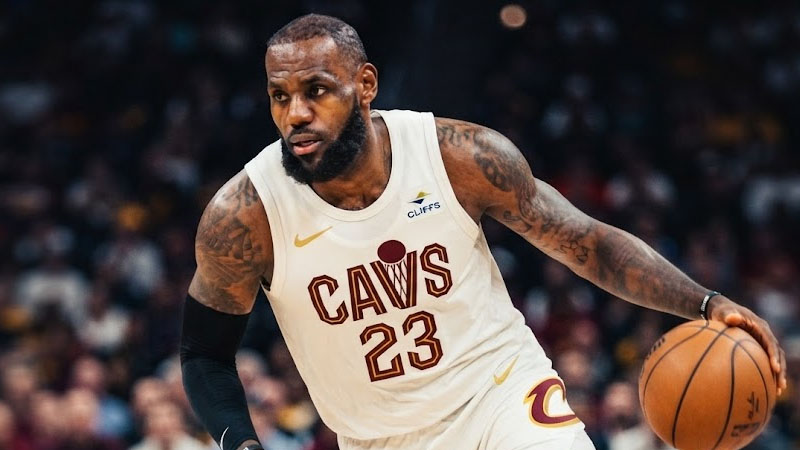
LeBron James remains a physical marvel, reaching a peak on-court top speed of 20.4 miles per hour. This elite velocity, comparable to the league’s quickest point guards, is remarkable given his massive 250-pound frame.
Beyond court sprints, James famously clocked a 4.6-second 40-yard dash during a 2013 workout, proving his acceleration mirrors that of elite professional linebackers.
While he averages a lower speed during games to conserve energy, his explosive bursts—like the 20.1 mph tracked during his legendary 2016 chasedown block—highlight a rare combination of mass, momentum, and mechanical efficiency that defines his greatness.
How Fast is LeBron James? Analyzing His Peak Velocity
When evaluating the sheer athleticism of an NBA icon, the numbers provide a definitive look at how he stacks up against the fastest humans on the hardwood.
Tracking data provides a granular view of these movements, confirming that even as he progressed into the later stages of his career, his “top gear” remained among the league’s elite.
The 20.4 MPH Breakthrough
Data reveals that during full-court transition sprints, LeBron James has hit a peak on-court tracking speed of 20.4 miles per hour (32.8 km/h).
To put this in perspective, this speed allows him to run alongside elite point guards like Chris Paul, despite James carrying an additional 75 pounds of muscle.
This velocity is not just a theoretical maximum; it is a functional tool used to dominate fast breaks and overwhelm defenders who lack the mass to withstand such a high-velocity collision.
Sustaining Momentum in High-Stakes Moments
His ability to sustain this speed over distance is perhaps best exemplified by the 2016 NBA Finals. During the iconic “Chasedown Block,” tracking sensors clocked him at 20.1 mph as he sprinted from half-court to the rim to stop a breakaway layup.
This was not a short burst but a sustained 60-foot sprint that required him to calculate his timing perfectly while maintaining near-maximum human velocity for his size.
Even at age 35, he was still being tracked at 19.8 mph during breakaway dunks, proving that his “slow down” is still faster than most players’ peaks.
LeBron’s 40-Yard Dash: Comparing the King to Professional Standards
While basketball is a game of lateral quickness and verticality, straight-line speed is the ultimate indicator of raw athletic potential.
Although the NBA does not have an official combine requirement for the 40-yard dash like the NFL, various private workouts and historical anecdotes have painted a clear picture of his sprinting prowess.
The 4.6-Second Benchmark
In 2013, during an offseason workout with no specialized track or sprint training, James reportedly clocked a 4.6-second 40-yard dash. In the world of professional sports, a 4.6-second time is the gold standard for an athletic linebacker or a large tight end.
For a basketball player of his height and weight to hit this mark without specific blocks-and-spikes training suggests that his natural explosive power is in the top 1% of all professional athletes globally.
High School Legends and Combine Comparisons
The legend of his speed began long before he entered the professional ranks. During his time as a high-ranked football recruit, scouts famously clocked him between 4.4 and 4.5 seconds when he was at his lightest playing weight.
While these high school times are often subject to “stopwatch inflation,” the consistency of his speed throughout his career lends credibility to the idea that he possessed world-class acceleration from a young age.
Comparing his 4.6-second mark to other legends, it becomes clear that his “speed-to-size” ratio is almost entirely unique in modern sports history.
The Physics of Power: How a 250-Pound Athlete Defies Gravity
Understanding how someone of his stature moves so quickly requires a look at the mechanical efficiency of his stride and the kinetic energy he generates. It is not merely about leg strength; it is about how he translates force into forward progress with minimal wasted movement.
Kinetic Energy and Mass Momentum
At a playing weight of approximately 250 pounds, the “Mass Momentum” James generates is staggering. Physics dictates that Force equals Mass times Acceleration. When James hits 20 mph, he is essentially a 250-pound projectile. This creates a psychological and physical deterrent for defenders.
The kinetic energy involved in his full-speed drives makes him nearly impossible to stop without fouling, as few players possess the combination of weight and bracing strength to halt his forward progress once he reaches his top-end velocity.
Stride Efficiency: The 9-Step Court Coverage
One of the most telling metrics of his speed is his stride length. While the average professional player requires 13 strides to cover the 94-foot length of a basketball court, James can clear the same distance in just 9 strides.
This efficiency means he covers more ground with less effort, allowing him to close gaps on defense or outrun opponents on the break without having to move his legs at a faster frequency than a smaller player.
His biomechanics are optimized for maximum coverage per step, a trait usually reserved for Olympic-level triple jumpers.
Strategic Pacing: The Efficiency of the King’s Walk
An interesting paradox in his data is the discrepancy between his peak speed and his average game speed. To maintain a career spanning over two decades at the highest level, James has mastered the art of “active recovery” during live gameplay.
| Metric Category | Tracking Statistic | Context / Comparison |
|---|---|---|
| Peak Sprint Speed | 20.4 mph | Matches elite point guards |
| Chasedown Velocity | 20.1 mph | Sustained over 60 feet |
| Average Game Speed | 3.3–3.4 mph | Conserves energy for bursts |
| Pacing Breakdown | 78% Walking | Deliberate energy management |
| 40-Yard Dash | 4.60 seconds | Equivalent to NFL Linebacker |
| Reaction Velocity | 40 mph | Release speed of his passes |
This pacing strategy is not a sign of fatigue but of high-level intelligence. By walking for roughly 78% of the game, he ensures that his cardiovascular system is ready for the 20+ mph bursts required in the fourth quarter.
This “efficiency-first” approach is why he is often ranked near the bottom of the league in average distance covered per hour, yet remains the most dangerous player on the court during transition opportunities.
Can LeBron James Run a Sub-5 Minute Mile? The Great Debate
The question of his endurance over distance has sparked intense discussion within the athletic community.
While basketball is a sport of intermittent high-intensity sprints, a one-mile run tests a different physiological system—specifically aerobic capacity and the ability to maintain a high pace over several minutes.
Analyzing Cardiovascular Capacity
Proponents of the “sub-5 minute” theory point to his incredible V02 max and professional conditioning. Given that he is a professional athlete whose job revolves around high-intensity cardio for 40 minutes a night, many believe he could easily transition that to a mile run.
Some enthusiasts note that if an average, non-professional runner can hit a 7 or 8-minute mile, an elite specimen like James should theoretically be significantly faster.
His massive stride length would also be a massive advantage in a middle-distance race, allowing him to maintain a high velocity with a lower step frequency.
The “LeMile” Speculation and Benchmarks
Within the community, the debate often settles on a range between 4:45 and 5:30. A key benchmark cited is Brian Scalabrine, who, at 6’9″ and 230 lbs, reportedly ran a 4:45 mile in college.
If a player of Scalabrine’s physical profile could achieve that, it is highly probable that an athlete of James’s caliber could break the 5-minute barrier with specific training.
Even at age 36 or older, experts suggest he could likely “wheeze out” a sub-6:30 mile with zero training, simply based on his baseline fitness.
Frequently Asked Questions About LeBron’s Physical Specs
What is LeBron James’ highest recorded speed?
His highest tracked speed on a basketball court is 20.4 mph, though he consistently hits 20.1 mph during transition blocks.
How fast is his 40-yard dash?
He officially clocked a 4.6-second 40-yard dash in 2013, though he was likely faster (4.4-4.5) in high school.
How does his speed compare to an NFL player?
His 4.6-second dash and 250-pound frame make him physically comparable to a top-tier NFL linebacker or tight end.
Why is his average game speed so low?
He averages 3.3 mph to conserve energy for explosive moments, walking during 78% of his on-court time.
What is his “Reaction Velocity”?
His passing release has been measured at 40 mph, which is faster than the average pass of an NFL quarterback.
How many strides does he take to cross the court?
He covers the full 94-foot court in just 9 strides, compared to the NBA average of 13.
The Verdict on the King’s Velocity
LeBron James is not just fast for his size; he is fast by any professional standard. His ability to hit 20.4 mph while carrying the weight of a heavy-duty athlete is a testament to his unique biomechanics and explosive power.
Whether it is the legendary 20.1 mph chasedown block or the 4.6-second 40-yard dash, the data confirms that his speed is a primary pillar of his longevity and dominance.
While he may “walk” more than his peers, it is a calculated strategy that allows him to remain the fastest player on the court exactly when it matters most.