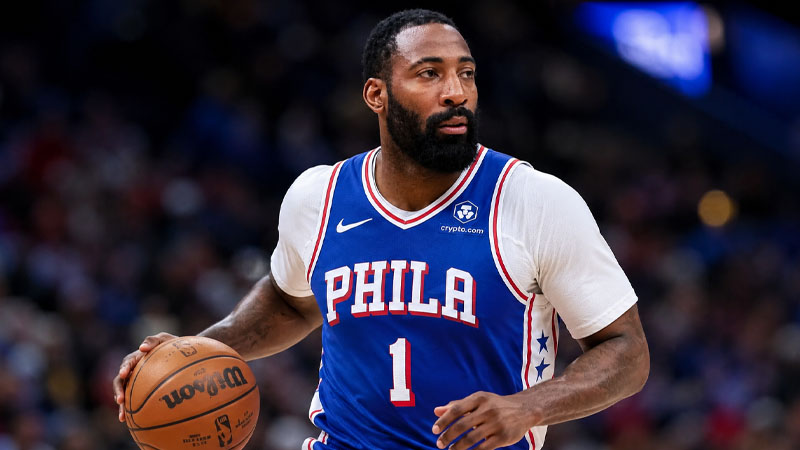
Andre Drummond is an elite, historically significant rebounding specialist who has successfully transitioned from a franchise cornerstone to a premier backup center.
While his lack of perimeter mobility and limited scoring range prevented him from remaining a max-contract star in the modern NBA, his 24.6% total rebound percentage remains one of the highest in basketball history.
Today, he provides exceptional value as a high-energy interior force capable of swinging games through second-chance opportunities.
Ultimately, he is a “good” player whose impact is maximized when utilized as a dominant rebounding specialist rather than a primary offensive hub.
The Historical Dominance of a Rebounding King
Andre Drummond’s career is defined by a level of statistical dominance on the glass that few players in the history of the sport have ever matched.
Over 14 seasons and 967 regular-season games, he has carved out a legacy as a “board beast,” securing four NBA Rebounding Championships and two All-Star selections.
His ability to control the paint during his prime with the Detroit Pistons made him a max-contract player and an All-NBA Third Team honoree in 2016.
Historic Rebounding Milestones and All-Time Rankings
Drummond recently became the 43rd player in NBA history to surpass the 10,000-rebound milestone, currently sitting at 11,540 total rebounds. This places him in the top 40 of the all-time rebounding leaderboard.
His efficiency is perhaps even more impressive than his totals; his career Total Rebound Percentage (TRB%) of 24.6% means he captures nearly a quarter of all available rebounds while he is on the floor—a mark that rivals the peak efficiency of legends like Dennis Rodman.
The Peak of Interior Production
During his most dominant stretch from 2016 to 2020, Drummond was a double-double machine, peaking in the 2017-18 season where he averaged a staggering 16.0 rebounds per game.
He is one of the few modern big men to log multiple seasons averaging over 15 rebounds per game, a feat that highlights his relentless motor and physical presence in the restricted area.
Beyond rebounding, his career averages of 1.3 blocks and 1.2 steals per game underscore a high level of defensive activity for a player of his size.
Is Andre Drummond a Future Hall of Famer?
Despite his gaudy statistical totals and multiple rebounding titles, the consensus among sports analysts and historical models suggests that Drummond faces a steep uphill battle for induction into the Naismith Memorial Basketball Hall of Fame.
While Drummond has expressed personal confidence in his resume, his career trajectory from a franchise centerpiece to a league-minimum veteran has complicated his legacy.
Analyzing the Accolade Gap
The primary barrier to Drummond’s Hall of Fame candidacy is a lack of high-level hardware and postseason success. Advanced probability models currently give him a mere 1.66% chance of induction.
| Achievement Category | Andre Drummond’s Career Totals |
|---|---|
| NBA All-Star Selections | 2 (2016, 2018) |
| All-NBA Team Honors | 1 (Third Team, 2016) |
| Rebounding Titles | 4 (2016, 2018, 2019, 2020) |
| Defensive Player of the Year | 0 |
| NBA Championships | 0 |
| Career Rebounds | 11,540 (Top 40 All-Time) |
The Impact of Team Success on Legacy
A significant detractor for Drummond is that his teams have rarely found success in the playoffs, often failing to advance past the first round.
Critics often point out that while he put up massive individual numbers in Detroit, those stats did not always translate into winning basketball.
After being traded from the Pistons to the Cleveland Cavaliers in 2020, his value shifted rapidly, leading to a series of short-term deals and backup roles that mirrored a journeyman’s path rather than a Hall of Famer’s climax.
Statistical Excellence vs. The “Stat Padder” Debate
One of the most persistent discussions surrounding Drummond’s career is whether he was truly a “great” player or simply a “generational stat padder”.
This debate stems from the discrepancy between his massive box-score totals and his actual impact on offensive and defensive efficiency. Analysts and fans alike have noted that his style of play often prioritized individual metrics over tactical discipline.
The “Own Miss” Phenomenon and Finishing Struggles
A common critique of Drummond is that his offensive rebounding numbers are inflated by his poor touch around the rim. He has been criticized for having “horrible touch” and “terrible hands,” leading to missed layups that he then rebounds himself.
Statistically, for a big man who stays almost exclusively in the restricted area, his career 53.9% field goal percentage is viewed by some as “atrocious” because it suggests a lack of elite finishing ability despite his size.
Defensive Versatility in the Modern Era
In the modern, high-paced NBA, Drummond’s limitations have become more pronounced. He struggles to guard the perimeter or switch effectively against dynamic, floor-spacing offenses.
While his “Defensive Box Plus-Minus” of 2.7 remains elite, the “eye test” often reveals lapses in defensive IQ, such as ball-watching or low effort when rotated out of the paint.
This lack of defensive versatility is a primary reason why he transitioned from a $100 million star to a veteran minimum role player.
How Drummond’s Game Has Evolved in Year 14
In a surprising turn for a player often labeled as one-dimensional, Andre Drummond has shown a remarkable ability to adapt and expand his skillset late in his career.
His 14th season showcased a transformation that few anticipated, particularly regarding his shooting and professional maturity.
The Unlikely Perimeter Expansion
Long criticized for his inability to shoot from outside the paint, Drummond displayed a vastly altered shooting profile during the 2025-26 season. He hit a career-high 35.6% of his three-pointers, a massive leap from his career average of 21.7%.
Additionally, he improved his traditionally poor free-throw shooting, rising to 63.1% compared to a career average of 48.9%. This evolution has allowed him to remain a viable floor-spacing threat in limited minutes.
Recent Statistical Snapshot: 2025-26 Season
The following data reflects Drummond’s production during his recent tenure with the Philadelphia 76ers, illustrating his efficiency as a specialist.
| Metric | Regular Season Average | Playoff Average |
|---|---|---|
| Points Per Game | 6.4 | 3.9 |
| Rebounds Per Game | 8.4 | 4.3 |
| Field Goal % | 47.2% | 69.6% |
| 3-Point % | 35.6% | 50.0% |
| Free Throw % | 63.1% | 70.0% |
Why NBA Teams Still Value Drummond’s Presence
Despite the criticisms, there is a reason Andre Drummond has maintained a 14-year career in the world’s toughest basketball league.
When cast in the correct role, he remains a high-energy veteran who can fundamentally change the geometry of a game through sheer physicality and rebounding.
Elite Interior Gravity and Screening
Drummond’s massive 6-foot-11, 279-pound frame makes him an exceptional asset in pick-and-roll situations. He sets “hard, fundamentally sound screens” that create space for dynamic guards to operate.
Even if he isn’t a primary scoring threat, his “interior gravity” forces defenses to account for his presence on the offensive glass, which creates open looks for his teammates on the perimeter.
Embracing the Humbled Specialist Role
Perhaps the most significant “improvement” in Drummond’s game has been his mental approach. He has been remarkably candid about his past attitude issues, admitting that “pouting on the bench” and having a “bad attitude” nearly cost him his career.
By embracing his role as a backup center for championship-contending teams like the New York Knicks, he has proven that he can contribute to winning basketball without needing to be the focal point of the franchise.
Frequently Asked Questions (FAQ)
Is Andre Drummond still in the NBA?
Yes, Andre Drummond is entering his 14th NBA season. He recently signed a one-year, $3.9 million deal to join the New York Knicks for the 2026-27 campaign.
What is Andre Drummond’s career high in rebounds?
Drummond’s career-high for a single game is 29 rebounds, and he averaged a career-high 16.0 rebounds per game during the 2017-18 season.
Is Andre Drummond a good defender?
Drummond is an elite post defender and rebounder with a career Defensive Box Plus-Minus of 2.7. However, he struggles with perimeter defense and “switchability” against faster, modern offenses.
Why did Drummond’s salary drop so much?
His value decreased as the NBA moved toward “positionless” basketball, which prioritizes centers who can shoot and guard multiple positions.
Drummond’s struggles with rim finishing, free throws (historically), and perimeter defense led to his transition from a max-contract star to a veteran minimum specialist.
Conclusion: The Final Verdict on the Big Penguin
Andre Drummond is a fascinating case study in NBA history. He is undeniably one of the greatest rebounders to ever play the game, possessing a statistical profile that rivals Hall of Fame legends.
However, his career serves as a reminder that individual numbers do not always equate to championship impact. By evolving from a “boneheaded board beast” into a disciplined, floor-spacing veteran, Drummond has secured his place in the league for over a decade.
Whether he is “good” depends entirely on the lens through which you view him: as a franchise star, he fell short; as a dominant rebounding specialist, he is nearly peerless.