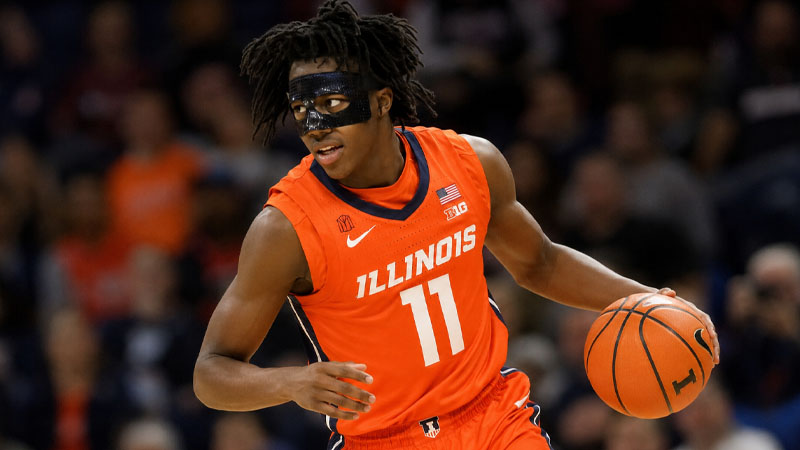
Ayo Dosunmu wore a protective black face mask during the final stretch of his 2020-21 college basketball season at Illinois to protect a broken nose and facial injuries.
The injury occurred on February 23, 2021, during a physical game against Michigan State when he was struck by an opponent’s forearm, an incident that also triggered concussion protocols.
While the mask was medically necessary to prevent reinjury, it quickly became an iconic symbol of resilience known as the “Masked Mamba,” a tribute to Kobe Bryant. Today, his injuries are fully healed, and he plays mask-free in the NBA.
The Medical Necessity: How Ayo Dosunmu Broke His Nose
The narrative of the mask began with a high-stakes encounter that many fans described as a “street fight” on the court.
During a game against Michigan State, Dosunmu suffered a significant facial injury that threatened to derail his All-American season and Illinois’ postseason aspirations.
The physicality of the Big Ten conference was on full display, leading to a moment that changed the trajectory of the year.
The Michigan State Incident and Flagrant Foul
The specific injury occurred when Michigan State’s Mady Sissoko struck Dosunmu in the face with his forearm during a drive to the basket. The play resulted in a flagrant 2 foul and Sissoko’s immediate ejection from the game.
Discussion among fans and observers was intense, with some calling the play “recklessly aggressive” while others viewed it as a “bang-bang play” where the defender was simply out of control.
Regardless of intent, the impact was severe enough to break Dosunmu’s nose and require immediate medical intervention.
Diagnosis, Concussion Protocols, and Recovery
Following the hit, Dosunmu was placed into concussion protocols, adding another layer of complexity to his return.
Initial reports from major news outlets confirmed the broken nose and noted that he was being fitted for a custom mask, though his return date remained uncertain for several days.
Fans expressed deep concern, fearing the injury might cost him the remainder of the regular season or even the Big Ten Tournament.
However, the medical team worked quickly to ensure he could return safely, focusing on a design that would offer maximum protection without compromising his vision or performance on the floor.
The Masked Mamba Persona and Cultural Impact
When Dosunmu finally returned to the court, he did not just wear a standard clear medical guard; he opted for a custom, all-black version that immediately captured the imagination of the basketball world.
This choice was deliberate and deeply personal, bridging the gap between medical necessity and psychological warfare.
A Tribute to Kobe Bryant and LeBron James
The decision to wear a black mask was a direct tribute to his idol, Kobe Bryant, who famously donned a mask after a similar injury.
By adopting the “Masked Mamba” persona, Dosunmu tapped into the “Mamba Mentality,” signaling to opponents and fans alike that the injury had not diminished his competitive fire.
He also drew inspiration from LeBron James, who had a memorable stint wearing a black mask during the 2013-14 NBA season. This stylistic choice transformed a piece of medical equipment into a badge of honor and a symbol of elite status in the sport.
The Superhero Aesthetic and Fan Enthusiasm
Dosunmu himself noted that wearing the all-black mask made him feel like a comic book superhero or Batman while competing.
This sentiment was echoed by the Illinois fanbase, who began to believe the mask bestowed “Phantom of the Opera-like powers” upon him. Fans jokingly speculated that the mask might even enhance his “intelligence, charisma, and physical strength”.
This cultural phenomenon helped galvenize the team and its supporters, turning a potentially negative injury into a rallying cry for the upcoming championship run.
A Comprehensive Look at the Masked Campaign
Dosunmu’s time behind the mask was brief but remarkably successful. He wore the protective gear for exactly six matches to close out his college career, a period defined by high-stakes victories and a conference title.
| Date | Opponent | Event | Result |
|---|---|---|---|
| March 6, 2021 | #7 Ohio State | Regular Season | Won 73-68 |
| March 12, 2021 | Rutgers | Big Ten Quarterfinal | Won 90-68 |
| March 13, 2021 | #9 Iowa | Big Ten Semifinal | Won 82-71 |
| March 14, 2021 | #9 Ohio State | Big Ten Championship | Won 91-88 (OT) |
| March 19, 2021 | #16 Drexel | NCAA Round of 64 | Won 78-49 |
| March 21, 2021 | #8 Loyola Chicago | NCAA Round of 32 | Lost 71-58 |
The campaign began with a statement win against a top-ten Ohio State team, proving that Dosunmu remained an elite force despite the facial protection.
His performance through the Big Ten Tournament was particularly dominant, leading Illinois to three straight wins and the tournament trophy.
The journey eventually ended in the NCAA Tournament’s Round of 32 against Loyola Chicago, which marked the final time he would wear the mask in a competitive setting.
Psychological Benefits and the “Phantom” Effect
Beyond the physical protection, many observers believe the mask provided a psychological edge.
Historical precedents in basketball suggest that players often find a unique rhythm when forced to wear protective gear, as seen with legendary figures like Rip Hamilton.
Feeling Safe and the Intimidation Factor
One recurring theme among basketball analysts is that a mask can actually make a player feel “safer” on the court. When a player no longer fears a secondary hit to a sensitive area, they can play with a level of uninhibited aggression that might otherwise be tempered by caution.
For Dosunmu, the black mask also served as an intimidation tool. The “masked-up” look presented a formidable image to defenders, contributing to the aura of the “Masked Mamba” that seemed to suggest he was playing at a level beyond a typical college athlete.
Enhanced Charisma and Leadership
The legend of the mask also touched on Dosunmu’s leadership. During his six-game masked run, his charisma and presence on the floor appeared to reach new heights.
Fans noted that he seemed more composed and focused, navigating the pressure of the Big Ten Tournament with the poise of a seasoned professional.
This period cemented his legacy as one of the greatest players in Illinois history, as he demonstrated the ability to overcome physical adversity while leading his team to one of its most successful seasons in recent memory.
Why Ayo Dosunmu No Longer Wears a Mask in the NBA
As Ayo Dosunmu transitioned from college to the professional ranks, many fans wondered if the mask would remain a permanent part of his on-court identity. However, the mask was always intended to be a temporary solution for a specific medical issue.
Full Medical Recovery and NBA Draft
By the time Dosunmu was preparing for the NBA Draft, his nose and facial bones had fully healed. There was no longer a clinical need for the protective gear, and he chose to return to playing without it to ensure maximum comfort and visibility.
His health was a key factor for scouts, and his ability to finish the college season so strongly while masked proved his durability and toughness to professional organizations.
Professional Career with the Bulls and Timberwolves
Since joining the NBA, Dosunmu has played mask-free for both the Chicago Bulls and the Minnesota Timberwolves. While the “Masked Mamba” era is now a part of his history, it remains a defining chapter of his career that fans still talk about today.
His time in the NBA has been marked by the same resilience he showed in college, though he now relies on his natural skills rather than a “superhero” mask to dominate his opponents.
Frequently Asked Questions About the Masked Mamba
When did Ayo Dosunmu start wearing the mask?
He began wearing the mask on March 6, 2021, for a game against Ohio State.
What was the specific injury that required the mask?
He suffered a broken nose and other facial injuries during a game against Michigan State on February 23, 2021.
How many games did he play with the mask?
Dosunmu played exactly 6 games while wearing the protective mask.
Why did he choose a black mask instead of a clear one?
The black mask was a tribute to Kobe Bryant and was inspired by similar looks worn by LeBron James.
Does he still wear the mask today?
No, his injuries are fully healed, and he has played mask-free throughout his entire NBA career.
The Enduring Legacy of the Masked Mamba
The “Masked Mamba” era was more than just a medical necessity; it was a masterclass in branding, resilience, and high-level performance under pressure.
Ayo Dosunmu took a painful injury and turned it into a legendary moment in Illinois basketball history, proving that a true competitor finds ways to thrive even when the odds—and the physical hits—are against them.
His six-game run will forever be remembered by the Orange and Blue faithful as the time a superhero took the court in Champaign.