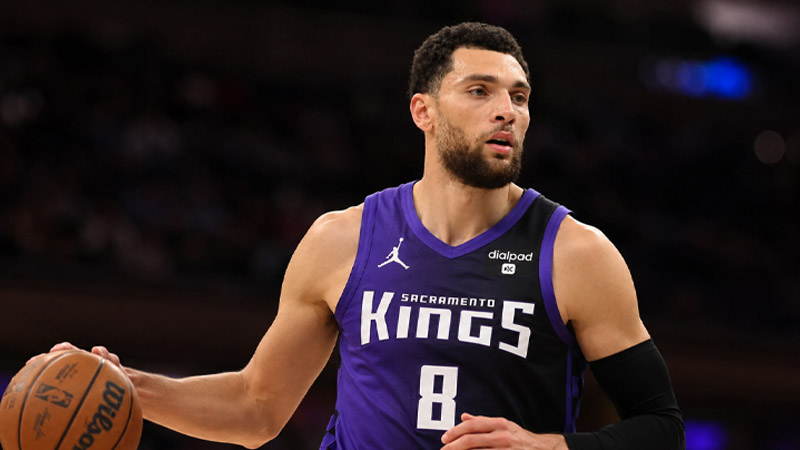
Zach LaVine is an elite offensive talent but a polarizing “winning” player in the modern NBA landscape. Statistically, he is one of the most efficient high-volume shooters in history, boasting career averages of 20.7 points on nearly 40% shooting from three-point range.
However, his overall value is frequently complicated by defensive lapses, playmaking limitations, and a massive $49 million contract option.
Whether he is considered “good” depends entirely on his role; as a primary option on struggling teams, he produces historic numbers, but as a secondary piece on a contender, his defensive profile becomes a significant hurdle.
What Makes Zach LaVine an Elite Offensive Player?
To understand if Zach LaVine is “good,” one must first acknowledge the rarified air he occupies as a pure scorer.
His ability to generate points at all three levels—at the rim, from mid-range, and beyond the arc—places him in a tier with the most gifted offensive weapons in the game today.
The Statistical Peer of Stephen Curry
In terms of raw offensive production, LaVine has reached peaks that few players in the history of the league have ever touched.
During his 2020-21 season, he averaged 27.4 points per game while maintaining shooting splits of approximately 50% from the field and 41.9% from three-point range.
This level of high-volume efficiency is historically significant; he is noted as one of the only players alongside 2016 Stephen Curry to average at least 27 points with 50/40 splits while taking at least six three-point attempts per game.
This comparison highlights that, at his best, LaVine’s shot-making is not just high-level—it is arguably generational.
Historic Three-Level Scoring and Efficiency
LaVine’s scoring repertoire is characterized by a unique blend of world-class athleticism and refined technical skill.
Even as a veteran who has navigated a devastating 2017 ACL tear, he retains the vertical pop and speed that made him a two-time Slam Dunk Champion.
This athleticism allows him to be a dangerous finisher at the rim, which he complements with elite perimeter shooting.
Over a career spanning 12 seasons and nearly 700 games, he has maintained a 39.1% average from three-point range on high volume, often exceeding seven attempts per game.
His ability to hit tough, self-created shots off the dribble makes him a “three-level scorer” capable of single-handedly carrying an offense for stretches.
Why Do Advanced Metrics Question His Impact?
Despite his breathtaking highlights and statistical milestones, a persistent gap exists between LaVine’s box score numbers and his impact on winning.
Critics and advanced metrics often suggest that his contributions do not always translate to team success, leading to the “empty calories” narrative that has followed him through various franchises.
The Playmaking and Basketball IQ Gap
One of the primary criticisms leveled against LaVine is his inability to elevate the players around him.
While he produces numbers similar to stars like Kyrie Irving or Anthony Edwards, his offensive advanced stats often align more closely with players like Bradley Beal or Karl-Anthony Towns.
This is largely attributed to his limitations as a playmaker; he has historically low assist numbers for a primary guard, averaging only 3.9 assists over his career and dipping to 2.3 in recent seasons.
Analysts point out a lack of “winning basketball” IQ, noting that LaVine may take a difficult, contested shot at a 50% clip rather than making a pass that leads to an 80% percentage look for a teammate.
Defensive Liabilities and the “Invisible Man” Label
Perhaps the most significant detractor from LaVine’s value is his performance on the defensive end. He is frequently described as a “non-existent” or “poor” defender who struggles with off-ball awareness and stopping penetration.
Because he often fails to disrupt passing lanes or collect steals at a high rate, he becomes a target for opposing offenses.
This defensive deficiency, combined with his playmaking struggles, has led to him becoming an “invisible” man in conversations regarding the NBA’s top-tier elite, as he lacks the well-rounded game required to anchor a winning culture.
How Does His Contract Affect His Overall Value?
In the modern NBA, a player’s quality is inextricably linked to their salary cap hit. Zach LaVine’s current financial standing has created a massive discrepancy between his on-court talent and his trade market utility.
| Metric | Standing | Impact on Game Analysis |
|---|---|---|
| Scoring Efficiency | Elite | Can single-handedly carry an offense or act as a lethal secondary option. |
| Playmaking | Below Average | Historically low assist (2.3–3.9) and rebound (2.8) numbers for a guard. |
| Defensive Impact | Poor | Frequently breaks down scheme flow and struggles to stop penetration. |
| Contract Value | Very Low | His $49M salary caps a team’s flexibility, making him difficult to trade. |
| Health/Availability | Concerning | Limited to 39 games in 2025–26; history of major surgeries. |
The decision to opt into a $49 million player option for the 2026–27 season means that teams acquiring him must view him as a cornerstone superstar.
However, because his value as a secondary option drops significantly when his defense is taken into account, many organizations have “buyers remorse” regarding his max-contract status.
He is often viewed as a “great #1 option on a bad team,” but his $50 million price tag makes him an expensive and risky gamble for a true contender.
Is Zach LaVine a Good Fit for Winning Teams?
The debate over whether LaVine is “good” often concludes that he is a victim of poor infrastructure. Throughout his tenure with the Timberwolves, Bulls, and Kings, he has rarely been surrounded by the specific talent needed to mask his defensive and playmaking flaws.
The Infrastructure Problem: Case Studies in Fit
To see the best version of Zach LaVine, analysts suggest he needs to be paired with a primary playmaker and a strong defensive system.
For instance, it has been theorized that he would “kill” alongside a playmaker like Cade Cunningham or thrive in a fast-paced system with Ja Morant setting him up.
Others suggest he would be an ideal fit next to a dominant force like Giannis Antetokounmpo, where his elite catch-and-shoot ability could be weaponized without the burden of being the primary decision-maker.
In the right environment—as a second or third option—he remains an All-Star caliber “bucket-getter” who could be a crucial piece of a championship roster.
Health Concerns and Professional Longevity
Beyond the tactical fit, LaVine’s durability remains a significant question mark for potential suitors. His 2025–26 season was cut short after just 39 games due to season-ending surgery on his right hand.
While he proved his resilience by returning from an ACL tear to become even more explosive, the accumulation of injuries as he enters his 30s complicates his long-term outlook.
Despite these setbacks, he has maintained a high level of professionalism, avoiding locker-room drama even as his name is constantly floated in trade rumors.
This professional attitude is a key “trust signal” for teams looking to integrate him into their culture.
Frequently Asked Questions About Zach LaVine
Is Zach LaVine a top 10 NBA player?
While some enthusiasts argue he is a top 10 talent who has never had a worthy team, the consensus among analysts is that his lack of defensive impact and playmaking prevents him from reaching that tier.
He is generally viewed as an All-Star caliber scorer rather than a top 10 overall impact player.
What is Zach LaVine’s career-high scoring game?
LaVine’s career-high is 51 points, achieved against the Detroit Pistons in 2023. Remarkably, he reached this total without making a single free throw, a feat that only a few players in NBA history have ever accomplished.
Why is his trade value considered low?
His trade value is depressed by the combination of a massive $49 million contract, a history of significant injuries, and the perception that he does not contribute to “winning basketball” through defense or playmaking.
Does he have any championship experience?
LaVine does not have an NBA championship, but he is an Olympic Gold Medalist (2020). During the Tokyo Olympics, he proved he could be a vital, high-energy contributor in a winning environment as an efficient bench scorer and defender for Team USA.
The Final Verdict: Talent vs. Utility
Ultimately, Zach LaVine is an exceptional basketball player whose “goodness” is obscured by the context of his contract and team situations.
He possesses the pure shooting and athletic traits of an all-time great, as evidenced by his 13 three-pointer game and his 50/40/80 statistical peaks.
However, for a player to be truly “good” in the eyes of the modern NBA, they must affect the game when the ball isn’t in their hands.
For LaVine to silence his critics, he must find a situation that allows him to focus on his strengths as a secondary finisher while being insulated by elite defenders.
Until that happens, he will likely remain the NBA’s most talented enigma—a player capable of matching Stephen Curry’s efficiency on paper while struggling to move the needle in the standings.
If your team needs a professional, high-volume scorer to stretch the floor, LaVine is elite; if they need a cornerstone to build a top-tier defense, the search continues.