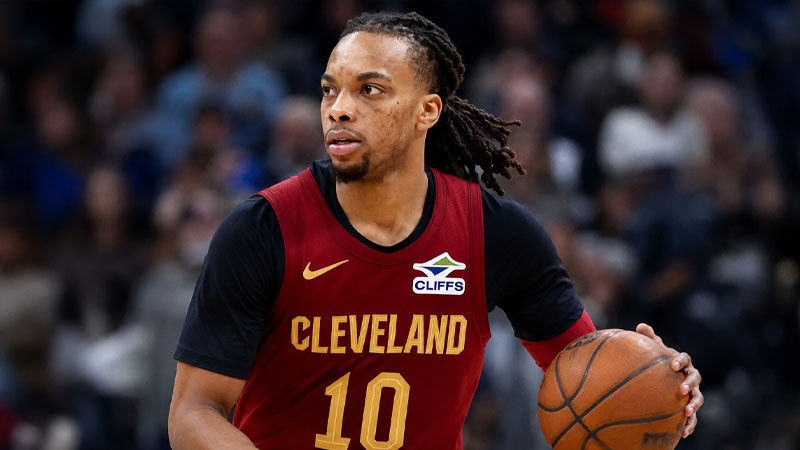
Darius Garland is not a rookie; he is an established veteran point guard with seven seasons of NBA experience. Selected fifth overall by the Cleveland Cavaliers in the 2019 draft, his actual rookie campaign concluded years ago during the 2019–20 season.
Today, the two-time NBA All-Star represents the LA Clippers, following a significant trade during the 2025–26 cycle.
While casual observers might still associate him with his youthful potential, his tenure and statistical growth firmly place him among the league’s seasoned leaders. This article explores his journey from analytical bottom-dweller to a premier backcourt cornerstone.
Is Darius Garland a Rookie? Identifying His Current Veteran Status
To provide a definitive answer for those tracking league rosters: Darius Garland is no longer a rookie and has not been one for over half a decade.
His status in the league has transitioned from a high-upside prospect into a verified veteran leader who has navigated multiple phases of a franchise’s life cycle.
After spending the first six years of his career in Cleveland, Garland has transitioned to a new chapter with the LA Clippers, bringing his elite playmaking to the Western Conference.
The Longevity of a Seven-Year Career
Entering the league in 2019, Garland’s tenure has spanned several major shifts in NBA playstyles. His professional journey began when he was just 19 years old, making him one of the younger prospects in his class.
Over seven seasons, he has moved through the standard developmental hurdles—rookie scale contracts, a massive maximum extension, and eventually, the trade market.
Defining “Veteran” in the Modern NBA
In professional basketball, a player generally loses rookie status after their first year and enters the “veteran” category as they move beyond their initial rookie-scale contract.
Garland surpassed this milestone when he signed a five-year, $193 million Designated Rookie Maximum Extension. Having played in nearly 60 games in his first year alone and securing two All-Star appearances, his resume is that of an established star rather than a newcomer.
Examining Darius Garland’s Real Rookie Season (2019–20)
The actual rookie season for Darius Garland took place during the 2019–20 NBA calendar. It was a year defined by high usage, heavy responsibility, and the growing pains associated with leading a rebuilding roster.
Despite being only 19 and coming off a significant injury, Garland started all 59 games he played, averaging 30.9 minutes per night.
A Debut for the Record Books
Garland made his professional debut on October 23, 2019, against the Orlando Magic. This game was culturally significant for the league as Garland became the very first player born in the 2000s to play in an NBA game.
This milestone marked the beginning of a new generation of talent entering the professional ranks.
Statistical Benchmarks of Year One
While his first year was a steep learning curve, Garland managed to post respectable volume numbers that hinted at his future ceiling. He averaged 12.3 points and 3.9 assists per game.
Notably, his passing was among the best in his class, as he led the Cleveland Cavaliers in assists and ranked second among all NBA rookies, trailing only Ja Morant.
Elite Shooting Indicators
One of the most promising signs from his debut season was his efficiency from the charity stripe and the perimeter. He shot 87.5% from the free-throw line, a mark that typically correlates with elite long-term shooting accuracy.
Furthermore, he set a Cleveland franchise record for rookies by making multiple three-pointers in 10 consecutive games.
The High-Risk Scouting Report Behind the 5th Overall Pick
Understanding why Garland is such a unique case study requires looking back at the 2019 NBA Draft. He was one of the most mysterious prospects in recent memory because teams had almost zero collegiate film to analyze.
His selection at number five was a testament to his high school reputation and the elite shooting mechanics he displayed in private workouts.
The Vanderbilt Knee Injury
Garland’s college career at Vanderbilt University lasted only five games due to a torn meniscus. This injury forced him to miss nearly the entire collegiate season, meaning the Cavaliers drafted him based on a incredibly small sample size.
This “drafting on potential” approach created immense pressure for him to perform immediately upon entering the professional ranks.
Navigating the “SexLand” Backcourt
A major hurdle during Garland’s early years was the roster construction in Cleveland. The team had drafted point guard Collin Sexton eighth overall just one year prior.
Pairing two undersized, underage guards together—famously dubbed “SexLand”—created significant defensive challenges.
This experiment often split playmaking duties and forced Garland to adapt his game while sharing the floor with another ball-dominant guard, which initially stalled his developmental chemistry.
Why Early Analytics Were Harsh on the Young Guard
While his surface-level numbers were solid, Garland’s rookie year was famously criticized by advanced tracking models. Because he was a 175-pound teenager playing heavy minutes on a struggling lottery team, his efficiency metrics were historically low.
| Statistical Category | Regular Season Value | Notable Context |
|---|---|---|
| Points Per Game | 12.3 | Led to 36 double-digit scoring games |
| Assists Per Game | 3.9 | 2nd among all rookies behind Ja Morant |
| Free Throw % | 87.5% | Signal of elite shooting mechanics |
| At the Rim % | 42.4% | Result of slight 175-pound frame |
| Games Leading Team in Assists | 19 | Highest mark on the Cavaliers roster |
The Battle with Efficiency Models
During the 2019–20 season, Garland ranked at the bottom of the league in several prominent advanced statistics, including Win Shares and Value Over Replacement Player (VORP).
These models penalized him for his high turnover rate and his struggle to finish near the basket against larger defenders.
Physical Limitations and Finishing
As a 175-pound rookie, Garland frequently shied away from contact in the paint. He shot a poor 43.4% inside the arc and only 42.4% at the rim.
These struggles were not a lack of talent but rather a result of his physical frame catching up to the speed and strength of the professional game.
The Financial Evolution: From Rookie Scale to Max Extension
A player’s transition from rookie to veteran is often marked by their contract status. Garland’s career earnings reflect his growth from a questionable draft pick into a franchise cornerstone. His financial journey is a textbook example of a player “betting on himself” and winning.
The Initial Rookie Scale Exception
As the 5th pick in the 2019 Draft, Garland was tied to the league’s strict Rookie Scale Exception. His first four-year contract was worth approximately $29 million. At the time, given his analytical struggles, some questioned if he would ever live up to the value of that initial investment.
The $193 Million Reward
Garland’s growth by his third season was so explosive that Cleveland rewarded him with a massive five-year, $193 million Designated Rookie Maximum Extension.
This contract officially moved him out of the “prospect” phase of his career and into the realm of the league’s highest-paid elite performers. It served as a formal recognition of his status as a cornerstone player.
From Struggling Debut to Two-Time All-Star
The narrative of Darius Garland’s career is one of persistence. Many players who rank last in advanced analytics during their first year never recover. Garland, however, used the heavy minutes and the “analytical struggles” of his first year as a developmental foundation.
Learning Through High Usage
The decision by the Cavaliers coaching staff to let Garland play through his mistakes in 2019 proved vital.
By leading the team in assists during 19 games as a rookie, he developed the floor vision that would eventually make him a 2-time All-Star. Those early “inefficient” reps were the laboratory where he refined his playmaking.
Physical Maturation and Skill Refinement
As he aged, Garland improved his finishing at the rim and utilized his 87.5% free-throw shooting to become a multi-level scoring threat. He transformed from a guard who was easily pushed off his spot into one who could navigate pick-and-rolls with elite precision.
Frequently Asked Questions About Darius Garland’s Career
Did Darius Garland win Rookie of the Year?
No, Darius Garland did not win Rookie of the Year, nor was he selected for an NBA All-Rookie Team. Despite his 12.3 points per game and leading his team in assists, his low efficiency and the team’s struggling record overshadowed his individual volume at the time.
How many years has Darius Garland been in the NBA?
As of the current season, Darius Garland is in his seventh year in the NBA. He has transitioned from the Cleveland Cavaliers, where he spent his first six seasons, to the LA Clippers.
What was Darius Garland’s rookie contract?
His initial rookie-scale contract was a four-year deal worth roughly $29 million. Following his breakout All-Star performance, he signed a significantly larger extension worth $193 million.
What were Garland’s rookie stats?
During the 2019–20 season, Garland averaged 12.3 points, 3.9 assists, and 1.9 rebounds per game while shooting 40.1% from the field and 35.5% from three-point range.
Conclusion: A Veteran Leader in a New Chapter
Darius Garland’s journey proves that a “rough” start on paper does not define a career. While he is far from being a rookie today, the lessons he learned during that 2019–20 campaign in Cleveland built the framework for the All-Star player we see now.
From being the first player born in the 2000s to take the court to becoming a $190 million veteran for the LA Clippers, Garland’s evolution is a masterclass in professional development.
For fans and analysts alike, his story is a reminder that elite talent often requires time, physical growth, and the patience to overcome early statistical hurdles.