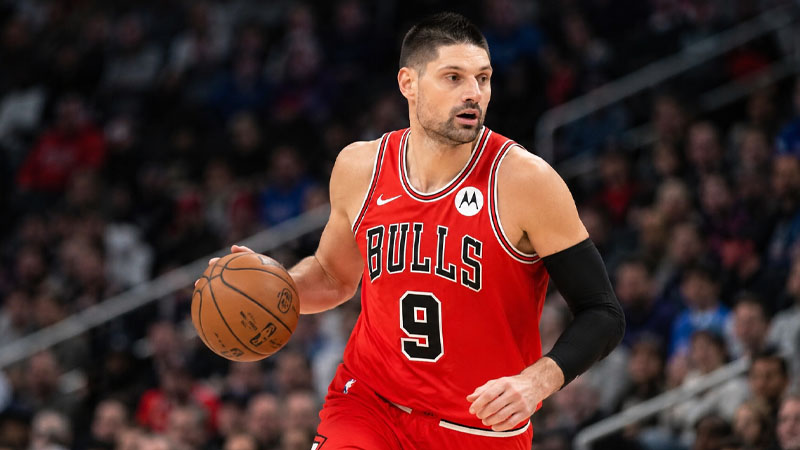
Nikola Vučević’s fantasy value for the 2025–26 season has shifted from a cornerstone to a late-round flyer.
While he remains a statistical “unicorn” for his efficient free-throw shooting and three-point range at the center position, his return to Orlando on a one-year veteran deal places him in a backup role behind Wendell Carter Jr..
Expect reduced volume, with projections hovering around 10 points and 7 rebounds per game. Consequently, he is no longer an early-round lock but serves as an elite “handcuff” or niche specialist for managers punting blocks in category leagues later in drafts.
The Historical Context of an Elite Statistical Asset
The transition of Nikola Vučević from a top-tier fantasy superstar to a situational veteran requires a deep look at his career trajectory and how he fundamentally changed the center position for managers over the last decade.
Understanding his historical floor helps in predicting how much of that veteran savvy can still translate into production during limited minutes.
The Peak Orlando Magic Years
During his prime years with the Orlando Magic, Vučević was an undisputed early-round cornerstone who provided massive volume. His peak reached a crescendo during the 2020–21 season where he functioned as a top-10 asset in both 9-category and points leagues.
During that monster campaign, he averaged 24.5 points and 11.8 rebounds while shooting over 40% from deep.
This “walking double-double” status rendered him a dominant force in head-to-head points formats where volume and extra bonuses for statistical milestones often dictate weekly matchups.
For nearly a decade, he provided a level of consistency that few big men in the league could match.
Durability and the Iron Man Status
A major driving force behind his all-time fantasy value has been his relentless availability on the court. Fantasy championships are often won simply by staying healthy, and Vučević was remarkably durable throughout his 15-year career.
He famously played and started in all 82 games during the 2022–23 season with the Bulls. Even into his mid-30s, he routinely played 73+ games per season, avoiding major long-term structural injuries for over a decade.
This reliability provided elite value over replacement players who frequently missed chunks of time.
Redefining the Modern Center
In 9-category formats, Vučević revolutionized the center position by allowing managers to completely pivot their drafting strategies. He served as a rare “unicorn” who could anchor a roster’s free-throw percentage while providing elite rebounding.
While most rebounding centers destroy a roster’s efficiency from the stripe, Vučević shot between 80% and 87% during his peak.
Furthermore, he was a pioneer of the floor-spacing big man, expanding his game to hit nearly 2.5 threes per night while dishing out over 3.5 assists—metrics usually reserved for small forwards and wings.
Analyzing the 2025–26 Statistical Projections
To determine if he remains a viable asset, we must look at the data from his split season in 2025–26, which serves as the most accurate blueprint for his current role.
The decline in minutes correlates directly with a drop in raw production, as seen in his time with the Celtics.
| Metric | Chicago Bulls Split | Boston Celtics Split | Total 2025–26 Baseline |
|---|---|---|---|
| Minutes Per Game | 30.8 | 21.1 | 28.4 |
| Points Per Game | 16.9 | 9.7 | 15.1 |
| Rebounds Per Game | 9.0 | 6.6 | 8.4 |
| Assists Per Game | 3.8 | 2.0 | 3.3 |
| Field Goal % | 50.5% | 43.9% | 49.3% |
| Three-Point % | 37.6% | 34.0% | 36.9% |
| Free Throw % | 83.8% | 78.9% | 82.8% |
Is Vučević Still a Viable Option in Category Leagues?
While his days as a top-25 asset are over, his unique statistical profile ensures he remains a specific chess piece for certain roster constructions. In 9-category formats, his value is tied more to his efficiency and “out-of-position” stats than his total points or rebounds.
Capitalizing on the Free-Throw Anchor
His greatest remaining strength is his ability to contribute center-position stats without the traditional drawbacks.
Most late-round centers are specialists who offer blocks or rebounds but shoot poorly from the free-throw line. Vučević, however, maintains a career average of 77% and has frequently touched the mid-80s.
This makes him an ideal fit for guard-heavy builds where you need to maintain a high team percentage from the stripe. He allows a manager to stay competitive in rebounds without sacrificing efficiency.
The Rarity of Out-of-Position Assists
Even in a reduced role, his high basketball IQ allows him to remain an effective playmaker from the high post. He averaged 3.3 assists per game last season, a metric that is highly valuable when coming from the center slot.
In 12-team leagues, finding a big man who can contribute three or more assists in the final rounds of a draft is exceedingly rare. This “out-of-position” playmaking can often be the difference-maker in tight weekly category battles.
Identifying Defensive Liabilities
The primary risk in drafting him for category leagues is his near-total lack of defensive production. Last year, he provided almost no blocks, averaging just 0.6 per game.
His steals are also negligible, meaning he is essentially a “three-category negative” in blocks, steals, and turnovers if his usage is high. Consequently, he is best utilized in “Punt-Blocks” builds where his offensive efficiency and spacing are prioritized over rim protection.
Navigating the Orlando Magic Frontcourt Rotation
Your entire evaluation of his value for the upcoming season hinges on how the Orlando Magic deployment strategy unfolds. He is returning to a familiar city on a one-year, $3.9 million contract, but the team he left is very different from the one he is joining.
The Backup Reality Behind Wendell Carter Jr.
Currently, he is locked in as a backup center behind Wendell Carter Jr. and will likely compete for secondary minutes with Goga Bitadze. Most industry analysts project him to play between 18 and 22 minutes a night, similar to his tenure in Boston.
If this pessimistic view holds true, his fantasy ceiling remains capped as a fringe standard-league option. In this role, he is purely a depth piece intended to stabilize the second unit rather than a primary producer.
The Upside of Floor Spacing
There is an optimistic path where his offensive consistency earns him more playing time than expected. The Magic have historically struggled with frontcourt floor-spacing, an area where Wendell Carter Jr. has occasionally been inconsistent.
If the coaching staff prioritizes the spacing provided by a veteran who can hit 36.9% of his threes, there is an outside chance he commands 25+ minutes a night.
Should he reclaim a starting spot or high-minute role, his offensive reliability would quickly return him to a safe double-double threat.
Strategic Valuation Across Different Formats
The way you handle this veteran asset should vary significantly based on the rules of your league. A “draft and hold” strategy that works in a deep category league could be a disaster in a shallow points format.
Points League Volume Considerations
In points-based formats, total volume is the primary driver of value. Because his minutes are projected to mimic his limited Boston tenure, his value in these leagues has bottomed out.
He no longer possesses the high floor that previously fueled his status as a “double-double machine”. You should avoid targeting him as a primary starter in points leagues and only consider him as a bench utility player where you can afford to absorb low-minute nights.
The Dynasty “Sell-High” Window
For managers in dynasty or keeper leagues, the recommendation is clear: sell immediately. Turning 36 in October and playing on a cheap veteran minimum contract indicates that he has officially entered the twilight of his career.
His long-term fantasy ceiling has bottomed out, and any remaining name recognition should be leveraged to acquire younger assets before his value vanishes entirely,.
Frequently Asked Questions on Veteran Assets
Is he worth a top-100 pick?
No. You should avoid him entirely if he is being drafted anywhere near the top 80–100 picks based on his past All-Star status.
What is his ideal draft range?
His target zone is Round 10 or later in 12-team leagues. At that stage, he provides excellent bench stability and serves as a high-upside flyer.
Can he be used as a handcuff?
Yes. He is considered a “premium handcuff” for Wendell Carter Jr.. If the starter misses time, his floor-spacing and rebounding could immediately return him to standard-league relevance.
What categories does he help the most?
He remains an asset for free-throw percentage, three-pointers, and out-of-position assists for a center.
Should I pick him up on waivers?
In shallow leagues, he may start the season on the wire. He is a primary “stream” candidate if the Orlando frontcourt suffers any injuries.
Final Verdict for the Upcoming Draft Season
Nikola Vučević is no longer the “Iron Man” superstar who could carry a fantasy roster to a championship through sheer volume and durability. However, labeling him as “bad” for fantasy would be a mistake of oversimplification.
He has evolved into a niche specialist—a high-IQ veteran whose value is now tied to specific build strategies and roster depth.
Do not reach for him based on his historical accolades. Instead, view him as a calculated late-round addition who can stabilize your percentages and provide elite insurance for your starting big men.
If you can secure him in the double-digit rounds, his ability to provide efficient scoring and floor-spacing from the bench makes him a valuable, though limited, asset for the 2025–26 campaign.