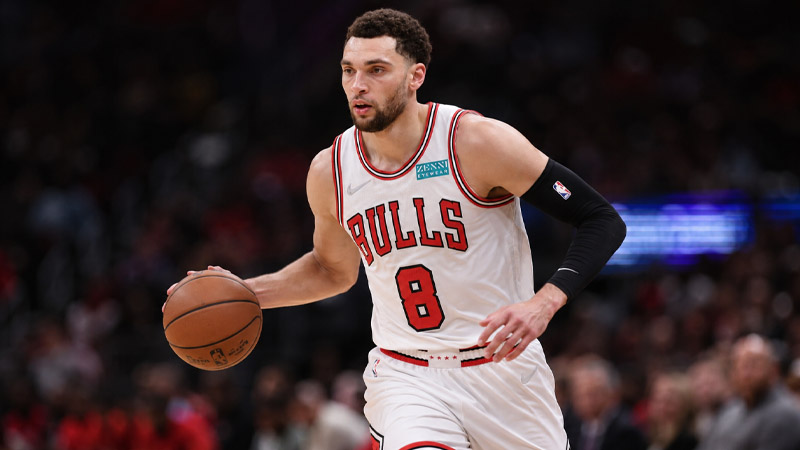
Zach LaVine was traded from the Chicago Bulls to the Sacramento Kings in February 2025 primarily to facilitate a full-scale roster rebuild and shed his massive five-year, $215.2 million maximum contract.
This blockbuster three-team deal, which also involved the San Antonio Spurs, allowed Chicago to regain control of their 2025 first-round draft pick.
Simultaneously, the Kings acquired LaVine as an offensive pivot after star point guard De’Aaron Fox declined a long-term extension.
By moving LaVine, the Bulls secured financial flexibility, while Sacramento sought to maintain a competitive core around Domantas Sabonis and DeMar DeRozan.
Why the Chicago Bulls Moved on from LaVine
The decision to move Zach LaVine was not an isolated event but rather the cornerstone of a broader organizational shift in Chicago.
After years of hovering in the “middle” of the Eastern Conference, the Bulls’ front office realized that the existing core had reached its ceiling.
The primary drivers behind the trade were a mix of financial pragmatism, draft asset recovery, and a desire to finally pick a definitive direction for the franchise.
Financial Flexibility and the Max Contract
The most immediate motivation for the Bulls was offloading LaVine’s massive 5-year, $215.2 million contract.
In the modern NBA, carrying a maximum-salary player who does not consistently elevate a team to elite status can paralyze a front office’s ability to improve the roster.
By moving this salary, Chicago gained the long-term payroll flexibility needed to build a more balanced team around younger talent.
Regaining the 2025 First-Round Draft Pick
A critical piece of the puzzle involved the San Antonio Spurs. Chicago originally owed a top-10 protected 2025 first-round pick to the Spurs, a lingering cost from previous transactions.
By including San Antonio in the three-team trade, the Bulls managed to regain full control of their own 2025 first-round selection. This allowed the organization to move forward without the fear of losing a high lottery pick during a rebuilding year.
A Strategic Shift Toward a Hard Rebuild
This trade signaled the official end of the LaVine-DeRozan-Caruso era. The Bulls’ front office prioritized a “hard reset,” trading away their veteran core to focus on younger assets and draft capital.
This move addressed long-standing fan frustration regarding the team’s “inaction” and refusal to commit to a rebuilding path.
The Sacramento Kings and the De’Aaron Fox Pivot
The Sacramento Kings entered the 2025 trade deadline facing a crisis of their own. Their franchise cornerstone, De’Aaron Fox, had signaled a reluctance to commit to the city long-term, forcing the Kings to make a difficult choice.
Rather than risking losing an All-Star for nothing in free agency, they used Fox as a lever to acquire both a high-scoring replacement and a mountain of draft assets.
The Fox Extension Dilemma
De’Aaron Fox’s unwillingness to sign a long-term contract extension in Sacramento was the primary catalyst for their involvement in the trade.
Facing the reality of “The Fox Dilemma,” the Kings pivoted by sending him to the San Antonio Spurs, where he could pair with Victor Wembanyama. This forced Sacramento to find a new primary perimeter threat to maintain their offensive identity.
Strategic Asset Accumulation
To justify taking on LaVine’s substantial contract, Sacramento demanded and received a significant haul of draft picks. In the three-team deal, the Kings netted three first-round picks (via the Hornets, Spurs, and Timberwolves) and three second-round picks.
These assets were essential to offset the risk of LaVine’s injury history and provide the Kings with future flexibility.
Replacing Star Offensive Production
Despite the risks, LaVine was brought in to serve as an explosive, high-level secondary scorer alongside Domantas Sabonis and the recently acquired DeMar DeRozan.
The Kings hoped LaVine’s elite shooting and transition scoring would fill the void left by Fox’s departure, keeping them competitive in a crowded Western Conference.
How the Three-Team Trade Structure Worked
The complexity of the 2025 blockbuster required three teams to align their divergent goals. While Chicago wanted to rebuild and Sacramento wanted to pivot, San Antonio acted as the facilitator to land their veteran floor general.
| Team | Players & Assets Received | Key Motivation |
|---|---|---|
| Chicago Bulls | Kevin Huerter, Zach Collins, Tre Jones, their own 2025 top-10 protected FRP back. | Clear salary and regain draft control. |
| Sacramento Kings | Zach LaVine, Sidy Cissoko, 3 First-Round Picks (2025, 2027, 2031), 3 Second-Round Picks. | Pivot from Fox and stockpile future assets. |
| San Antonio Spurs | De’Aaron Fox, Jordan McLaughlin. | Pair a star PG with Victor Wembanyama. |
Analyzing the Bulls’ Real Intent: Playoffs or Tanking?
In the aftermath of the trade, a heated debate erupted among fans and analysts regarding Chicago’s true intentions. Some viewed the move as a traditional tanking maneuver, while others suggested it was a clever way to chase a “guilt-free” postseason berth.
The “Guilt-Free” Play-In Push Theory
A popular theory among the Chicago community was that the trade allowed the team to pursue a playoff spot without the risk of losing their draft pick.
Previously, if the Bulls played well enough to make the playoffs, their pick would likely have landed around #15 and transferred to the Spurs.
By getting the pick back, they could try to win games while knowing their draft future was secure regardless of the outcome.
Criticism of Roster Building Without Direction
Not all observers were convinced by the strategy. Critics argued that the Bulls remained in “no man’s land,” caught between a meaningful rebuild and a mediocre play-in push.
Some fans expressed jealousy toward teams like the Pistons that had committed to a clear direction earlier, suggesting that the Bulls’ inaction had led to a roster that was “stuck in neutral”.
The Impact of Emerging Talent
Part of the reason the Bulls felt comfortable moving on from LaVine was the emergence of younger players like Coby White and Matas Buzelis.
The development of these players provided a glimpse of a future that didn’t rely on LaVine’s high-volume scoring, allowing the front office to justify the “architectural shift” of the roster.
What is Zach LaVine’s Current Status in 2026?
As of June 2026, the narrative surrounding Zach LaVine has shifted from “franchise centerpiece” to “valuable expiring asset.” His first full season in Sacramento was marred by the same health concerns that have followed him throughout his career.
Injury Recovery and the $49 Million Option
LaVine’s tenure in Sacramento has been plagued by injuries, most notably a season-ending hand surgery that limited his impact during the 2025–26 campaign.
Despite the missed time and constant trade rumors, LaVine recently exercised his $49.3 million player option to remain under contract for the 2026–27 season.
Future Trade Implications as an Expiring Asset
Now that LaVine is entering the final year of his contract, his value on the trade market has changed significantly.
Teams that were previously wary of his long-term salary may now see him as a low-risk, high-reward rental or a way to clear massive cap space in 2027.
The Kings are widely expected to explore trade options for his expiring deal before the next deadline to further their own rebuilding efforts.
The Historical Context of LaVine’s NBA Journey
To understand why the 2025 trade was so significant, one must look at the bookends of LaVine’s career. He has been a central figure in two of the largest trades of the last decade, both of which redefined the teams involved.
From Minnesota to Chicago: The Jimmy Butler Deal
LaVine’s first major move occurred on June 22, 2017, when the Minnesota Timberwolves traded him to Chicago in exchange for Jimmy Butler.
At the time, LaVine was recovering from a torn ACL, but the Bulls viewed him as the centerpiece of their post-Derrick Rose era. He spent nearly eight seasons in Chicago, earning two All-Star nods and becoming one of the most prolific shooters in franchise history.
Evolution of a Trade Asset
The transition from being the “young piece” acquired for a superstar in 2017 to being the “contract dump” that facilitated a De’Aaron Fox move in 2025 highlights the volatile nature of NBA careers.
Over 12 seasons, LaVine transformed from a high-flying prospect into a veteran whose primary value in 2026 lies in his expiring salary and elite, if occasionally unavailable, scoring ability.
Frequently Asked Questions About the Zach LaVine Trade
Who won the Zach LaVine trade?
The “winner” depends on the perspective. The San Antonio Spurs secured a franchise point guard in De’Aaron Fox to pair with Wembanyama.
The Chicago Bulls achieved their goal of financial flexibility and draft control. The Sacramento Kings acquired a mountain of picks but took on significant injury risk with LaVine.
Why did the Kings want Zach LaVine?
They primarily wanted the six draft picks included in the deal and needed a high-volume scorer to replace De’Aaron Fox after he refused to sign a long-term extension.
Will Zach LaVine be traded again in 2026?
It is highly likely. Since LaVine is now on an expiring $49 million contract, he is a prime candidate to be moved to a team looking for cap relief or a veteran scoring punch for a playoff run.
Navigating the Future of NBA Roster Building
The Zach LaVine trade serves as a case study for the modern NBA’s complex landscape of max contracts, draft protections, and star movement.
For franchises like the Bulls, the move was a necessary admission that their previous path had failed. For the Kings, it was a calculated gamble to turn a departing star into a chest of future assets.
As we look toward the 2027 season, the “architectural shift” initiated in February 2025 continues to resonate.
Whether Chicago can successfully build around their regained picks or if Sacramento can flip LaVine for even more assets remains the defining storyline of this era.
Stay tuned to our deep dives into NBA salary cap strategy for more updates on how these moves impact the league’s competitive balance.