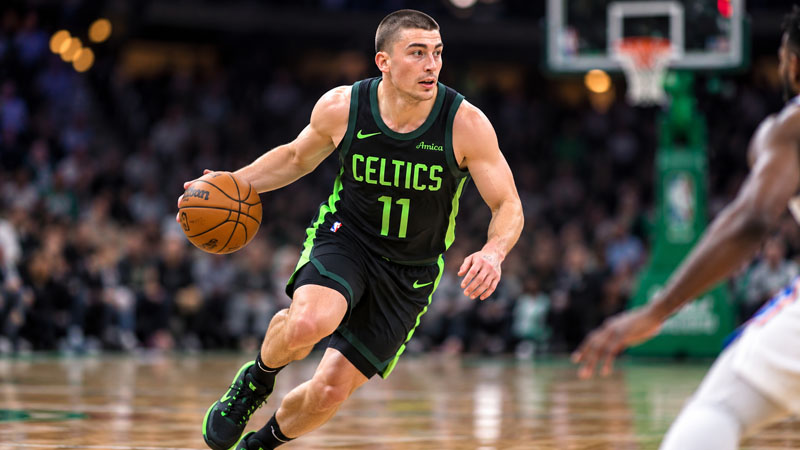
Payton Pritchard is an elite long-range shooter, a highly secure ball handler, and one of the NBA’s premier clutch weapons.
Known for his “limitless” range, he weaponizes deep-court spacing with a 39.5% career three-point average, frequently hitting shots from the logo.
Beyond shooting, his game is defined by masterclass ball security and technical craft, such as the signature “punch drag” stop. Despite his 6’1″ frame, he maintains high efficiency in the paint using physical “bumps” to displace defenders.
Ultimately, his success stems from a legendary work ethic and a pedigree of winning at every level of basketball.
The Mechanics of Limitless Deep-Range Shooting
Pritchard has evolved into a lethal perimeter threat whose presence on the floor fundamentally alters defensive spacing. His ability to hit shots from well beyond the standard three-point line creates a gravitational pull that opens lanes for his teammates.
The following breakdown illustrates the specific components of his elite shooting profile.
High-Volume Perimeter Sniping
At the professional level, Pritchard has translated his collegiate range into a weapon of mass displacement. He currently maintains a career average of 39.5% from beyond the arc.
This efficiency is not limited to standard catch-and-shoot opportunities; he is exceptionally dangerous as a spot-up threat, consistently ranking in the upper percentiles of NBA shooters.
One of his most fascinating statistical quirks is his “guarded accuracy,” where his efficiency often tracks higher when closely contested than when left wide open, showcasing an extreme level of mental focus.
Logo Range and Buzzer-Beating Mastery
The “limitless” label is not hyperbolic; Pritchard has famously weaponized half-court heaves, most notably during the 2024 NBA Finals where he sank a pair of stunning buzzer-beaters.
His trademark ability to hit game-winners from near the half-court logo first became a national storyline during his tenure at the University of Oregon, where he routinely sank desperate, game-winning bombs against conference rivals.
This range forces defenders to pick him up as soon as he crosses the timeline, disrupting traditional defensive shells.
Statistical Breakdown of NBA Clutch Scoring
The 2025–26 campaign served as a definitive breakout for Pritchard, moving him from a reliable spark plug to a high-volume contributor. His impact is most visible through advanced metrics that highlight his efficiency in high-pressure environments.
| Metric | 2025–26 Performance Data |
|---|---|
| Points Per Game | 17.0 |
| Assists Per Game | 5.2 |
| Games Played | 79 |
| Late-Clock/Buzzer Points | 203 |
| Isolation eFG% | 64.2% |
| Paint Efficiency (Non-Restricted) | 62.5% |
The “Clutch P” Efficiency Factor
Pritchard has earned a reputation as one of the league’s most feared late-shot-clock weapons. During the 2025–26 regular season, he logged over 200 points specifically in late-clock or isolation situations.
His 64.2% effective field goal percentage in isolation is particularly striking given his smaller frame; he consistently beats larger defenders by utilizing a low center of gravity and an aggressively quick dribble that keeps opponents off-balance.
Elite Playmaking and Ball Security
As a floor general, Pritchard prioritizes ball safety without sacrificing playmaking aggression. His tight handle allows him to navigate high-pressure traps while maintaining an elite assist-to-turnover ratio.
This reliability makes him a highly dependable option for running the offense during critical stretches, ensuring that the team maximizes every possession without committing unforced errors.
Technical Mastery: Footwork and Interior Craft
To survive and thrive as a 6’1″ guard in a league dominated by wingspan and height, Pritchard has developed a specialized technical toolkit. These moves are designed to create separation and neutralize the “size tax” often imposed on smaller players.
The Signature “Punch Drag” Stop
One of the most effective tools in Pritchard’s arsenal is the “punch drag” stop. During a downhill drive, he utilizes an outside-foot plant to halt his momentum instantly, creating immediate separation from trailing defenders.
This masterclass in footwork allow him to reset for a jumper or a floater before the defense can recover their positioning.
Mastering Interior Displacement
While many small guards struggle at the rim, Pritchard leads the league in efficiency from the non-restricted paint area. He achieves this by using low-leverage physical “bumps” against larger defenders.
By initiating contact first, he displaces the defender just enough to clear space for mid-range floaters and short jumpers. This scrappy interior craftsmanship allows him to maintain a high scoring floor even when his three-point shot isn’t the primary option.
Is Payton Pritchard Good at Defense?
A common inquiry regarding smaller guards is their defensive viability. Pritchard is often characterized as a neutral-to-slightly-above-average defender who compensates for his lack of length with tenacity and high-level tracking.
Elite Isolation On-Ball Tracking
Pritchard is exceptionally skilled at staying directly in front of his assignment. Data indicates he tracks in the upper percentiles of NBA guards for isolation defensive efficiency.
He treats defensive possessions like an endurance test, using a relentless motor to fight through screens and fatigue opposing ball-handlers by the fourth quarter.
His functional core strength and broad lower base further allow him to hold his ground against larger guards attempting to back him down in the post.
Navigating Physical Limitations
Despite his grit, Pritchard faces unfixable structural challenges. His 6’1″ frame and matching wingspan prevent him from significantly contesting the vertical release of taller perimeter creators, who can often score over him despite perfect positioning.
Additionally, elite offenses frequently attempt to force switch actions to match him against wings 6’7″ or taller. He also offers minimal rim protection or weak-side shot disruption, focusing instead on being a “nuisance” defender and a high-level rebounder for his size.
The Foundation of a Legendary Work Ethic
The technical proficiency seen today is the result of what many describe as an obsessive, legendary work ethic. Pritchard’s identity has been built around winning pedigrees at every level of the game.
High School: The “Bleeding Hands” Routine
Pritchard’s path to the NBA began with a rigorous self-imposed training regimen in West Linn, Oregon. To overcome his small frame, he initiated a daily 5:30 AM routine where he dribbled a heavy, coarse weighted basketball in his garage.
This practice was so intense that his hands frequently bled, requiring medical tape to continue. This obsession translated into results: he led his team to four consecutive Class 6A State Championships and was a three-time State Player of the Year.
University of Oregon: Historical Excellence
His collegiate career was equally historic. Pritchard became the first men’s player in Pac-12 history to record over 1,900 points, 600 assists, and 500 rebounds.
He graduated as Oregon’s all-time leader in wins and assists, capping his senior season as a consensus All-American and a Naismith College Player of the Year finalist.
This era solidified his reputation as a “winner” who could command an entire court regardless of the competition level.
Frequently Asked Questions About Payton Pritchard
What makes Payton Pritchard so effective despite his size?
His effectiveness stems from a combination of elite shooting range, which stretches the defense, and a very low center of gravity that aids his ball security and interior scoring. He uses his strength to displace taller defenders rather than trying to out-jump them.
How does his shooting impact team dynamics?
Pritchard’s “logo range” forces defenses to play higher up the floor, which creates more space in the paint for cutters and post players. His high efficiency in catch-and-shoot situations also makes him a perfect floor-spacer alongside high-usage stars.
What are the primary weaknesses in his defensive profile?
The primary weaknesses are purely physical. His lack of height and wingspan makes it difficult for him to contest shots from tall perimeter players and limits his ability to provide help-side rim protection.
Conclusion: The Ultimate Competitor
Payton Pritchard has successfully transitioned from a “microscopic” high school freshman into a premier NBA contributor through sheer force of will and technical refinement.
Whether it is his league-leading efficiency in the paint, his record-breaking collegiate stats, or his ability to sink demoralizing half-court heaves, he consistently finds ways to impact winning.
His career serves as a blueprint for how technical craft and a relentless motor can overcome traditional physical limitations. As he continues to refine his game, his role as a high-volume spark plug and clutch master remains a vital component of his team’s success.