Jalen Hurts left Alabama because he lost his starting quarterback position to Tua Tagovailoa, which threatened his professional football aspirations.
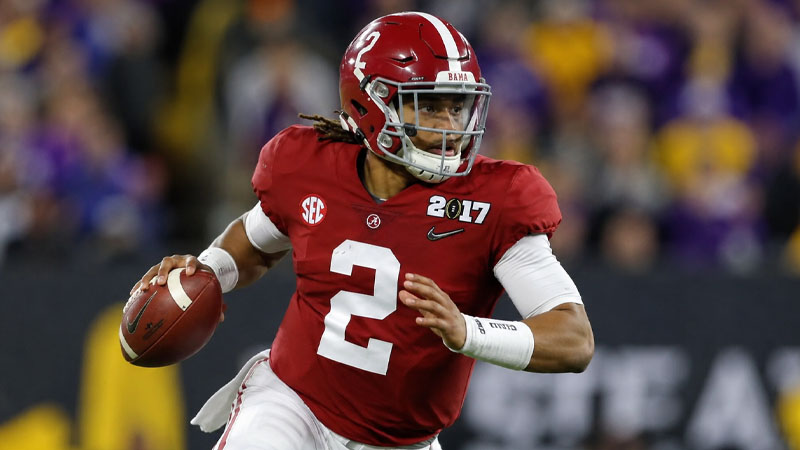
After compiling a legendary 26-2 record as a starter, Hurts was benched at halftime during the 2018 national championship game.
Rather than exiting immediately, he stayed as a backup, graduated early, and subsequently utilized the NCAA graduate transfer policy.
This strategic pivot allowed him to play immediately for Oklahoma, where he modernized his game under Lincoln Riley, answered critical pocket-passing questions, and secured a highly coveted draft position.
The Halftime Benching: Why Jalen Hurts Lost the Starting Role
Before analyzing his departure, one must understand the dramatic tactical shift that changed the trajectory of college football and initiated Jalen Hurts’ transition to a backup role.
The 2018 National Championship Catalyst
Hurts led the Crimson Tide to consecutive national championship appearances with an exceptional 26-2 record.
However, during the 2018 CFP National Championship Game against Georgia, Alabama trailed 13-0 at halftime. Head coach Nick Saban made the audacious decision to bench Hurts in favor of freshman Tua Tagovailoa.
This move ultimately redefined the program’s offensive identity and began the sequence leading to his transfer portal entry.
The Permanent Rise of Tua Tagovailoa
Tagovailoa threw a thrilling walk-off touchdown in overtime to secure the national championship. This championship performance cemented the freshman as the undisputed future starting quarterback of the Crimson Tide.
Consequently, Hurts was relegated to the bench for the 2018 season. This loss of the starting role served as the main prompt for his eventual transition out of Tuscaloosa.
The Backup Season: Managing Adversity with Unmatched Grace
Instead of choosing immediate relocation, Hurts chose a path of patience and team commitment that earned him permanent adoration from fans and set up his future academic transfer.
Forgoing the New NCAA Redshirt Option
A newly enacted NCAA rule allowed players to participate in up to four games and still preserve their eligibility. Hurts chose to sacrifice this protective option, fully dedicating himself as Tagovailoa’s backup.
This selflessness surprised analysts who expected him to protect his collegiate clock. His commitment showed unmatched character during a deeply trying career demotion.
Conquering the Mental Hurdle and Thoughts of Quitting
Dealing with a high-profile demotion on a national stage was not easy for the young quarterback. Hurts later admitted that the intense public criticism and personal doubt deeply affected his mental well-being.
During this challenging period of adversity, he acknowledged that he “almost quit football” entirely. However, his resilience kept him focused on daily preparation.
The 2018 SEC Championship Redemption Story
His unmatched patience yielded a legendary payoff during the 2018 SEC Championship Game against Georgia. When Tagovailoa suffered a severe ankle injury in the fourth quarter, Hurts stepped onto the field with Alabama trailing.
He executed a miraculous comeback, throwing a game-tying touchdown and rushing for a 15-yard game-winning score to seal a 35-28 victory.
Entering the Graduate Transfer Portal: The Academic Pathway to Play Immediately
Academic achievement played a pivotal role in Hurts’ ability to seamlessly transition programs. By prioritizing his studies, he unlocked the regulatory mechanism necessary for immediate collegiate competition.
Graduating Early from the University of Alabama
Because Hurts remained enrolled at Alabama during his backup year, he successfully finished his bachelor’s degree in communication and information sciences in December 2018. This academic achievement was crucial.
It provided him with the graduate status needed to bypass traditional athletic restrictions and transition seamlessly to a new program.
Leveraging the Graduate Transfer Policy in January 2019
In January 2019, Hurts officially entered the transfer portal as a graduate student. Under NCAA rules, this specific designation meant he could transfer to another institution and play immediately.
He did not have to sit out the mandatory one-year residency period required for standard undergraduate transfers, preserving his final year of eligibility.
Why Did Jalen Hurts Leave Alabama for Oklahoma?
Deciding where to play his final year of college football required meticulous strategic evaluation. Oklahoma emerged as the premier destination for several distinct and compelling competitive advantages.
The Lincoln Riley Quarterback Whisperer Influence
Oklahoma under head coach Lincoln Riley was the ultimate destination for transfer quarterbacks seeking professional development.
Prior to Hurts’ arrival, Riley had successfully coached consecutive transfers into Heisman Trophy winners and first-overall draft selections.
This track record included Baker Mayfield from Texas Tech and Kyler Murray from Texas A&M. Hurts sought to replicate this high-level professional preparation.
Shattering the One-Dimensional Running Narrative
During his tenure at Alabama, Hurts faced heavy criticism for being a run-first quarterback who struggled with intermediate pocket passing.
Professional evaluators doubted his ability to read complex coverages and throw efficiently from the pocket.
Oklahoma’s explosive, vertical offensive system offered a high-profile national stage to silence critics and display refined pocket passing capabilities.
Sustaining High-Level National Championship Contention
Hurts refused to compromise his competitive standards by joining a rebuilding program. Oklahoma was a perennial powerhouse coming off back-to-back College Football Playoff appearances.
Joining the Sooners ensured Hurts would remain under the intense spotlight of championship-level football, keeping his performance highly visible to national talent evaluators and professional decision-makers.
The Secret Strategist: How Nick Saban Provided Transfer Guidance
In a surprising turn of events, the legendary Alabama head coach did not block Hurts’ exit. Instead, Saban actively participated in guiding his former starter toward the optimal competitive environment.
Analyzing Roster Matchups and Offensive Schemes
When evaluating potential transfer destinations, Hurts looked closely at several major football programs, including Maryland and Miami. Saban personally assisted Hurts by reviewing the rosters, coaching staffs, and offensive schemes of his suitors.
Rather than harboring resentment over the quarterback’s departure, Saban prioritized Hurts’ long-term development and professional viability.
The Recommendation of Oklahoma’s Superior Wide Receivers
Saban explicitly recommended Oklahoma because of their exceptional offensive roster. He pointed out that the Sooners possessed superior wide receivers who would consistently win matchups and elevate Hurts’ passing statistics.
This honest assessment convinced Hurts that Norman provided the perfect environment to answer scout questions and repair his passing reputation.
The Strategic Outcome: Maximizing Athletic Value and Draft Position
The decision to move from Tuscaloosa to Norman resulted in an unprecedented individual and team success story.
By aligning himself with an offensive mastermind, Jalen Hurts put together one of the most statistically dominant quarterback seasons in modern collegiate history, proving his mettle to professional evaluators.
| Performance Metrics & Draft Outcome | Statistical Achievement & Historical Impact |
|---|---|
| Passing Yards | Achieved a staggering career-high 3,851 passing yards in a single season. |
| Passing Touchdowns | Threw for 32 touchdowns, showcasing dramatic pocket development. |
| Rushing Touchdowns | Added 20 rushing touchdowns to demonstrate elite dual-threat capabilities. |
| Heisman Trophy Standing | Finished as the highly respected 2019 Heisman Trophy runner-up. |
| NFL Draft Selection | Selected 53rd overall in the second round of the 2020 NFL Draft. |
| NFL Franchise | Selected by the Philadelphia Eagles, cementing his professional dream. |
This structured transition maximized his collegiate exposure and completely altered his draft trajectory, proving that strategic career pivots can yield massive professional dividends.
Frequently Asked Questions About Jalen Hurts’ Transfer
Did Jalen Hurts graduate from Alabama?
Yes, Jalen Hurts graduated from the University of Alabama in December 2018. He earned his bachelor’s degree in communication and information sciences.
Completing his degree early was a vital strategic step because it qualified him for the NCAA graduate transfer policy. This enabled him to play immediately at Oklahoma without sitting out a season.
What other colleges did Jalen Hurts consider before Oklahoma?
During his evaluation in the transfer portal, Hurts considered several prominent programs, most notably Maryland and Miami. He evaluated coaching systems and rosters before consulting with Nick Saban.
Ultimately, the superior wide receiver talent and explosive downfield passing concepts at Oklahoma made Norman the superior choice for his final year of eligibility.
How did Nick Saban help Jalen Hurts transfer?
Nick Saban helped Hurts by providing objective, scheme-based advice. Saban analyzed the rosters and offensive systems of Hurts’ top transfer candidates.
Recognizing that Hurts needed to improve his passing profile for professional scouts, Saban recommended Oklahoma due to their exceptional wide receiver group, which would elevate his passing productivity.
Conclusion: A Blueprint for Modern Collegiate Athletics
Jalen Hurts’ departure from Alabama is a masterclass in professional career management, resilience, and personal maturity.
Instead of expressing bitterness after his benching, he stayed to support his team, completed his degree, and carefully planned his next career move.
His subsequent success at Oklahoma validated his approach, showcasing how patience and strategic alignment can overcome sudden adversity.
Ultimately, Hurts did not just survive a high-profile demotion; he used it to build a stronger foundation for a successful career in the professional ranks. His journey remains an enduring blueprint for athletes navigating the modern landscape of collegiate sports.