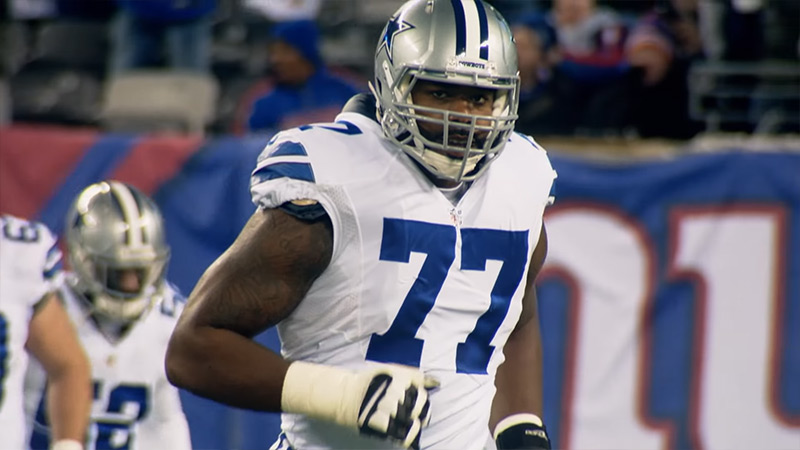
The 40 time is a measure of how fast you can run the 40-yard dash. Tyron Smith had an impressive time, clocking in at 4.53 seconds. Other prospective NFL draft picks didn’t fare as well, with some taking much longer than Smith to finish the race.
This comparison gives us an idea of how athletic and fast each player is relative to others in their class or position groupings. It also provides us with an idea of what kind of potential each prospect has for the NFL level and beyond.
What Was Tyron Smith 40 Time?
What is the 40 Time? How Did Tyron Smith Perform in the 40 Time? Comparison of Other Prospective NFL Draft Picks.
How big are Tyron Smith arms?
Tyron Smith’s arms are one of the most impressive things about him. They’re almost as long as his legs. His 36.38-inch arms give him an advantage on the field that few other players can match.
He uses his arms to dominate defenders and create openings for himself in the offensive backfield. His massive arm length is a major reason why he has been so successful over the years, and it will continue to serve him well in the future too.
How many times has Tyron Smith been to the Pro Bowl?
Tyron Smith has been named to his eighth Pro Bowl team even though he missed six games last season. This is a testament to Smith’s dominant play over the course of his NFL career.
He was originally drafted by the San Francisco 49ers in 2007 and has since played for the Dallas Cowboys, St Louis Rams and now Kansas City Chiefs. Smith is one of only two players with at least 10 sacks, five interceptions and 50 tackles in each of their first seven seasons in the league (the other player is JPP).
His impact on both sides of the ball makes him an indispensable part of any football team, no matter how many games he misses.
Is Tyron Smith a Hall of Famer?
No, Tyron Smith is not a Hall of Famer. He was not chosen in the 2018 Hall of Fame election. He has been an NFL defensive end for 15 years and has had some good moments but does not have enough accolades to be considered for the hall yet.
When he retires, Smith could be eligible for the Pro Football Hall of Fame as an enforcer or special teamer if he meets certain qualifications set by the committee that selects players into this category Smith will likely never get enshrined in Canton because there are many better candidates ahead of him on the list who have more accomplishments than him at this point 5 .However, his career is still noteworthy and he should be remembered fondly by fans.
What is Tyron Smith salary?
LT Tyron Smith signed a 5-year, $103 million contract with the Dallas Cowboys in 2011. In 2023, his salary will be $13.4 million and he’ll have unamortized bonus money of $8 million left on the cap that would be left on the team’s books after it is paid out.$4 million in 2024 and another$4 million in 2025 In 2020 and 2021, his base salaries are both set at just over $14million each year which means that if released or traded before those seasons end, he’d still count against their cap for two more years at around $16m each Because of how much guaranteed money is already baked into his deal (unlike players such as Ezekiel Elliott who could see their guarantees reduced by playing through injury), there is little incentive for him to leave Dallas prior to expiration despite being unhappy with recent coaching changes made by head coach Jason Garrett He has consistently been one of the top defensive lineman in the NFL throughout his career so it’s likely that he will continue producing high level play for many years to come.
How fast is Ezekiel Elliott?
Ezekiel Elliott is really fast. At the Cowboys’ offseason workout, he was clocked at a speed of 22 MPH. Ezekiel Elliott was caught speeding according to NFL officials who spoke with The Dallas Morning News .
If you were driving 22 MPH and got pulled over, you’re probably going to get fined for it. Nobody wants to be behind the wheel when someone’s driving recklessly, so it’s important to be safe on the road no matter how fast you’re moving.
Keep your eyes open while traveling – even if you’re not breaking any laws – and don’t risk getting a ticket for being too zealous about reaching your destination quickly.
How fast is CD lamb?
CD Lamb is a fast-growing lamb that runs an official 4.5 second 40-yard dash. You can cook this meat quickly by using high heat and direct cooking methods like searing or grilling.
Don’t forget about the flavor when you cook with CD Lamb – it has a rich, gamy taste that’s perfect for dishes like lamb chops or roasts. If you’re looking for something special to serve at your next dinner party, try out this delicious lamb option.
Who is the longest NFL player?
Morten Anderson was the longest-serving player in NFL history, playing for 26 years between 1984 and 2003. He was a kicker with the Minnesota Vikings and Atlanta Falcons, amassing 7 Pro Bowl appearances during his career.
Anderson is also considered one of the best passers in NFL history, completing 2,097 passes for 19,355 yards and 156 touchdowns over his career. At 6 feet 5 inches tall and weighing 245 pounds, he was an imposing figure on the field – even more so when he kicked a football.
The all-time leader in games played (1,244), Morten Anderson is still regarded as one of the greatest players to have ever taken part in the NFL.
Frequently Asked Questions
Does Tyron Smith wear a knee brace on his arm?
Tyron Smith wears a knee brace on his arm.
Who will replace Tyron Smith?
Cowboys agree to terms with OT Jason Peters, source said. The #Cowboys have agreed to terms with future Hall of Fame OT Jason Peters. Another year for the 40-year-old who figures to help Dallas at a position of need.
How good is Tyron Smith?
“In 11 games played, Tyron Smith had the highest Pro Football Focus rating of his career at 91.9 and his 78.3% run block win rate was No. 7 among tackles.”
How many games has Tyron Smith missed this season?
Smith has missed 2 games this season due to back pain.
Is Zack Martin a HOF?
Zack Martin is a Hall of Fame player.
Can the Cowboys cut Tyron Smith?
According to Over The Cap, the Cowboys have a comfortable “out” with Smith in the 2023 offseason. If the Cowboys designate Smith as a post-June 1 cut, they can get out of the final two years of his 11-year, $97.6 million contract and only pay $4,005,000 while saving $13.6 million against the salary cap.
How long is Tyron Smith out for?
Cowboys’ Tyron Smith: Surgery date set
Who is the highest paid left tackle?
Who is the highest-paid left tackle in NFL history?
How old is Tyron Smith?
Tyron Smith is 27 years old.
What is Ezekiel Elliott’s contract?
There is no definitive answer as to what Ezekiel Elliott’s contract with the Cowboys actually says, but some say it could be time for him to end his career in Dallas. The extension he signed in 2019 certainly suggests that this might be the case – and if it is, then his final season would likely come in 2022.
To Recap
Tyron Smith was 40 time for rape.