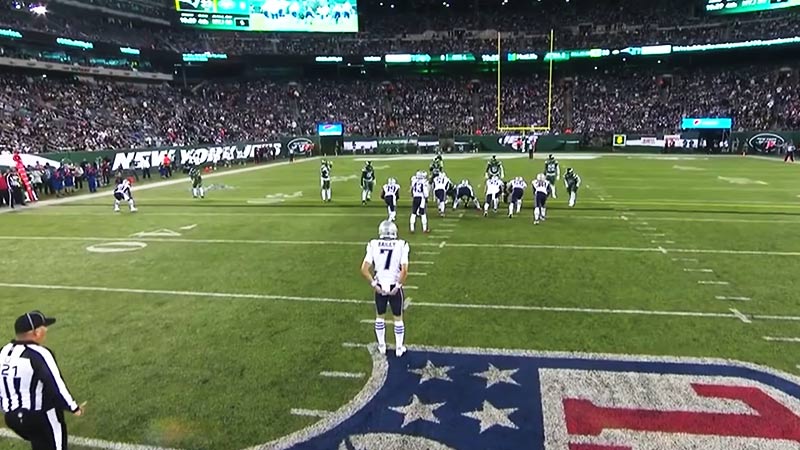
In the high-stakes environment of professional gridiron football, every yard is a currency, and every second is a finite resource.
Typically, when an officiating crew throws a yellow flag and announces a five-yard penalty against the opposition, the decision to accept is an instinctive reflex.
However, there exists a specialized subset of circumstances where the most sophisticated tactical move is to simply say “No, thank you.”
The Delay of Game penalty is the most common pre-snap infraction in the sport.
While it usually results from a simple failure of the offense to snap the ball before the play clock expires, the decision to decline this penalty reveals a deep layer of psychological and mathematical warfare between head coaches.
Understanding when and why a team declines these yards requires an analysis of field geometry, clock management, and the specific mechanics of “dead-ball” versus “live-ball” fouls.
The Fundamental Mechanics of the Pre-Snap Foul
To comprehend the decline, one must first understand the nature of the foul itself. A Delay of Game is categorized as a pre-snap, dead-ball foul.
Unlike holding or pass interference, which occur during the heat of a play, a Delay of Game happens when the “heart” of the play has not yet started beating.
Because the play is blown dead immediately when the clock hits zero, no actual football play occurs. There are no yards gained or lost on the ground, no passes completed, and no turnovers possible.
If the defense accepts the penalty, the ball moves five yards forward, and the down remains the same. If the defense declines the penalty, the ball simply stays exactly where it was before the clock expired.
For the average fan, declining five “free” yards seems counterintuitive. However, in professional football, yardage is not always a linear benefit.
There are moments where moving the ball forward actually complicates the objective of the team in possession, and the defense must use its right to decline the penalty to maintain its own strategic advantage.
The Punting Chess Match: Manipulating the “Dead Zone”
The most frequent scenario for a tactical decline occurs during punting situations, particularly when the line of scrimmage is near the 40-yard line—a territory often referred to as the “dead zone.”
The Punter’s Objective
When a team is too far away for a high-probability field goal but too close to the end zone for a standard “booming” punt, the punter faces a dilemma.
If they kick the ball with full power, it will likely land in the end zone for a touchback, resulting in the opposing team starting at the 20-yard line (or 25-yard line depending on the league’s specific touchback rules). The net gain of such a punt is minimal.
To avoid this, the punting team may intentionally take a Delay of Game penalty. By moving back five yards, the punter gains:
- Increased Operating Room: Five extra yards of field allows for a more natural kicking motion without the fear of the ball traveling too deep into the end zone.
- Enhanced Hang Time: The extra distance allows the punter to kick the ball higher. Higher hang time gives the coverage team more time to sprint downfield and surround the returner or “down” the ball near the goal line.
- Improved Angles: For directional punters who prefer to kick toward the sidelines (coffin corner kicks), moving back slightly can widen the effective target area.
The Defensive Response
A savvy defensive coordinator recognizes this intent. If the defense accepts the penalty, they are effectively helping the punter achieve a better “pinning” position.
By declining the Delay of Game, the defense forces the punter to stay at the original, more awkward spot.
This increases the likelihood that the punt will either be “shanked” due to the punter trying to take power off the ball or result in a touchback that brings the ball out to the 20-yard line.
Field Goal Geometry and Hash Mark Strategy
While less common than punting scenarios, field goal attempts present another opportunity for the tactical decline. This occurs most often on short, high-angle kicks.
In football, the goalposts are 18 feet, 6 inches wide. If the ball is spotted on the extreme left or right “hash mark” very close to the end zone, the angle to the goalposts becomes surprisingly sharp.
A kicker may actually prefer to be 25 yards away from the posts rather than 20 yards away, as the extra distance “opens up” the angle and makes the target appear wider from their perspective.
If an offense intentionally draws a Delay of Game to move the ball back and improve the kicker’s angle, the defending team can decline the yardage.
By doing so, they keep the kicker at the more difficult, acute angle, maintaining the highest possible statistical chance of a missed field goal.
Clock Management and the “Vrabel/Belichick” Loophole
Beyond physical field position, the Delay of Game is a tool for temporal manipulation. Professional football games are governed as much by the clock as they are by the scoreboard.
In a famous 2019 playoff game between the Tennessee Titans and the New England Patriots, Titans coach Mike Vrabel utilized a loophole involving intentional penalties.
With the clock running and the Titans leading late in the game, they committed a Delay of Game.
The Patriots declined, but because of the rules at the time, the clock continued to run after the penalty was processed. The Titans then committed a false start. Again, the penalty was declined, and the clock kept ticking.
This allowed the Titans to burn nearly two minutes of game time without ever running a play. This “loophole” was so effective—and so frustrating to the opposing coaches—that it eventually led to rule adjustments.
However, the core principle remains: a team may take a Delay of Game to bleed the clock, and a defense might decline the yardage if they believe the “state” of the game (the down and the distance) is more valuable to them than the five yards.
Institutional Safeguards: Preventing the “Infinite Loop”
One might wonder: if a team can take a Delay of Game and the defense can decline it, what stops a team from doing this forever to run out the entire game clock?
The football rulebooks (such as NFL Rule 14 and NCAA Rule 10) have built-in “circuit breakers” to prevent this type of gamesmanship from breaking the integrity of the contest.
- The Unsportsmanlike Conduct Pivot: If an officiating crew determines that a team is repeatedly and intentionally committing Delay of Game penalties to manipulate the clock or frustrate the flow of the game, they can escalate the foul. Instead of a five-yard Delay of Game, the referee can charge the team with Unsportsmanlike Conduct, which carries a 15-yard penalty and can lead to the ejection of personnel or league-mandated fines.
- The “Palpably Unfair Act” Rule: This is the most powerful tool in an official’s arsenal. It allows referees to penalize any “sketchy” or intentional rule-breaking that isn’t specifically covered in the text of the rulebook in whatever way they deem “fair”. This could include awarding the other team a touchdown, moving the ball to a specific spot, or resetting the clock to a prior state to negate the advantage gained by the offending team.
Commemorative and Symbolic Declines
Not all tactical declines are about winning the game; some are about honoring the spirit of the sport. A notable example occurred in 2021 when the Denver Broncos honored the late Demaryius Thomas.
On the first play of the game, the Broncos took the field with only 10 players, leaving Thomas’s position vacant.
They intentionally let the play clock expire, taking a Delay of Game penalty as a tribute. Their opponent, the Detroit Lions, gracefully declined the penalty, ensuring the tribute was memorialized without impacting the yardage of the game.
Conclusion: The Value of the “Empty” Play
The Delay of Game penalty is often viewed as a mistake—a lapse in communication or a failure of the quarterback to get the play off in time.
But as we have explored, it is frequently a calculated maneuver designed to bait the defense into giving up a tactical advantage.
By exercising the right to decline, a defense asserts control over the geometry of the field and the flow of the clock. It is a reminder that in football, as in business and strategy, the most obvious gain is not always the most beneficial one.
Success belongs to those who understand not just the rules, but the strategic ripple effects of every decision made on the gridiron.