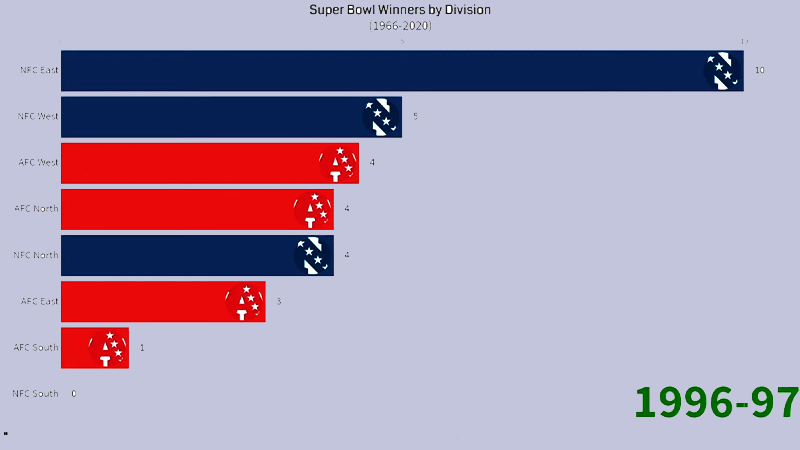
The NFC East has the most Super Bowl titles, currently holding a total of 6 championships. This division is also historically successful – during the Super Bowl era, they have had more success than any other division.
Make sure to get your tickets for next year’s game and cheer on your favorite team.
Which Nfl Division Has Every Team Won A Super Bowl?
NFC East has the most Super Bowl titles. NFC East is currently the most successful division in NFL during Super Bowl era.
Which NFL division has the least Super Bowl wins?
The AFC South has the least number of Super Bowl wins with two. The Colts’ first win in 1971 was a significant moment for this division, and it’s continued to produce some talented teams over the years.
Other divisions have had more success at winning the big game, but the AFC South is still worthy of attention thanks to its history and current talent pool. Despite having only two titles, there are plenty of fans in this region who would love to see their team take home another championship one day soon.
Having less experience playing in Super Bowls doesn’t mean that this division can’t compete; they’ve just had fewer chances so far.
Which division in football has the most Super Bowl wins?
The NFC East has the most Super Bowl wins by division with 13. It’s also the only division where every team has at least 1 Lombardi Trophy. This season, it looks like it might be a battle between the Dallas Cowboys and Philadelphia Eagles for supremacy in the NFL.
Who will come out on top? Only time will tell. But one thing is for sure – if you’re a fan of either team, you’ll want to follow their progress closely. If you’re not interested in professional football but still want to learn more about some of America’s most iconic teams, check out our guide to American Football History.
Who has more championships NFC or AFC?
The NFC/NFL has led the AFC/AFL in championships with 29 to 27. However, the AFC/AFL is still a very competitive league and will likely continue to grow in popularity over time.
Both leagues have had some great players and teams throughout their histories, which makes it hard to choose just one as the best. It’s interesting to see how each league develops its own style of play, which can be appealing for different fans nationwide.
Be sure to follow both leagues closely so you don’t miss any major playoff or championship events.
Who has lost the most Super Bowls?
The Patriots and the Broncos are tied for the most Super Bowl losses (five). The four teams to have never appeared in a Super Bowl are the Browns, Lions, Texans, and Jaguars.
All of these teams have history before the Super Bowl era; however, only one team has won an NFL Championship prior to appearing in a Super Bowl game. It’s always exciting to see who will win their respective divisional championships leading up to the big game and see who makes it far into overtime or even wins it all.
Even if your favorite team does not make it far in their appearance at a Super Bowl tournament or championship round, don’t forget about them – they still have plenty of football left to play.
Which conference has more Super Bowls?
The NFC/NFL has won more Super Bowls than the AFC/AFL, with 27 victories to their 26. Super Bowl, including teams that have relocated to another city. Winning a Super Bowl is an achievement for any team, no matter which league they play in.
It’s important to remember that every team has had a chance to win one of these championships – it doesn’t always happen by chance. There are many memorable games and moments from past Super Bowls that we’ll never forget…
How many times have the Bengals won the AFC North?
The Bengals have won the AFC North seven times since realignment, but they’ve never been able to take home the division title. Pittsburgh has won the division title seven times since realignment, and Baltimore and Cincinnati each have four titles.
All three teams are looking for their first league championship in over two decades this season, so it will be an exciting race to the finish line. In terms of head-to-head matchups, Cincinnati has had some impressive wins against Pittsburgh (twice), Baltimore (once) and Cleveland (once).
Be sure to tune into all three games this week as a chance for one team to claim victory in what is shaping up to be a very close race.
Is there any NFL team that has never been to the playoffs?
No, there is no NFL team that has never made it to the playoffs ever since the AFL and the NFL merged together into the new and current NFL. While a few teams have never won or even reached the Super Bowl, this doesn’t mean they are unsuccessful; in fact, many of these teams continue to be successful each year.
Some of these teams include the Jacksonville Jaguars, Detroit Lions and Carolina Panthers – all of whom have qualified for at least one Super Bowl but have yet to win it. However, not every team has been unsuccessful in making it to or winning a championship – some such as Indianapolis Colts and Philadelphia Eagles have both accomplished this several times over during their histories within professional football leagues.
The most important thing for any team vying for a title is consistency – if you can make it past your weaker seasons and keep playing hard until game day then anything is possible.
Frequently Asked Questions
Who has never been to the Super Bowl?
No NFL team has ever made it to the Super Bowl.
Is AFC Stronger Than NFC?
NFC is definitely stronger than AFC. The NFC has 2 Super Bowl champions and 3 of the last 5 winners. AFC does not have any of these titles.
Has an 8 8 team won the Super Bowl?
Yes, the 2008 Cardinals have won the Super Bowl.
Has a 7 9 team won the Super Bowl?
Yes, the New York Giants are the only team in NFL history to win a Super Bowl. They did it following a 9-7 regular season with QB Eli Manning having 4,933 passing yards and an excellent scoring defense.
Which QB has started the most Super Bowls?
To find out who has started the most Super Bowls, look at this list.
Which division is the best in the NFL?
NFC East teams are 11-3 in the 14 interdivisional games, showcasing how strong the division actually is in 2022. Thanks to the Eagles, Cowboys, and Giants — the NFC East is back to being the best division in football.
Who won the AFC North the most?
Pittsburgh Steelers
When did Bengals last win the division?
The Bengals last won the AFC championship in 1981, 1988, and 2021.
When was the last time Bengals won the AFC North?
The last time the Bengals won the AFC North was in 2015.
Who has the most 8 8 seasons in NFL history?
Who has the most 8 8 seasons in NFL history?
What NFL team has the longest drought?
N/A
Has an NFL team ever scored 100 points?
No NFL team has ever scored 100 points.
What’s the lowest score in Super Bowl history?
The Super Bowl is the annual championship game of the National Football League (NFL). The game was first played in 1967, and has been held in Detroit, Los Angeles, New Orleans, St. Louis, Phoenix, Minneapolis–St. Paul, Baltimore and Miami since then.
To Recap
The NFL is the most successful professional sports league in the world, with 32 teams competing for a championship. Of those teams, only 6 have ever won a Super Bowl – Patriots (5), Cowboys (1), Steelers (3), Rams (1), Eagles (1) and Giants (2).