In the modern landscape of high-performance collegiate athletics, the journey to elite-level success is rarely a straight line.
Program leaders, athletic directors, and aspiring athletes frequently debate the optimal route to quarterback development: Is it immediate on-field exposure, or is it a structured, multi-phase progression?
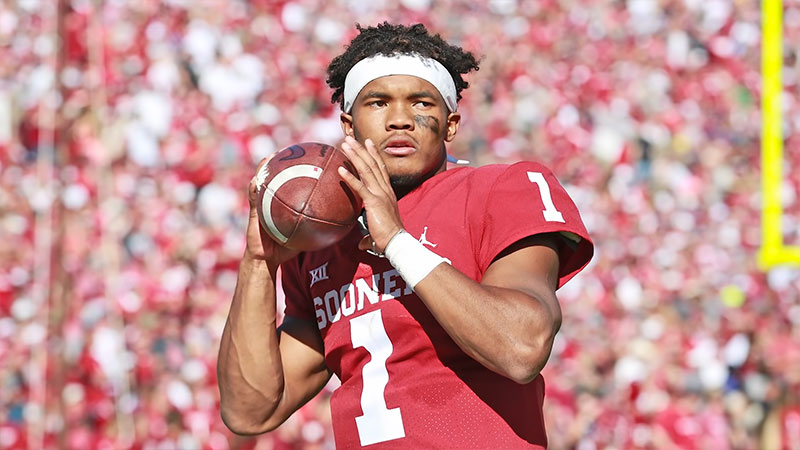
This analysis examines the collegiate career of Heisman Trophy winner Kyler Murray as a premier case study in strategic patience, institutional transition, and developmental incubation.
By evaluating his progression across two elite football programs—Texas A&M University and the University of Oklahoma—we outline a professional framework for career management and athletic development.
What Colleges Did Kyler Murray Attend?
To understand the trajectory of Kyler Murray’s collegiate journey, one must first trace the specific institutional environments that shaped his development. Murray attended two major collegiate institutions during his career:
- Texas A&M University (2015)
- The University of Oklahoma (2016–2018)
This transition from the Southeastern Conference (SEC) to the Big 12 Conference represents more than a simple change of scenery; it was a structural pivot that redefined his career and ultimately led to his recognition as the nation’s outstanding college football player.
                                 [ COLLEGE TIMELINE ]

       2015                     2016                     2017                     2018
  Texas A&M Uni.           Univ. of Oklahoma        Univ. of Oklahoma        Univ. of Oklahoma
  (Freshman Year)          (Transfer Transition)       (Backup Phase)         (Starting QB Apex)
         │                        │                        │                        │
         ▼                        ▼                        ▼                        ▼
Played in 8 games     Sat out due to rules   Backed up Mayfield    Won Heisman Trophy
The Freshman Launchpad at Texas A&M (2015)
Murray began his collegiate career in 2015 as a highly regarded true freshman at Texas A&M University. Entering a high-pressure environment in the SEC, he was immediately integrated into the active rotation, playing in eight games during his debut season.
The Strategic Value of Early Exposure: In elite athletic recruitment, there is immense pressure to play young talent immediately. Murray’s freshman season at Texas A&M highlights the advantages and challenges of this approach:
- Accelerated Acclimatization: Playing in eight games provided immediate exposure to the speed, complexity, and physical demands of elite college football.
- Real-Time Diagnostics: Early game action allows coaching staffs and athletes to identify specific areas of developmental need under actual competitive conditions, rather than relying solely on practice environments.
- Psychological Adaptation: Navigating the pressures of major collegiate stadiums as a true freshman builds a baseline of mental resilience that cannot be simulated.
However, a rapid entry into major competition can also expose an athlete to premature scrutiny and limit the time available to master fundamental concepts in a low-risk environment.
For Murray, this initial phase served as a crucial launchpad, establishing his on-field viability at the highest level of collegiate competition before his subsequent transition.
The Transition and the Value of the Sitting-Out Year (2016)
Following his freshman season, Murray made the decision to transition to the University of Oklahoma.
Under the collegiate athletic regulations of that era, transferring between major programs carried a significant structural hurdle: the requirement to sit out an entire competitive season. Consequently, Murray did not play in any games during the 2016 campaign.
Reconceptualizing the “Lost” Season: In professional career planning, a period of forced inactivity is often viewed negatively. However, in a structured developmental model, this transition year can be leveraged as a powerful asset:
- Systemic Mastery: Sitting out a season allows an athlete to learn a completely new offensive philosophy, playbook, and coaching terminology without the immediate pressure of preparing for weekly opponents.
- Physical Conditioning: Without the weekly physical toll of games, athletes can dedicate maximum energy to strength and conditioning, building the physical durability required for the starting role.
- Cultural Integration: Entering a new program requires building trust with teammates and adapting to a different locker room culture. A non-playing year provides the space to establish leadership capital quietly and authentically.
Murray’s 2016 season at Oklahoma demonstrates that a temporary pause in active competition is not wasted time; rather, it can be a period of strategic accumulation, setting the stage for long-term alignment and future high-performance output.
The Incubation and Elite Peer Mentorship (2017)
Upon regaining eligibility for the 2017 season, Murray did not immediately step into the starting lineup. Instead, he assumed the backup quarterback role, playing behind the established starter and future Heisman winner, Baker Mayfield.
The Strategic Utility of the Backup Role: In the modern era of athletics, players often seek immediate transfers if they are not named the starter. The narrative of Murray’s 2017 season offers an alternative, highly successful blueprint:
- Observational Learning: Backing up an elite peer like Baker Mayfield provided Murray with a daily masterclass in game preparation, leadership style, and in-game adjustments under pressure.
- Low-Stress Execution: When called upon, backup players can execute the offense in controlled situations, reinforcing their confidence and maintaining competitive sharpness without bearing the full weight of the team’s outcomes.
- Patience as a Competitive Advantage: Remaining with a program as a backup, rather than seeking a secondary transfer, demonstrates commitment and allows the athlete to inherit a fully optimized offensive system once the starter departs.
This incubation phase ensured that when the starting position eventually opened, Murray was not merely talented—he was fully prepared, culturally aligned, and thoroughly integrated into the system.
The Apex of Readiness and Heisman Triumph (2018)
The culmination of this multi-phase developmental journey arrived in 2018. Having transitioned programs, sat out a season, and bided his time as an elite backup, Murray was named the starting quarterback for the University of Oklahoma.
The result was one of the most remarkable individual campaigns in the history of college football, ending with Murray winning the prestigious Heisman Trophy.
Analyzing the Compounding Returns of Patience: The Heisman Trophy season was not an overnight miracle; it was the direct product of a compounded developmental process:
- The 2015 Foundation: The eight games of experience at Texas A&M provided the raw, competitive baseline.
- The 2016 Foundation: The year sitting out at Oklahoma provided the physical growth and playbook mastery.
- The 2017 Foundation: The year backing up Baker Mayfield provided elite peer mentorship and situational awareness.
When Murray finally took the field as the starter in 2018, he operated with a level of maturity, poise, and systemic efficiency that is rarely seen in first-year starters.
This Heisman-winning performance serves as the ultimate validation of a structured, patient approach to athletic career progression.
The Strategic Framework for Athletic Career Pathing
For athletic directors, coaches, and corporate leaders analyzing talent development, Kyler Murray’s collegiate career offers three critical takeaways:
- Reject the Cult of Immediacy: True readiness takes time. Forcing elite talent into starting roles prematurely can stunt long-term growth, whereas structured progression yields superior peak performance.
- Leverage Structural Obstacles: Regulatory constraints, such as mandatory sitting-out periods, can be converted into developmental advantages when paired with a disciplined, growth-oriented mindset.
- Prioritize Systemic Fit over Instant Status: Transitioning to a program with a highly compatible offensive system and strong leadership—even if it requires waiting behind an established star—is infinitely more valuable than starting immediately in a suboptimal environment.
Conclusion: A Legacy of Process Over Hype
The collegiate journey of Kyler Murray is a powerful reminder that elite success is built on a foundation of process, preparation, and patience.
From an eager freshman playing eight games in College Station to a Heisman-winning quarterback commanding the field in Norman, his career stands as a monument to the power of structured development.
By understanding and applying these developmental phases, modern sports organizations and aspiring athletes can build their own sustainable pathways to the peak of performance.