For decades, the evaluation of professional football talent relied on static, linear metrics to project how an athlete’s physical profile would translate to the field.
The traditional benchmark of athletic prowess has long been the 40-yard dash, performed in specialized track gear under highly controlled conditions.
This environment, often referred to by analysts as the “underwear olympics,” strip-mines an athlete’s physical profile to its most sterile components.
However, modern football is not played in track spikes on a synthetic surface. The introduction of micro-sensor global positioning technology embedded in player shoulder pads has initiated a massive paradigm shift.
Today, sports analytics professionals evaluate play speed through real-time velocity, lateral acceleration, and throwing mechanics under extreme physical pressure.
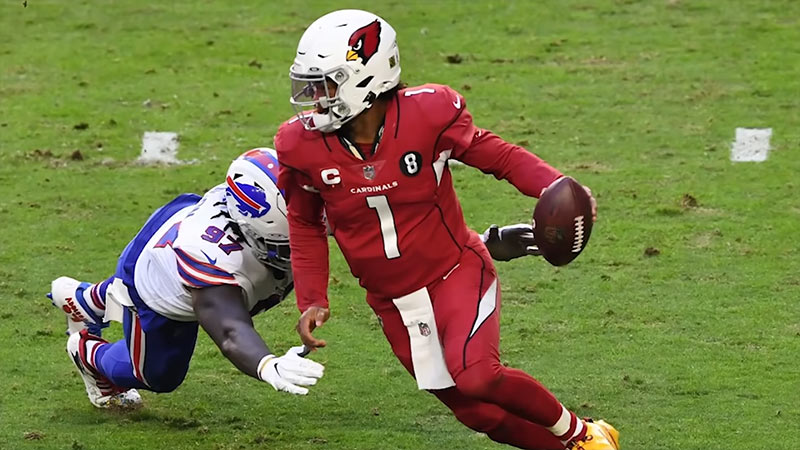
At the center of this technological revolution is Arizona Cardinals quarterback Kyler Murray.
Rather than relying on pre-draft times or projection models, the real-time tracking data collected over recent seasons paints a picture of an athlete whose functional velocity is rewriting the historical record books.
This analysis examines the metrics behind Murray’s elite speed, explores how his in-motion passing capabilities create historic outliers, and dissects the tactical impact of containing a quarterback who plays with track-level speed.
1. Peak Velocity Metrics: The 21.27 MPH Threshold
To comprehend Murray’s acceleration, one must examine his peak recorded velocities under actual competitive conditions.
In October 2024, during a critical matchup against the San Francisco 49ers, Murray escaped the pocket on a 50-yard touchdown run. During this run, modern tracking equipment recorded him reaching a peak speed of 21.27 miles per hour.
This figure is not merely impressive in isolation; it represents a historic high-water mark. According to historical tracking data spanning eight consecutive seasons, this 21.27 mph mark stands as the fastest top speed recorded by any NFL quarterback acting as a ball carrier.
While peak speed captures the imagination of fans, sustained efficiency is what frustrates defensive coordinators. Murray does not merely flash speed during isolated plays; his tracking records demonstrate a consistent ability to operate at elite thresholds:
- Routine Scrambles: Murray regularly registers velocities between 19 and 21 miles per hour when executing vertical runs and escaping edge pressure.
- Instantaneous Burst: In his professional debut, Murray logged a top speed of 19.68 miles per hour against the Detroit Lions, proving his baseline velocity was immediately functional at the professional level. For context, on that same weekend, Lamar Jackson hit a peak of 20.11 miles per hour against the Miami Dolphins.
Historical Speed Metrics Comparison
The following table contextualizes Murray’s verified top-end velocities alongside notable quarterback baselines and comparative performance milestones:
| Athlete / Performance Milestone | Event / Context | Tracked Velocity / Time | Significance |
|---|---|---|---|
| Kyler Murray | 50-Yard Rushing TD vs. SF 49ers (Oct 2024) | 21.27 mph | Fastest QB ball carrier speed over an 8-season span |
| Lamar Jackson | Regular Season Week 1 vs. Dolphins | 20.11 mph | Benchmark elite rushing performance |
| Kyler Murray | Regular Season Week 1 vs. Lions | 19.68 mph | Debut metric proving instant elite baseline |
| David Rudisha | 800-Meter World Record Run | ~18.00 mph (Average) | Elite global middle-distance track speed |
| Kyler Murray | 23-Yard Completion to A.J. Green | 18.10 mph (At Release) | Fastest completion ever tracked in Next Gen history |
| Josh Allen | NFL Scouting Combine | 4.75 seconds (40-Yard Dash) | Example of a player whose play speed outpaces testing |
2. Biomechanics of the Run-and-Throw: The 18.1 MPH Passing Record
While rushing velocity poses a severe threat, the ultimate test of a dual-threat quarterback is the ability to maintain mechanical integrity while moving at full velocity.
Throwing a football with precision requires a stable base, rotational torque from the hips, and synchronized upper-body release.
Historically, quarterbacks sprinting at top speed had to slide, step out of bounds, or decelerate significantly to release an accurate pass.
Murray shattered this physical limitation during a 23-yard completion to receiver A.J. Green. As Murray rolled out to evade pressure, tracking systems recorded his speed at 18.1 miles per hour at the exact millisecond he released the football.
This play is recognized as the fastest velocity at the moment of release on any completed pass documented since tracking databases began in 2016.
   [Line of Scrimmage]
          │
          ├───────► Evading Pressure (Accelerating to 18.1 MPH)
          │            │
          │            ▼ [The Release] ──► 23-Yard Dart in Strides
          │                                  │
          │                                  ▼
          └──────────────────────────────► [Receiver: A.J. Green]
To put an 18.1 mph throwing velocity into perspective, sports science analysts noted that this is faster than the average speed sustained by track icon David Rudisha during his historic 800-meter world record run.
Sprinting at middle-distance world-record pace while executing a highly complex overhead throwing motion with absolute accuracy is a feat that conventional biomechanical models deem highly improbable.
Rather than releasing a standard, desperate throw, Murray delivered a high-velocity pass that hit his target cleanly in stride.
Observers described the physical execution of the play as nearly superhuman, noting that Murray’s ability to maintain high velocity and body control simultaneously represents a rare evolutionary step for the quarterback position.
3. Agility, Endurance, and Spatial Gravity: The 21-Second Scramble
Rushing speed is often measured in straight lines, but football is played in an open, shifting space.
Defensive units are trained to pursue, take correct angles, and exhaust an escaping runner. To counter this, an athlete must possess extreme metabolic endurance and spatial awareness.
The definitive demonstration of Murray’s combination of stamina, lateral quickness, and spatial gravity occurred during a legendary 2-point conversion play against the Las Vegas Raiders.
Forced to escape collapsing pockets and multiple defenders, Murray embarked on a lateral and vertical journey behind the line of scrimmage:
- Total Elapsed Time: The play lasted an extraordinary 20.8 to 21 seconds before Murray crossed the goal line.
- Total Distance Traveled: To gain the single yard needed for the conversion, Murray’s winding path required him to run between 84.9 and 85 yards.
- Tactical Implications: For nearly a third of a minute, Murray sustained near-peak running rates while constantly changing direction. This display of functional endurance demonstrates that his quickness is backed by the cardiovascular conditioning required to survive extended, chaotic sequences.
4. The Draft Metric Dilemma: Combine Testing vs. Live Performance
One of the most common inquiries regarding Murray’s physical profile centers on his lack of official testing numbers from the NFL Scouting Combine.
In 2019, Murray opted not to run the 40-yard dash during the annual scouting event in Indianapolis.
Consequently, the football world was left without an official baseline time, forcing analysts to rely on game tape and estimation models.
- The Projection Model: Murray has publicly estimated his personal 40-yard dash time to reside in the low 4.3-second range.
- The Pad Weight Discount: Traditional scouts often discount track speeds because running in a T-shirt and shorts does not equal running in full protective equipment. However, Murray’s consistent live-tracking numbers of 19 to 21 mph are achieved while wearing full pads and carrying a football.
- The Josh Allen Paradigm: The limitation of traditional draft testing is evident when comparing players like Josh Allen. Allen registered an official 4.75-second 40-yard dash at his Combine session, yet his live performance tape shows a player who consistently runs much faster than his testing indicates. This discrepancy points to poor technical running form during track testing versus elite biomechanical movement when reacting to live defensive schemes.
Murray’s play speed bypasses the need for track verification. Whether escaping a collapsing pocket or sprinting down the sideline, his live tracking numbers prove that his functional velocity on the field is far superior to athletes who merely test well in sterile environments.
5. Historical Context: Kyler Murray vs. Michael Vick
Whenever an exceptionally fast quarterback enters the league, comparisons to former Atlanta Falcons star Michael Vick are inevitable.
Vick is widely regarded as the gold standard of rushing quarterbacks, possessing a combination of raw acceleration and arm strength that terrified defenses in the early 2000s.
However, modern tracking data and tactical evaluations suggest a distinct divergence in how these two eras of speed manifest on the field:
- Decisive Run Commitment vs. Throwing Threat: Analysts observing these players highlight that Michael Vick was far more likely to tuck the football and run the moment he reached top speed. His default instinct was to gain yardage downfield with his feet.
- Sustaining the Pass Option: Conversely, Murray’s playstyle utilizes speed as a mechanism to create throwing windows. By maintaining an 18.1 mph pace while keeping his eyes downfield, Murray leverages his speed to secure passing records rather than relying solely on rushing statistics.
- Top-End Speed Estimates: Due to his efficient running mechanics and modern athletic training, some sports analysts theorize that Murray may actually possess a higher absolute top-end speed on the field than Vick did during his prime.
Strategic Outlook: The Defensive Dilemma
For defensive coordinators, Murray’s speed changes the basic rules of containment. Standard defensive concepts rely on edge rushers maintaining outside leverage to keep the quarterback in the pocket.
However, when a quarterback can accelerate to over 21 miles per hour or release accurate, 18-mph passes while sprinting sideways, traditional containment structures fail.
To counter this, modern defenses are forced to utilize defensive spies—typically fast, athletic linebackers tasked with tracking the quarterback’s movements.
Yet, very few linebackers possess the closing speed to match a runner who can reach 21.27 miles per hour in pads.
Murray’s unique speed profile forces opponents to play more conservatively, dropping extra defenders into coverage and opening up lanes for intermediate passing concepts.
Ultimately, Murray has not just broken records; he has established a new physical standard for the modern quarterback position.