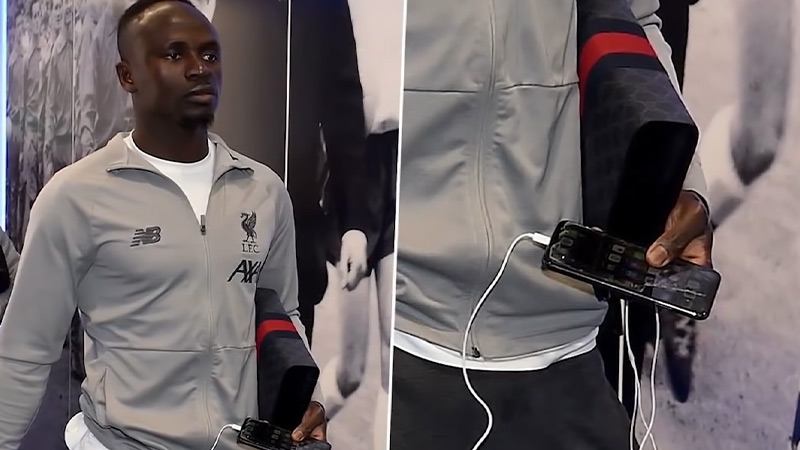
In the high-octane world of the English Premier League, where stars are often defined by their multi-million-pound contracts, luxury supercars, and designer wardrobes, a single photograph of Sadio Mane managed to stop the world in its tracks.
It wasn’t a photo of a spectacular overhead kick or a trophy celebration. Instead, it was an image of the Senegalese forward carrying a cracked iPhone 11.
This viral moment sparked a global conversation about the nature of wealth, the responsibility of fame, and the grounded reality of one of football’s most humble figures.
For Mane, the broken screen was not a sign of neglect, but a visual testament to a philosophy that prioritizes human life over material luxury.
The Viral Moment: A Cracked Screen in a Millionaire’s Hand
The story began on December 27, 2019, just hours before a critical Premier League fixture between Liverpool and Leicester City.
As Mane walked into the stadium, cameras captured him holding his phone. Sharp-eyed fans immediately noticed that the top half of his iPhone 11 was severely fractured.
In an era where elite footballers earn enough in a single day to buy dozens of top-of-the-line smartphones, the image felt like an anomaly. Fans on social media were initially baffled, with some even jokingly offering to buy the superstar a new screen protector.
However, the reality behind the cracked screen was far more profound than a simple case of a broken device.
The Financial Paradox: Earning Millions While Carrying a Broken Phone
To understand why this image was so shocking, one must look at the financial context of Mane’s career at the time. As a cornerstone of Jurgen Klopp’s legendary Liverpool squad, Mane was earning an estimated £11.5 million per year, with weekly wages reported between £100,000 and £250,000.
Statistically, Mane could afford to purchase roughly 150 new iPhones every week without making a dent in his savings. Despite this immense purchasing power, he chose to use a disfigured phone for as long as it remained functional.
This choice stood in stark contrast to the traditional image of the “celebrity athlete” who often feels pressured to display the latest symbols of status.
“Why Would I Want Ten Ferraris?” Mane’s Philosophy of Wealth
When the public and media eventually questioned Mane about his modest lifestyle and his refusal to upgrade his broken phone, his response became one of the most famous quotes in modern sports history. He did not offer an excuse; he offered a worldview.
“Why would I want ten Ferraris, 20 diamond watches, or two planes? What will these objects do for me and for the world?”
Mane asked during an interview with TeleDakar and other outlets. He reflected on his humble beginnings, noting that he had survived hard times, worked in fields, and even played football barefoot because his family could not afford shoes.
For Mane, the accumulation of luxury goods was a meaningless pursuit when compared to the ability to “help my people”.
He explicitly stated that he preferred that the people of his home country receive a little of what life had given him, rather than displaying luxury cars or trips.
The Roots of Humility: Bambali and the Loss of a Father
To understand Sadio Mane’s detachment from material things, one must look back to his childhood in the remote village of Bambali, Senegal. Mane’s narrative is a true “rags-to-riches” story, beginning with him playing football with grapefruits because real balls were a luxury.
A pivotal moment in his life occurred when he was just seven years old. While playing on a field, he was told his father had passed away.
His father had been sick for weeks, but because there was no hospital in Bambali, he had to be taken to a neighboring village in a desperate attempt to save his life—an attempt that failed.
This tragedy left an indelible mark on Mane. He recalled that his sister was also born at home because of the lack of medical facilities.
These experiences fueled a lifelong mission: to ensure that no one else in his community would have to suffer because of a lack of basic infrastructure.
From a Broken Phone to a Multi-Million Dollar Hospital
The money Mane “saved” by not buying Ferraris or the latest iPhones was funneled directly into his home province of Sédhiou, where poverty rates are estimated at nearly 70%. His philanthropic record is staggering:
- Healthcare: Mane donated approximately $693,000 (£500,000) to fund the construction of a state-of-the-art hospital in Bambali. This facility includes departments for maternity care, dental services, and consulting rooms, serving a village that previously had no medical center.
- Education: In 2019, he donated nearly $350,000 (£250,000) to build a new secondary school, telling the local youth that “education is the key”.
- Infrastructure: He has financed the construction of a mosque, a sports stadium, a fuel station, and a post office.
- Direct Aid: Mane provides a monthly stipend of 70 euros (approx. $78) to families in a very poor region of Senegal to support their local economy.
- Connectivity: He has even provided 4G internet and laptops to schools to help bridge the digital divide.
The Story of the Phone: A Gift from a Teammate
Interestingly, the cracked iPhone was not even a purchase that Mane made for himself. He revealed that the device was a gift from his Liverpool teammate Georginio Wijnaldum.
By continuing to use a gifted phone with a broken screen, Mane demonstrated a total lack of interest in the “upgrade cycle” that dominates modern consumer culture.
For him, the phone was a tool for communication and a token of friendship from a colleague, and as long as it worked, its physical appearance was irrelevant.
Sadio Mane as a Modern Role Model
Mane’s story serves as a powerful counter-narrative to the “furloughing” and excess sometimes associated with professional sports.
His life demonstrates that a successful athlete can be a media celebrity and a pious role model simultaneously, using their platform to drive social change rather than just personal branding.
Whether he is helping kit staff carry water crates or donating hundreds of thousands of dollars to build a hospital, Mane’s consistency has made him a fan favorite far beyond Anfield. He proves that true wealth is measured by what you give away, not by the condition of the phone in your pocket.
Conclusion: More Than Just a Cracked Screen
The cracked iPhone was never really about a broken piece of glass. It was a window into the soul of a man who remembered what it was like to be hungry, to play barefoot, and to lose a loved one for want of a doctor.
Sadio Mane’s refusal to repair or replace that phone was a quiet, viral protest against the excesses of modern life.
By choosing to “build schools and give poor people food” over displaying luxury cars, Mane has created a legacy that will outlast any football trophy.
He remains a beacon of humility and hope, showing the world that even in the most profitable industry on earth, the most valuable thing you can carry is a sense of where you came from.