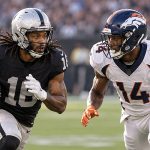
In the modern era of professional football, labels often serve as a shorthand for talent evaluation.
For years, the “slot receiver” designation was used to categorize players who lacked the size or speed to compete on the perimeter, relegating them to the middle of the field to navigate traffic and find soft spots in zone coverage.
However, every generation produces an outlier that renders traditional terminology obsolete. Cooper Kupp is not merely a slot specialist; he is a comprehensive offensive engine whose utility redefines the wide receiver position.
To understand why the “slot” label is a reductive mischaracterization, one must analyze the strategic layers of the Los Angeles Rams’ offensive architecture.
While Kupp is undeniably one of the most productive players from the interior in the history of the sport, his impact is felt across every blade of grass on the field.
He is a player who combines the technical precision of a traditional flanker, the physicality of a modern tight end, and the spatial awareness of an elite quarterback.
The Evolution of Offensive Utility
Historically, the slot was the domain of the “underneath” threat—smaller, shiftier players like Wes Welker or Julian Edelman.
Kupp has taken that foundation and expanded it into a multi-dimensional role that demands a new classification.
He does not just line up inside to avoid press coverage; he lines up across the entire formation to create structural mismatches that defensive coordinators cannot easily solve.
| Traditional Slot Receiver | Cooper Kupp’s Versatile Role |
|---|---|
| Primarily operates in the short-to-intermediate middle. | Operates at all three levels: short, intermediate, and deep. |
| Relies on quickness to create separation. | Relies on elite “football IQ” and precise route-running. |
| Often a “pass-only” threat. | Acts as an elite run-blocker, often compared to a tight end. |
| Limited usage on the boundary/outside. | Wins consistently on the outside boundary against top cornerbacks. |
Technical Mastery on the Boundary
One of the most persistent criticisms of “system” receivers is their perceived inability to win “outside the numbers.”
The assumption is that without elite, track-level speed, a receiver cannot survive against the physical press coverage and limited space of the boundary.
Kupp systematically dismantles this theory through technical excellence rather than raw athleticism.
His success on the perimeter is a masterclass in the economy of movement. By utilizing a sophisticated understanding of leverage and defensive back tendencies, Kupp can line up wide and beat cornerbacks who are technically faster or more explosive.
- Precise Route-Running: Kupp’s breaks are sharp and unpredictable. He understands how to “sell” a vertical route to force a defender into a backpedal before snapping off a comeback or a dig.
- Leveraging Football IQ: He identifies the coverage shell pre-snap, allowing him to adjust his stem and timing to find the optimal window.
- The Power of Nuance: Unlike “burners” who rely on outrunning the coverage, Kupp uses subtle shoulder dips and head fakes to freeze defenders, creating passing lanes where none existed.
This ability to win on the outside boundary is what prevents defenses from simply “bracketing” him in the middle of the field. If a defense commits its primary safety help to the slot, Kupp moves outside and punishes them in one-on-one matchups.
The Physicality of a “Tight End” in the Run Game
Perhaps the most overlooked aspect of Kupp’s game—and the factor that most separates him from the “slot” stereotype—is his contribution to the ground attack.
In Sean McVay’s offensive system, the wide receivers are expected to be active participants in the blocking scheme. Kupp does not just “chip” defenders; he engages them with the tenacity and technique typically reserved for tight ends.
- Elite Run-Blocking: Kupp is frequently used as a lead blocker or a “crack” blocker in gap schemes.
- Physicality at the Point of Attack: His willingness to engage linebackers and larger safeties allows the Rams to run “11 personnel” (one running back, one tight end, three receivers) while maintaining the physical presence of a “heavy” formation.
- Opening Ground Space: By neutralizing edge defenders or sealing off lanes, Kupp’s blocking directly translates into explosive runs for his teammates.
This “tight end-like” utility is a strategic nightmare for opponents. When Kupp is on the field, the defense cannot assume a pass play is coming. His presence in the box as a blocker forces defenses to stay in their base packages, which the Rams then exploit by passing to him out of those same heavy looks.
A Case Study in Dominance: The 2021 Triple Crown
The 2021 NFL season serves as the definitive proof of Kupp’s versatility. It was not merely a high-volume season; it was a demonstration of “total offensive integration”.
By leading the league in receptions, receiving yards, and receiving touchdowns—the elusive Triple Crown—Kupp proved that he could shred defenses from any alignment.
Key Milestones of the 2021 Campaign:
- Triple Crown Winner: Led the NFL in all major receiving categories.
- Super Bowl MVP: Delivered the game-winning performance on the world’s biggest stage.
- Alignment Diversity: Recorded significant yardage from the slot, the boundary, and even the backfield.
During this historic run, Kupp’s production was a result of his inside mastery being combined with an expanded outside role.
He was the focal point of the offense, yet defenses were powerless to stop him because his “alignment-agnostic” style meant they could never pinpoint his location or intent.
Strategic Impact: The “Position-less” Wide Receiver
The modern NFL is moving toward a “position-less” philosophy where the best players are defined by their skill sets rather than their spots on a depth chart.
Cooper Kupp is the archetype for this shift. By being a threat in the slot, on the boundary, and in the run game, he provides a level of flexibility that changes how entire games are called.
Tactical Advantages of Kupp’s Versatility:
- Personnel Flexibility: Allows the offense to stay in a single personnel grouping while shifting the “look” of the play.
- Defensive Dictation: Forces defenses to choose between playing “nickel” (extra defensive backs) to stop his routes or “base” (extra linebackers) to stop his blocking.
- Mental Exhaustion: Defenders must account for his pre-snap motions, his blocking responsibilities, and his deep-threat capability simultaneously.
Conclusion: Redefining the Standard
To answer the question definitively: No, Cooper Kupp is not just a slot receiver. He is a technician who has mastered the nuances of the boundary, a physical presence who dominates the run game, and a historical talent who has reached the pinnacle of the sport.
The greatness of Cooper Kupp lies in his refusal to be categorized. He is a reminder that in a league obsessed with measurables like 40-yard dash times and vertical jumps, there is still no substitute for “football IQ,” “precise route-running,” and a relentless commitment to every facet of the game.
Whether he is lining up inside, winning on the boundary, or clearing a path for a touchdown run, Kupp is the ultimate example of what it means to be a complete football player.