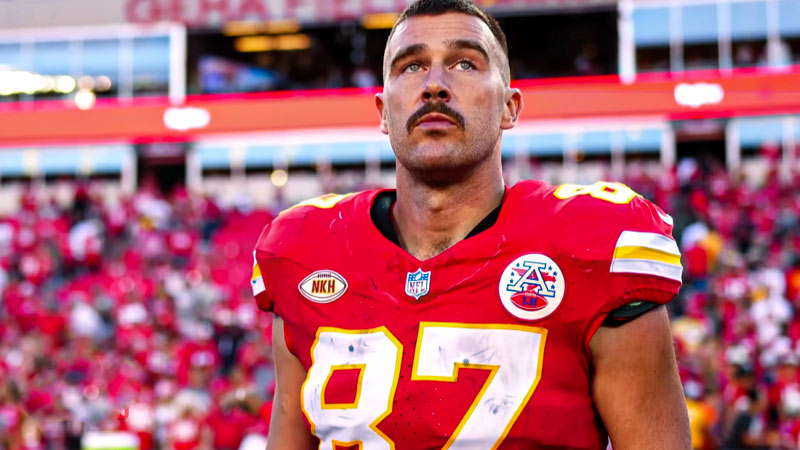
In the modern landscape of professional sports, the financial profile of an elite athlete is no longer defined solely by the contract they sign with their franchise.
The true measure of modern athletic wealth lies in the architecture of their total portfolio—a complex integration of on-field compensation, strategic tax and salary cap planning, corporate brand alignments, and intellectual property ownership.
Travis Kelce’s current financial structure serves as a premier case study for this contemporary paradigm.
By analyzing his guaranteed team salary, the administrative structure of his bonuses, and the strategic positioning of his media assets, we can map out a masterclass in modern sports business.
Unpacking the Numbers: Travis Kelce’s On-Field Compensation
To understand the core foundation of Travis Kelce’s earnings, one must first look at his primary contract with the Kansas City Chiefs.
For the current season, his on-field compensation is structured around a highly optimized agreement designed to maximize guaranteed cash flow while maintaining flexibility for his team’s salary cap management.
The headline figure of his contract is a fully guaranteed commitment of $12,000,000 for the season.
However, looking at the total sum alone obscures the sophisticated engineering of the contract itself. Modern sports contracts are highly segmented instruments, divided into distinct categories of cash delivery.
Below is the complete, granular breakdown of Travis Kelce’s on-field contract architecture:
Travis Kelce’s Complete On-Field Contract Breakdown
| Financial Component | Allocated Amount | Percentage of Total Cash | Description & Strategic Purpose |
|---|---|---|---|
| Base Salary | $1,345,000 | 11.21% | The baseline salary paid out across the weeks of the regular season. Kept deliberately low to optimize salary cap accounting. |
| Bonuses & Adjustments | $10,655,000 | 88.79% | Composed of restructure, roster, and training camp bonuses to reach the total guaranteed mark. Distributed as upfront or milestone-based cash. |
| Total Cash Commitment | $12,000,000 | 100.00% | The fully guaranteed total cash compensation Travis Kelce is scheduled to receive for the season. |
| Accounting Cap Hit | $4,896,666 | N/A | The actual space occupied by this contract on the franchise’s team salary cap. |
This structure highlights a crucial trend in elite sports compensation: the transition from high base salaries to heavy bonus structures.
By keeping the base salary at a modest $1,345,000, the contract ensures steady weekly cash flow during the active season while shifting the vast majority of the wealth—nearly 89%—into bonuses.
The Mechanics of the NFL Salary Cap: Cash Flow vs. Cap Hit
One of the most complex elements of professional sports finance is the distinction between actual cash payout and salary cap accounting.
In professional football, teams operate under a strict, hard salary cap. Franchises must manage their roster within these limits to remain competitive.
Travis Kelce’s contract is structured to assist the Kansas City Chiefs in managing this balance. While he receives a guaranteed cash flow of $12,000,000, his cap hit is restricted to just $4,896,666.
This represents an accounting difference of over $7.1 million. How is this achieved, and why is it beneficial for both the player and the franchise?
Cash Flow vs. Salary Cap Accounting Mechanics
| Dimension | Actual Cash Flow | Salary Cap Hit Accounting |
|---|---|---|
| Monetary Value | $12,000,000 | $4,896,666 |
| Recipient Impact | Direct liquid cash delivered to the player’s bank account via standard payroll and bonus disbursements. | The nominal value assigned to the franchise’s collective salary limit. |
| Structural Vehicle | Driven by a small base salary combined with heavy restructure, roster, and training camp bonuses. | Managed by converting immediate cash commitments into amortized or restructured accounting formats. |
| Strategic Leverage | Provides the athlete with financial security through fully guaranteed compensation. | Gives the franchise the financial flexibility to sign additional high-tier players to build a championship roster. |
This divergence is made possible through the use of restructure bonuses. When a franchise restructures a contract, they can pay the athlete a large sum in cash immediately but distribute the accounting impact of that payment over multiple years on the salary cap ledger.
For Travis Kelce, this provides the best of both worlds: he receives the absolute security of $12,000,000 in guaranteed cash, while his low cap hit of $4,896,666 frees up millions of dollars for the team to build a competitive roster around him.
This collaborative financial relationship between player and front office has been a cornerstone of the team’s sustained championship window.
The Off-Field Portfolio: Brand Collaborations & Commercial Strategy
While a $12,000,000 on-field salary places Travis Kelce among the upper echelon of professional athletes, his financial architecture reaches an entirely different level when factoring in his corporate endorsements.
In the modern economy, an athlete’s on-field performance is a platform used to launch a highly lucrative commercial brand.
Kelce has established an endorsement portfolio that spans multiple sectors, aligning with premier global corporations. This diversification minimizes risk and ensures long-term cash flow that will persist long after his playing days are over.
Corporate Partner Alignment Matrix
| Industry Sector | Corporate Partner | Strategic Synergy & Brand Positioning |
|---|---|---|
| Athletics & Apparel | Nike | Anchors his elite athletic credibility, providing high-visibility performance gear and lifestyle apparel placement. |
| Insurance & Services | State Farm | Leverages humor and broad demographic appeal, cementing his status as a mainstream household name. |
| Consumer Brands | Bud Light | Capitalizes on his charismatic, celebratory personality, targeting casual consumer demographics. |
| Healthcare & Pharma | Pfizer | Connects his brand to large-scale public health and wellness initiatives, elevating his corporate authority. |
| Financial Services | Experian | Aligns his public image with personal finance, credit wellness, and long-term security. |
By partnering with market leaders across distinct industries, Kelce avoids over-indexing on any single market segment.
The financial yields of these partnerships generate millions of dollars annually, matching or potentially exceeding his playing salary. This balance is the hallmark of a mature corporate athlete portfolio.
The Media Ownership Revolution: New Heights and Wondery
Perhaps the most forward-thinking component of Travis Kelce’s financial architecture is his venture into media ownership. Historically, athletes interacted with the media purely as interview subjects or hired brand ambassadors.
Today, elite players are building their own media platforms, capturing the underlying equity and distribution value of their content.
Alongside his brother Jason, Travis Kelce co-hosts New Heights, a weekly podcast that has grown into one of the most popular sports and lifestyle shows globally. The podcast is not merely a creative outlet; it is a highly valuable media property.
The ultimate validation of this media strategy came when New Heights secured a landmark, multi-million dollar network distribution deal with Wondery, Amazon’s premium podcast network.
The Athlete-Led Media Ownership Model
| Traditional Media Model | Modern Athlete Ownership Model (New Heights / Wondery) |
|---|---|
| Dependent Placement: Athletes appear on established networks as talent, earning a flat fee or standard salary. | Equity Control: Athletes own the intellectual property, show format, and direct relationship with the audience. |
| Limited Monetization: Ad revenue and distribution rights are held entirely by the media conglomerate. | High-Leverage Licensing: Multi-year distribution deals (such as the Wondery partnership) secure guaranteed multi-million dollar licensing fees. |
| Short-Term Value: Compensation is tied directly to active participation and current playing status. | Enterprise Value: The media property can be scaled, monetized, and maintained indefinitely, even after retirement. |
This distribution deal represents a structural shift in athlete wealth. By retaining ownership of the show while partnering with Amazon’s Wondery for distribution and ad sales, the Kelce brothers have built a highly scalable business.
This ensures that Travis Kelce’s media income is decoupled from his physical health and playing schedule, representing a permanent, high-margin revenue stream.
Comparative Market Valuation: Tight End Positioning
To put Kelce’s $12 million cash payout and contract structure into perspective, it is useful to look at the broader landscape of tight end compensation across the league.
Historically, tight ends have been undervalued relative to other pass-catching positions, such as wide receivers, despite often carrying equal or greater offensive responsibilities.
Kelce’s financial architecture represents a correction in this market. By structuring his contract to guarantee $12,000,000 cash while maintaining an incredibly team-friendly cap hit of $4,896,666, he has set a new standard for how elite tight ends can balance personal compensation with team competitive needs.
Strategic Tight End Compensation Dynamics
| Metric | Travis Kelce’s Position Value | Market Implications |
|---|---|---|
| Guaranteed Annual Cash | $12,000,000 | Sets a strong baseline for elite veteran tight ends, proving that guaranteed money can be secured without hurting team flexibility. |
| Cap Hit Optimization | $4,896,666 | Demonstrates how front offices can utilize restructure bonuses to defer cap space, serving as a template for other teams. |
| Off-Field to On-Field Ratio | High (Driven by Nike, State Farm, Wondery, etc.) | Illustrates that tight ends can achieve wide-receiver-level commercial success by developing unique media properties and personal brands. |
Through this balanced approach, Kelce has achieved both championship success on the field and maximum monetization off the field.
This layout provides a blueprint for future generations of tight ends looking to navigate their negotiations.
Strategic Takeaways: The Legacy of Modern Athlete Wealth
The financial architecture of Travis Kelce represents the evolution of the modern sports superstar.
By analyzing his professional ecosystem, we can extract three core pillars that define this new era of wealth accumulation:
- Strategic Contract Structuring: High-value athlete compensation is no longer about simple base salaries. The integration of low base structures, guaranteed cash conversions, and cap-friendly bonus mechanics allows elite players to secure their wealth while empowering their organizations to build championship-caliber rosters.
- Comprehensive Brand Diversification: A robust endorsement portfolio must be diversified across consumer goods, apparel, corporate services, and finance. Aligning with top-tier brands like Nike, State Farm, and Experian ensures a steady stream of passive income that elevates the athlete’s cultural footprint.
- Intellectual Property and Media Control: The ultimate level of financial independence is achieved through content ownership. By launching and retaining equity in New Heights and securing a premier partnership with Wondery, the Kelce brand has built an enterprise that operates outside the constraints of traditional team salary structures.
Ultimately, Travis Kelce’s playbook proves that the modern athlete is no longer just a player on a roster—they are the Chief Executive Officer of a highly sophisticated, diversified corporate enterprise.