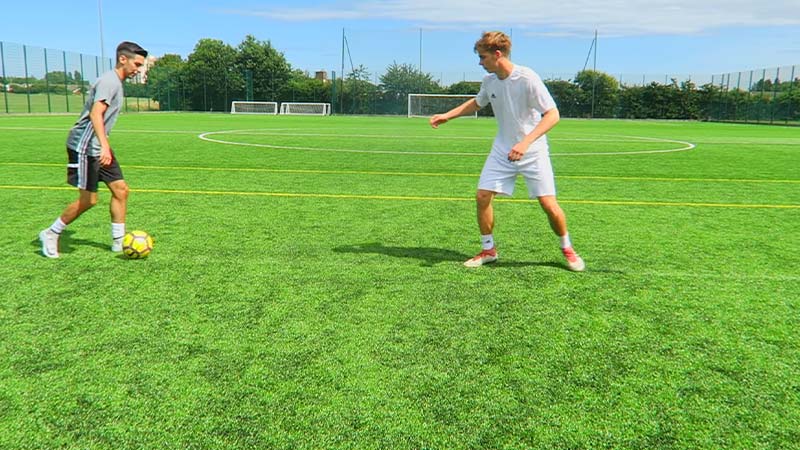
Soccer is often called “The Beautiful Game” not just for its grace, but for its profound accessibility. If you have ever wondered, “Is soccer easy to learn?” the answer is a resounding yes—at least at the start.
Unlike sports that require specialized equipment or complex technical overhead just to begin, soccer relies on the most basic human movements: running and kicking. However, beneath this simplicity lies a deep ocean of technicality and tactical strategy.
This guide explores the realistic timeline of soccer development, the core skills you need, and why this sport remains the most popular global pastime.
The Paradox of Simplicity: Why Soccer is Accessible
The fundamental reason soccer is widely considered one of the easiest sports to pick up is that its core mechanics are highly intuitive. Most people naturally understand how to run and how to move their legs to strike an object.
Because these actions are innate, a beginner can step onto a field and contribute to a game almost immediately without a steep learning curve for basic participation.
The Intuitive Nature of Mechanics
For many other sports, such as tennis or golf, the initial barrier is learning how to use an extension of your body—like a racket or a club—to strike a ball. In soccer, your feet are the primary tools.
This direct connection between the brain and the limb makes the basic act of kicking a ball toward a target much easier for the human nervous system to grasp.
A Simplified Objective and Rule Set
The primary objective of the game is refreshingly simple: get the ball into the opponent’s goal without using your hands. While professional soccer involves complex regulations such as the offside rule, these can be learned quickly once a player begins active participation.
This “learn as you go” nature allows new players to focus on the joy of movement rather than memorizing a thick rulebook before their first match.
The Realistic Timeline for Skill Development
While the basics are easy to grasp, the transition from a casual kicker to a technical master is a journey that requires significant time and dedication. Understanding the timeline of development is crucial for setting realistic expectations and maintaining motivation.
Phase One: The Amateur Foundation (1–2 Months)
Within the first 30 to 60 days of consistent practice, most individuals can learn to play at an amateur level. During this initial stage, the focus should be almost entirely on ball control and short passing.
These are the most critical starting skills because they allow a player to maintain possession and participate in the flow of a team environment. At this stage, you are moving from simply “chasing the ball” to intentionally “directing the ball.”
Phase Two: Building Competency (6–12 Months)
To move beyond a basic beginner level and reach what is considered “decent competency,” a much higher volume of training is required.
If a player commits to daily practice of three hours or more, they can become a competent player within six to twelve months. This period is characterized by the refinement of coordination and the ability to execute skills under mild pressure.
However, it is important to note that even at this stage, mastering complex tricks or consistently beating experienced defenders remains a significant challenge.
Phase Three: The Path to Technical Mastery (2–3 Years)
True technical mastery is a long-term commitment. It typically takes two to three years of daily dedication to develop the deep muscle memory and “touch” required to feel completely comfortable with the ball in all game situations.
This level of expertise allows a player to act instinctively rather than thinking about their feet, enabling them to focus on the tactical “chess match” occurring across the pitch.
The Low Barrier to Entry: A Sport for Everyone
One of the most compelling arguments for soccer’s ease of learning is its lack of financial and physical barriers. In many parts of the world, this accessibility is what makes it a life-long passion for billions of people.
| Feature | Soccer Accessibility |
|---|---|
| Equipment Required | A ball and a flat surface. |
| Financial Cost | Extremely low; no expensive pads, clubs, or rackets needed. |
| Space Requirements | Can be practiced in a park, a driveway, or a street. |
| Social Barrier | Easy to join pickup games due to the intuitive nature of the sport. |
This low barrier to entry ensures that the “learning” process can happen anywhere. You do not need a specialized court or a coach to begin; you simply need the ball and the desire to move.
The Five Pillars of Technical Foundation
To accelerate your learning curve, it is essential to focus on the core technical areas that provide the most “return on investment” for your training time. By mastering these five pillars, you build a foundation that supports all advanced play.
- Passing: This is the most critical team skill. Accuracy in passing allows you to keep the ball away from the opponent and move your team toward the goal.
- Receiving (The First Touch): Your “first touch” refers to how you control the ball the moment it reaches you. A soft, intentional touch allows you to immediately transition into your next move, whether that is a pass, a dribble, or a shot.
- Dribbling: Keeping the ball close to your feet while moving is essential for navigating through tight spaces and maintaining possession under pressure.
- Shooting: Learning to strike the ball with both power and accuracy is the key to achieving the game’s primary objective—scoring goals.
- Positioning: Perhaps the most overlooked skill for beginners, positioning is the ability to understand where to stand on the field. Good positioning makes you a viable passing option for your teammates and an effective obstacle for your opponents.
Developing Your Soccer IQ: Beyond the Physical
As you progress through the months of physical training, the mental aspect of the game—often called “Soccer IQ”—becomes increasingly important. While kicking the ball is easy, knowing where to kick it and when to move is what separates great players from good ones.
Spatial Awareness and Scanning
Effective positioning requires a player to constantly “scan” the field. This means looking away from the ball to identify where teammates and defenders are located. Beginners often suffer from “ball watching,” where they only focus on the ball at their feet.
Developing the habit of looking around allows you to make decisions faster, which is essential as the pace of the game increases during your second year of play.
Understanding Game Flow
Soccer is a game of continuous movement. Unlike sports with set plays, soccer requires players to react to an ever-changing environment. By studying the game and practicing positioning, you learn the “rhythm” of the sport.
You begin to anticipate where the ball will be three seconds into the future, rather than just where it is now. This mental foresight is a key component of the 2-to-3-year mastery timeline.
Overcoming the Challenges of Mastery
It is a common mistake to assume that because soccer is easy to start, it will remain easy to master. The difficulty in soccer lies in the precision required at high speeds.
The Difficulty of “Touch”
“Touch” is the term used to describe a player’s sensitive control over the ball. It is the result of thousands of hours of the ball hitting the foot, allowing the brain to calibrate exactly how much force is needed for every situation.
This is why mastery takes years; there is no shortcut to the neurological adaptations required for elite ball control.
Managing Physical Conditioning
Because soccer involves constant running, your ability to learn and execute skills is heavily dependent on your fitness. When a player becomes tired, their technical skills are usually the first thing to decline.
Part of the 6-to-12-month competency phase involves building the cardiovascular endurance to remain technically sound for a full 90-minute match.
Frequently Asked Questions (FAQ)
Is soccer harder to learn than basketball or football?
In terms of basic participation, soccer is often considered easier because it relies on more intuitive movements like running and kicking.
However, because you cannot use your hands, the “ceiling” for technical ball control is arguably higher and takes longer to master compared to sports that allow hand-eye coordination.
Can I learn soccer by myself?
Yes. Since you only need a ball and a flat surface, many of the fundamental skills—such as dribbling, shooting, and receiving (by kicking the ball against a wall)—can be practiced solo. However, positioning and passing are best learned in a team environment.
What is the most important skill for a beginner?
According to technical experts, passing and the “first touch” are the most critical starting skills. If you can control the ball when it comes to you and move it accurately to a teammate, you can be a valuable asset to any team.
How many hours should I practice to get good?
To reach a level of “decent competency” within six months, a commitment of about three hours of daily practice is recommended. For those looking for casual play, consistent practice for 1–2 months is usually sufficient to join an amateur league.
Conclusion: Start Your Journey Today
Soccer is a rare sport that offers immediate gratification for beginners while providing a lifetime of challenges for those seeking mastery. Its accessibility is unmatched; with nothing more than a ball and a patch of ground, you can begin developing skills that are recognized in every corner of the globe.
Whether you are looking to improve your fitness, join a social community, or test your competitive limits, the path forward is clear. Focus on the five pillars—passing, receiving, dribbling, shooting, and positioning—and embrace the 2-to-3-year journey toward technical mastery.
The game is waiting for you. Pick up a ball, find a flat surface, and take your first step toward mastering the world’s most popular sport.