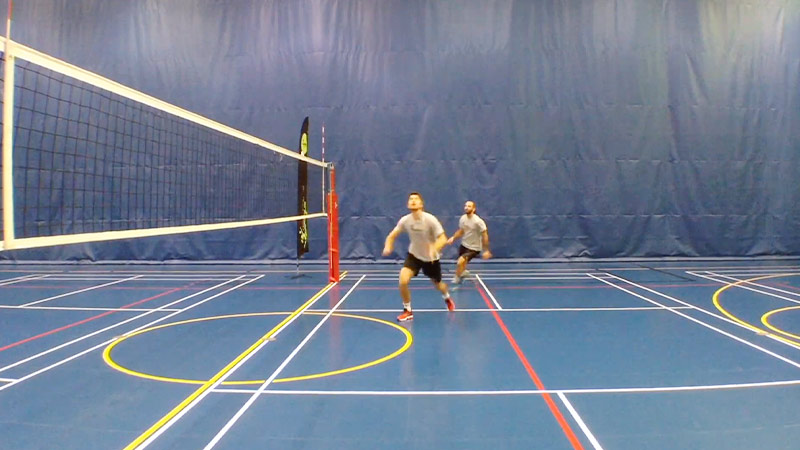
Whether a game is played in a professional gymnasium, a local park, or on the sand, the markings on a volleyball court are the fundamental “rulebook” of the floor.
To the uninitiated, the grid of lines can seem like a complex mystery, but for players, coaches, and facility managers, these lines dictate every tactical move and legal play.
Understanding these boundaries is essential not only for competitive integrity but also for avoiding “fault” penalties that can cost a team the match.
This guide provides a comprehensive breakdown of regulation indoor volleyball court markings, player positioning, and the high-quality equipment required to maintain a professional standard.
The Anatomy of a Regulation Indoor Court
The foundation of every volleyball match is the court itself. A regulation indoor volleyball court is defined by a rectangle measuring 18 meters (59 feet) long by 9 meters (29.5 feet) wide. This area is strictly demarcated to ensure a uniform playing field across all levels of competition.
The Perimeter: Sidelines and End Lines
The outermost lines of the court are the sidelines and end lines. These define the “in-bounds” area.
- Sidelines: The two long lines (18 meters) that determine the width of the playing area.
- End Lines: The two shorter lines (9 meters) at each end of the court.
A ball is considered “in” if any part of it touches these lines during play. Conversely, the area beyond these lines is out of bounds.
The service area is specifically located in the space beyond either end line; this is the designated zone where a player must stand to initiate action via the serve.
The Center Line and Net Area: The “No-Go” Zone
The center line is perhaps the most critical marking for player safety and fair play. It runs directly under the net, dividing the court into two equal squares of 9×9 meters.
Navigating the Center Line Faults
Precision is vital when playing near the net. According to regulation standards, any player who crosses the center line with any part of his or her body is called for a “fault” penalty.
This rule prevents collisions between opposing players and ensures that the space under the net remains a neutral buffer zone.
The Role of the Antennae
Verticality is just as important as horizontal boundaries. Attached to each side of the net, directly above the sidelines, are poles known as antennae. These serve as a vertical extension of the sidelines.
- Any ball that contacts the antennae is considered out of bounds.
- Any ball hit outside the antennae (even if it lands on the opponent’s side) is considered a fault.
Net Height Standards
The net must be set at specific heights depending on the demographic of the players to ensure a fair challenge.
- For Girls/Women: The net is placed approximately 7.5 feet above the ground.
- For Boys/Men: The net is placed approximately 8 feet above the ground.
The Attack Line: Tactical Depth and Rules
Three meters (approximately 9.8 feet) from the net on both sides of the center line lies the attack line, also commonly referred to as the 3-meter line. This line is the primary divider between the frontcourt and the backcourt.
Frontcourt vs. Backcourt
- Frontcourt: The area between the net and the attack line where front-row players operate.
- Backcourt: The area between the attack line and the end line where back-row players are positioned.
Back-Row Attack Restrictions
The attack line dictates how back-row players can contribute to the offensive play. Players positioned in the back row are prohibited from jumping to attack the ball if they are inside the 3-meter zone.
However, they may jump from behind the attack line, land on the other side of the line (in the frontcourt), and remain legal as long as their takeoff was initiated from the backcourt.
This rule ensures that the tallest or most powerful hitters cannot dominate the net from every position on the rotation.
Player Positioning and Rotational Strategy
A standard volleyball team consists of six players, and their movement is strictly governed by six rotational spots on the court. These spots must be occupied during each serve to maintain a legal formation.
The Six Rotational Spots
- Left-Front (LF): Positioned in the frontcourt on the left side.
- Center-Front (CF): Positioned in the frontcourt in the middle.
- Right-Front (RF): Positioned in the frontcourt on the right side.
- Left-Back (LB): Positioned in the backcourt on the left side.
- Center-Back (CB): Positioned in the backcourt in the middle.
- Right-Back (RB): Positioned in the backcourt on the right side.
The player in the Right-Back (RB) spot is the designated server who initiates the action from the service area beyond the end line.
Once the ball is served, players may move from their rotational spots to their tactical positions, provided they follow the rules regarding back-row attacks.
Investing in Professional Court Equipment
To maintain the integrity of these lines and the safety of the players, high-quality equipment is a necessity. First Team Sports Inc. provides a wide range of residential and institutional sports equipment designed to meet these rigorous standards.
Choosing the Right System
Depending on the venue, different volleyball systems are required:
- Competition Systems: Designed for high-school, collegiate, and professional play, focusing on net tension and stability.
- Recreational Systems: Ideal for parks or community centers where ease of setup is a priority.
- Portable Systems: Perfect for multi-use facilities that need to clear the floor for other sports like basketball or soccer.
First Team offers products that are largely made in America with a mix of domestic and imported components, backed by a 100% satisfaction guarantee.
Their offerings extend beyond volleyball to include basketball goals, soccer goals, and spectator seating, making them a comprehensive resource for athletic directors and facility managers.
Enhanced FAQ: Mastering the Details
Q: What happens if a player’s foot is on the center line but not over it?
A: In most regulation play, a player is only called for a fault if their entire foot (or another body part) crosses completely over the center line into the opponent’s space. Touching the line is generally permitted as long as it does not interfere with the opponent.
Q: Is the 3-meter line different for beach volleyball?
A: While this guide focuses on regulation indoor courts (18m x 9m), beach volleyball often uses smaller court dimensions and does not typically utilize a 3-meter attack line, as there are fewer players and no rotation-based attack restrictions.
Q: Where can I find specific diagrams for court installation?
A: Professional resources such as Court/Field Diagrams, Architect Resources, and a Download Center are available to assist in the precise layout of institutional sports flooring.
Conclusion: Precision Leads to Performance
Mastering the lines of a volleyball court is the first step toward competitive excellence. These markings are not merely aesthetic; they define the strategy, safety, and legality of the sport.
From the 18-meter perimeter to the tactical nuances of the 3-meter attack line, every inch of the court serves a purpose.
For those looking to build or upgrade their athletic facilities, utilizing high-quality, reliable equipment is paramount.
First Team Sports Inc. stands as a leader in the industry, offering the tools necessary to bring professional-grade volleyball to any environment.