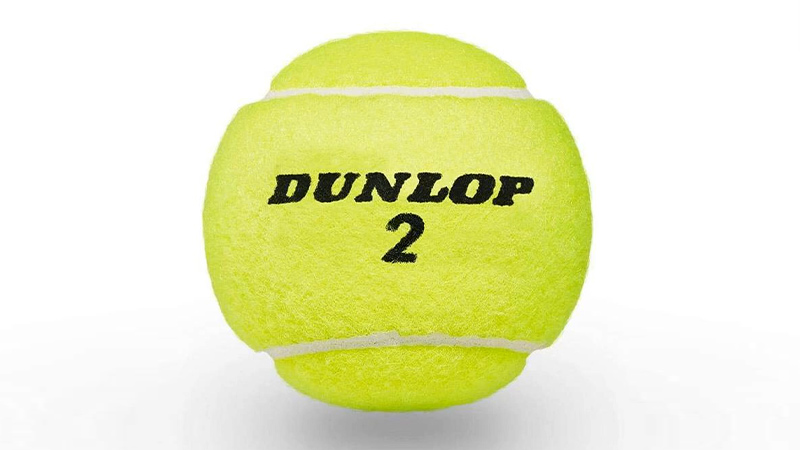
The sensation of stepping onto a tennis court with a fresh can of balls is a ritual for players at every level.
However, a persistent debate often arises the moment the pressurized seal is broken: are these balls actually the same size? Among competitive players, Dunlop frequently finds itself at the center of this discussion.
There is a widespread perception that Dunlop balls, particularly those used on the professional tour, appear and feel smaller than their counterparts from Wilson or Penn.
To understand whether this is a matter of physical reality or an optical and tactile illusion, we must look at the strict engineering standards that govern the sport.
The short answer is that official Dunlop tennis balls are not smaller than other standard tennis balls; rather, their unique construction creates a distinct physical profile that challenges player perception.
The Uniformity of the Game: ITF Rule 3
Tennis is a game of millimeters, and the equipment is regulated with the same precision as the court dimensions themselves.
Every ball used in sanctioned match play must adhere to the International Tennis Federation (ITF) Rules of Tennis. This governing body ensures that a player in London is hitting a ball with the same fundamental specifications as a player in Melbourne or New York.
According to these official regulations, the diameter of a standard tennis ball must fall between 2.57 and 2.70 inches (approximately 6.54 to 6.86 cm).
This range is non-negotiable for manufacturers. Whether a brand is producing a ball for a local club or a Grand Slam, it must pass rigorous testing to ensure it fits within these parameters.
Therefore, any Dunlop ball sold for regular adult play is legally and physically required to be the same size as any other standard ball on the market.
The Perception of “Compactness”: Why Dunlop Feels Different
If the measurements are identical, why do so many players insist that Dunlop balls are smaller? The answer lies in the material science of the ball’s exterior and the density of its core.
Dunlop’s premium offerings, such as the Dunlop ATP and the Australian Open balls, are engineered with a specific philosophy. These balls are widely recognized for being dense and heavily packed with felt.
This high-density felt construction serves a functional purpose: it provides greater durability and a more consistent flight path. However, this density has a side effect on player perception.
Because the felt is tightly woven and closely cropped, the ball lacks the “fluff” or fuzziness seen in other brands. A ball with loosely woven felt will appear larger to the eye because the stray fibers extend the visual silhouette of the sphere. In contrast, the streamlined profile of a Dunlop ball makes it appear more compact.
Furthermore, this construction makes the ball feel heavier and firmer during the hit. In the hands of a player, a firmer object is often mentally categorized as being smaller or more “concentrated” than a softer, more pliable one.
The Role of Internal Pressure and Felt Density
The “feel” of a tennis ball is a combination of its internal air pressure and the quality of the rubber used in the core. Dunlop tends to favor a construction that maintains a high level of “pop” and responsiveness. When a ball is firm, it resists deformation upon impact with the strings.
When a softer ball hits a racquet, it flattens slightly, increasing the dwell time and the surface area in contact with the strings. A Dunlop ball, being denser, maintains its shape more effectively.
This lack of deformation contributes to the sensation that the ball is a smaller, harder object flying through the air, even though its static diameter is identical to its competitors.
Navigating the Youth Ball Exception
While standard adult balls are uniform in size, there is one legitimate instance where a tennis ball might be significantly smaller: youth training equipment.
The ITF “Play + Stay” campaign utilizes a color-coded system (Red, Orange, and Green) to help children learn the game. While Green and Orange balls are typically the same size as standard balls but with lower pressure, certain training variations or specialized equipment for very young children can differ in physical dimensions.
However, these are clearly labeled for developmental use and are never intended for use in standard adult games. If you are playing with a ball that is visibly and significantly smaller than a standard yellow ball, it is likely a specialized training tool rather than a standard Dunlop match ball.
Comparative Brand Analysis: Dunlop vs. The Field
In the global marketplace, tennis ball manufacturers often differentiate themselves through “signature” feels. Understanding these differences can help players move past the illusion of size:
- Wilson: Known for the US Open ball, which is often perceived as having a more “active” felt that fluffs up over time. This fluffing increases the visual diameter of the ball during a set.
- Penn: Particularly the Championship and Pro Penn Marathon lines, these are often seen as having a slightly softer feel, which can lead to a perception of the ball being larger and more forgiving on the arm.
- Dunlop: Positions itself as the “Tour” choice, emphasizing consistency, density, and a premium felt weave that resists “ballooning”. This resistance to fluffing is exactly what keeps the ball looking “small” and playing fast throughout its lifespan.
The Performance Impact: How “Compactness” Affects Your Game
The perception that a Dunlop ball is smaller can actually lead to a different style of play. Because these balls feel firmer and denser, players often report a higher level of control on high-velocity shots.
The ball doesn’t “pancake” on the strings as much, which can be advantageous for players who use heavy topspin or those who want a predictable launch angle.
For a competitive player, the “smallness” of a Dunlop ball is actually a hallmark of its quality. It suggests that the felt is not breaking down or becoming unmanageable.
A ball that maintains its sleek, compact profile is a ball that will continue to cut through the air with less aerodynamic drag, providing a more professional experience from the first game to the last.
Standardization and Quality Control
It is also worth noting that the manufacturing process for a brand like Dunlop involves high-level quality control.
To be the official ball of the ATP Tour and the Australian Open, the margin for error is nearly zero. Each batch of balls is tested not just for size, but for bounce height, weight, and deformation under pressure.
When you pick up a Dunlop ball, you are holding a piece of equipment that has been verified to meet the 2.57 to 2.70-inch requirement. The consistency of their production is one of the reasons they remain a dominant force in the industry.
The perceived “smallness” is simply evidence of a more tightly controlled manufacturing process that prioritizes structural integrity over visual bulk.
Common Questions Regarding Ball Size
Do Dunlop balls get smaller as you play?
No. While the felt will eventually wear down, which could technically reduce the diameter by a fraction of a millimeter, the rubber core remains the same size.
In fact, most balls appear to get larger as they are used because the felt fibers loosen and “fluff up,” though Dunlop is specifically designed to minimize this effect.
Why do Dunlop balls feel heavier if they are the same size?
Weight and size are independent variables. The ITF allows a weight range of 56.0 to 59.4 grams. Because Dunlop balls are densely packed with felt, they often sit at the higher end of the weight spectrum or simply feel more solid due to their firmness, contributing to the “compact” sensation.
Are there different sizes of Dunlop balls for different court surfaces?
While there are “All Court,” “Clay Court,” and “Hard Court” versions of Dunlop balls, these distinctions refer to the type of felt used (to handle moisture or abrasion) rather than the diameter of the ball. All must still fit the standard ITF size window.
Conclusion: Trusting the Dimensions
In the world of high-performance tennis, perception often overrides physics. The “Dunlop is smaller” myth is a testament to the brand’s ability to create a ball that feels remarkably different from its peers.
By focusing on density, felt quality, and firmness, Dunlop has created a product that provides a unique tactile experience.
However, the data is clear: every Dunlop ball intended for adult match play is a precision-engineered sphere that complies with the global standards of the ITF.
The next time you find yourself questioning the size of the ball at the baseline, remember that you are likely feeling the density of a tour-grade product designed for maximum consistency.
Rather than a smaller target, you have a more aerodynamic and durable one, engineered to withstand the rigors of the modern game.
When selecting your next can of balls, ignore the visual illusion of size and focus on the performance characteristics.
If you prefer a ball that stays “tight,” feels firm on the strings, and offers long-lasting durability, the compact feel of a Dunlop is not a drawback—it is your greatest advantage on the court.