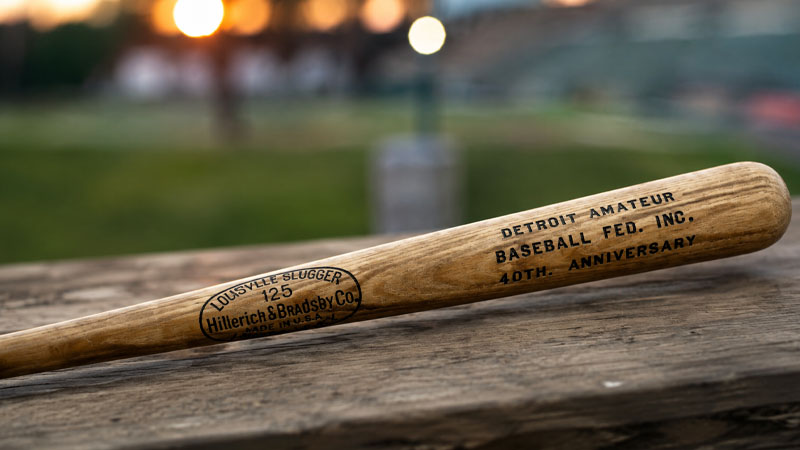
Few pieces of sports equipment evoke as much reverence as the wooden baseball bat. At the center of American baseball history stands the Hillerich & Bradsby Louisville Slugger Model 125.
For over a century, the number “125” served as Hillerich & Bradsby’s gold-standard designation, signaling that a bat was crafted from top-grade timber.
Whether you inherited a weathered bat from a relative’s attic or you are building a sports memorabilia collection, understanding the history, valuation, and authentication process of the Model 125 is essential.
What Makes the Louisville Slugger Model 125 Iconic?
In the early 20th century, Hillerich & Bradsby (H&B) created a cataloging system to differentiate their lumber tiers. The number 125 was assigned exclusively to their premium line.
- Timber Selection: Model 125 bats were turned using top 3% professional-grade Northern White Ash wood. This wood was selected for its tight grain structure, flexibility, and hard-hitting surface density.
- Dual Market Purpose: H&B turned Model 125 bats both for Major League players under contract and for consumer retail store lines featuring facsimile player signatures.
- Cultural Impact: From Babe Ruth and Ted Williams to Roberto Clemente and Mickey Mantle, baseball legends used 125-stamped timber to define eras of the game.
Retail Store Models vs. Professional Game-Issued Bats
The most common misconception among collectors is assuming that every bat stamped “125” was swung by a Major League player in a game. Knowing the structural differences protects you from overpaying for a retail souvenir.
| Feature | Retail Store Model (“125”) | Professional Game-Issued Model |
| Barrel End Marking | Features stamped facsimile signatures or general model codes. | Features block-letter player names or custom vault spec codes. |
| Knob Markings | Typically blank or stamped with retail length numbers (e.g., 33, 34). | Stamped with custom factory codes (e.g., M110, P89, K55) or player jersey numbers. |
| Finish & Weight | Standard light/medium finish; uniform stock dimensions. | Custom balance ratios, specialized handle finishes, pine tar, or ball marks. |
| Wood Density | High-grade ash, though tuned for general consumer usage. | Hand-selected, bone-rubbed top-tier professional stock. |
| Market Value Range | $20 – $150+ (depending on player name and condition) | $300 – $10,000+ (depending on player provenance and game wear) |
How to Date a Model 125 Bat Using Center Brand Marks
Hillerich & Bradsby systematically updated their center brand oval throughout the 20th century. Inspecting the precise wording and symbols inside this stamp provides a accurate timeline.
                     +---------------------------------------+
                     |           LOUISVILLE SLUGGER           |
                     |         HILLERICH & BRADSBY CO        |
                     |            LOUISVILLE, KY             |
                     +---------------------------------------+
                                         |
         +-------------------------------+-------------------------------+
         |                               |                               |
    (1921–1930)                     (1934–1943)                     (1944–1964)
 "Made in U.S.A." below         "Powerized" added right          Refined center oval;
  oval; pre-Powerized era.       of center brand oval.           oval width adjustments.
Key Logo Timeline:
- 1921–1930 (Pre-Powerized Era): Features “Louisville Slugger” inside the oval with “Made in U.S.A.” centered below it.
- 1934–1943 (Early Powerized Era): The trademarked term “Powerized” was stamped into the wood to the right of the oval center brand.
- 1944–1964 (Classic Era): Oval branding was simplified. Registered trademark symbols (
®) began making subtle appearances near the end of this range (consistently applied around 1960). - 1973–1979: The registered trademark
®was placed inside or directly beneath the lower arc of the center oval brand.
Step-by-Step Bat Inspection Guide
When evaluating a vintage Model 125, follow this inspection process:
Market Value Factors
The value of a Louisville Slugger Model 125 depends on three primary variables:
                          [ MARKET VALUE ]
                                 |
        +------------------------+------------------------+
        |                        |                        |
  [ PROVENANCE ]            [ CONDITION ]           [ PLAYER NAME ]
  • Game-Used Evidence      • Clear Center Brand    • Hall of Fame Era
  • Factory Order Matching  • Uncracked Handle      • Popularity/Rarity
  • Player Provenance       • Natural Patina        • Signature Type
Player Association: Bats linked to high-profile players (Babe Ruth, Lou Gehrig, Ted Williams, Roberto Clemente) command top prices across both retail and game-used categories.
Condition Grade: Unaltered wood with strong, dark branding stamps earns higher evaluations than bats affected by grain rot, heavy varnish overlay, or severe handle cracks.
Authentication: Professional Third-Party Authentication (PSA/DNA or MEARS) provides documentation for high-value game-used models, confirming factory shipping records and order dates.
Frequently Asked Questions
What does “Powerized” mean on a Model 125 bat?
“Powerized” was a proprietary heat-treating process introduced by Hillerich & Bradsby in the 1930s. The process hardened the outer wood fibers of the ash timber to resist splitting and improve pop upon impact.
Why are some Model 125 bats lighter or smaller than standard bats?
H&B produced youth and junior retail lines (such as the 125LL or Little League series) using the same “125” designation to indicate quality wood construction in scaled-down dimensions.
How can I tell if a signature on the barrel is real or stamped?
Retail store model bats feature facsimile signatures that were stamped or burned into the wood during production. These impressions have uniform depth, matching the color tone of the central branding. Hand-signed autographs, by contrast, are applied over the wood using ink pens, markers, or paint pens.