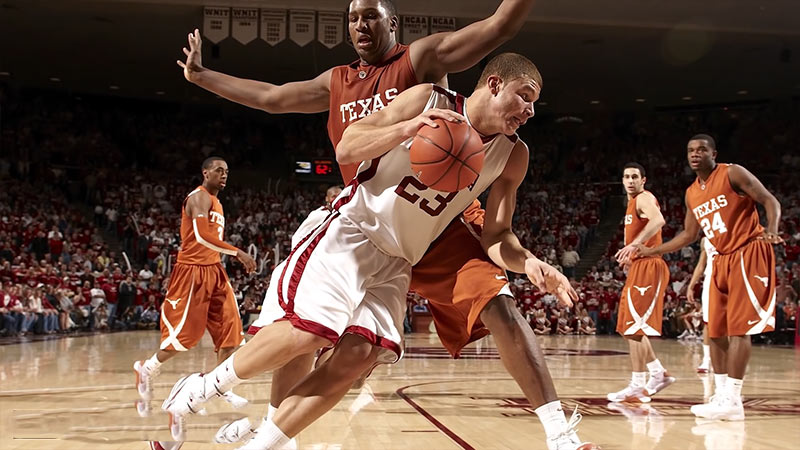
Since he burst onto the NBA scene as the number one overall pick in 2009, Blake Griffin has been a figure of fascination for basketball fans and cultural commentators alike.
Known for his explosive athleticism, high-flying dunks, and underrated playmaking ability, Griffin’s physical appearance—specifically his light complexion, freckles, and signature red hair—has frequently led to the same recurring question from the public: “What race is Blake Griffin?”.
While the question might seem simple to some, the answer is rooted in a rich, multicultural family history that spans from the Caribbean to America’s heartland.
Understanding Griffin’s race requires looking past the highlights on the court and into the lives of his parents, his upbringing in Oklahoma, and his own candid reflections on navigating life as a biracial man in the public eye.
The Foundation: Tommy and Gail Griffin
To understand Blake Griffin’s heritage, one must look at his parents, Tommy and Gail Griffin. Blake is biracial, born to a Black father and a white mother.
His father, Tommy Griffin, is of African-Haitian and African-American descent. Standing 6’8”, Tommy was a standout athlete himself, playing basketball and competing in track at Northwestern Oklahoma State University.
The Haitian side of the family carries a deep, if sometimes obscured, history. Sources note that while specific ancestral records for many in Haiti were lost during the era of French colonial slavery, the nation’s demographics today are roughly 95% of African descent.
Tommy eventually became a basketball coach, notably coaching both Blake and his older brother, Taylor, at Oklahoma Christian School.
His mother, Gail Griffin, is white, with English ancestry. Standing 5’10”, Gail is the source of Blake’s most distinct physical traits: his red hair and freckles.
Beyond genetics, Gail played a pivotal role in Blake’s intellectual development, homeschooling both him and Taylor for much of their childhood—Blake from first through eighth grade, and Taylor until the tenth grade.
Growing Up in Oklahoma: Sacrifice and Values
Blake was born on March 16, 1989, in Oklahoma City, Oklahoma. Growing up in a predominantly white state, the Griffin family remained a tight-knit unit focused on hard work and “the right values”.
Blake frequently speaks about the sacrifices his parents made to ensure he and Taylor had every opportunity to succeed. He recalls them working “crazy hours” and holding two jobs each.
To support the family while homeschooling the boys, the Griffins even ran a side business building trophies out of their home.
Blake remembers this as a family assembly line: his father would cut the trophy columns, his mother would unpack them, Taylor would dust them off, and Blake would pack the finished products back into boxes.
This upbringing was also defined by a unique dynamic on the basketball court. Tommy Griffin coached his sons through high school, leading them to two state championships.
Blake has noted that while his father knew exactly how to “push the right buttons” as a coach, he was masterful at “balancing the two,” immediately reverting to being “Dad” the moment they left the gym.
This influence is so profound that Blake has a “state” tattoo, which serves as an ode to his parents and a reminder to “stay in that lane” regarding the morals they instilled.
The Reality of the Biracial Experience
Despite the supportive environment at home, Griffin was not shielded from the complexities of race in America. As a child and teenager, he encountered both subtle and “outwardly blatant” racism.
One particularly jarring memory Blake shared involved a gas station clerk who questioned him and his brother, looking at them with suspicion.
Only later did Blake realize the clerk likely assumed their father had kidnapped them because of the difference in their skin tones. He also noted a disparity in how authority figures treated his parents, observing that his mother was treated better by police than his father was.
In high school, the personal impact of racial prejudice hit home when a girl Blake was interested in told him she was not allowed to date him because her father “wouldn’t let her date somebody that was Black”.
Looking back, Blake reflected on how, at the time, he simply accepted these interactions as “just how it is,” though he now recognizes the “racial undertones” or blatant prejudice involved.
The Art of “Code-Switching”
As Blake moved from the “predominantly white state” of Oklahoma into the “predominantly Black” world of the NBA, his ability to navigate different cultural spaces became a defining aspect of his identity.
Recently, Griffin spoke candidly about “code-switching”—the act of altering one’s language, behavior, or demeanor to fit into different social or cultural groups.
During a podcast appearance, Blake admitted that he adapts his speech and mannerisms depending on his environment.
He noted a “stark contrast” in how he might present himself; for instance, wearing glasses and a more reserved demeanor for one interview, then “blacking it up” with a chain and different slang in a locker room setting or on a podcast hosted by a peer like Carmelo Anthony.
For Griffin, this isn’t necessarily a conscious calculation but rather a “natural” adaptation to his surroundings. However, this ability to move between worlds has sometimes led to him being viewed as an “anomaly”.
Throughout his career, because of his lighter complexion and reserved personality, some observers have criticized him for not being “Black enough,” a label that adds another layer of pressure to the biracial experience.
Legacy Beyond the Labels
Blake Griffin’s race is not a simple “either/or” categorization. He is a mixed-race individual who draws strength and identity from both his Haitian-African American and Caucasian-English roots.
His journey reflects a broader societal discussion about the nuances of identity. While fans initially asked about his race because of his red hair and freckles, the answer reveals a story of family sacrifice, the challenges of navigating prejudice, and the fluid nature of cultural identity.
Whether he is seen as a “high-flying dunker” or a “god-like phenomenon” in the sport, Griffin’s openness about his background—from his “state” tattoo to his discussions on code-switching—offers a glimpse into the complexities of being a biracial athlete in the modern era.
Ultimately, as many have noted, his true substance as an athlete and a person is determined not by a racial category, but by the legend he continues to build on and off the court.