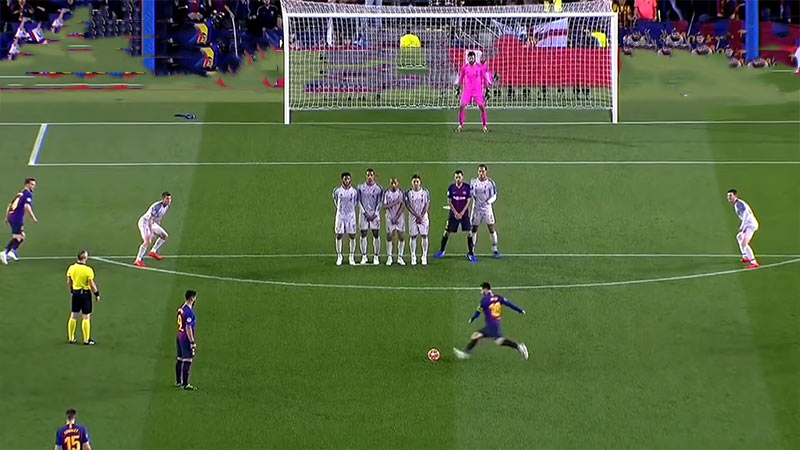
In the high-stakes environment of professional soccer, dead-ball situations often represent the difference between a hard-fought draw and a decisive victory.
Among these, the direct free kick stands out as one of the most potent offensive weapons available to a team. It is a restart that demands technical precision from the kicker and disciplined organization from the defense.
Understanding the specific mechanics, from the referee’s horizontal arm signal to the intricate “ten-yard rule,” is essential for anyone seeking to master the game’s strategic landscape.
This guide provides a definitive analysis of the regulations governing these pivotal moments.
Defining the Direct Free Kick and Its Scoring Power
A direct free kick is a specific method used to restart play following a foul or infraction. Its defining characteristic is the ability for the kicker to score a goal immediately from the strike without the ball needing to touch any other player, teammate, or opponent.
This distinguishes it from other restarts where multiple touches are a legal requirement for a goal to be recorded.
The Scoring Advantage
When a direct free kick is awarded, the attacking team gains a significant tactical advantage. Because the kick is “direct,” a goal is officially awarded if the ball enters the opponent’s net following the initial strike.
This often leads to the iconic “spectacular goals” seen in professional highlights, where a player curls the ball over a defensive wall and into the corner of the net.
The Own-Goal Protocol
There is a specific, often misunderstood nuance regarding goals scored at the “wrong” end of the pitch. If a player takes a direct free kick and the ball enters their own net without touching another player, a goal is not awarded.
Instead, the referee will award a corner kick to the opposing team. This regulation prevents a team from being unfairly penalized with a goal due to a mechanical error or a severe miskick during a restart.
Essential Mechanics and Ball Placement Regulations
To ensure the integrity of the restart, several mechanical requirements must be met before the whistle is blown. These rules are strictly enforced at the professional level to prevent either team from gaining an unfair head start.
Ensuring a Stationary Ball
The most fundamental rule of the direct free kick is that the ball must be completely stationary at the moment of the strike. It must be placed at the exact spot where the foul occurred.
If the ball is rolling or moving even slightly when the kicker makes contact, the referee will typically order the kick to be retaken, as the restart is considered invalid under the Laws of the Game.
The Ten-Yard Defensive Perimeter
To provide the kicker with a fair opportunity to restart play, the defending team is subject to strict proximity limits.
- Minimum Distance: All opponents must remain at least 10 yards (9.15 meters) away from the ball until it is officially in play.
- The Defensive Wall: In many scenarios near the goal, defenders will form a “wall” at this 10-yard mark to block a direct shot.
- Enforcement: Professional referees often use vanishing spray to mark the 10-yard line, ensuring that defenders do not “creep” forward to narrow the shooting angle.
Identifying the Ten Direct Free Kick Offenses
A referee awards a direct free kick when a player commits one of ten specific offenses that are deemed to be careless, reckless, or involving excessive force. These offenses are generally categorized by the nature of the physical contact or the technical infraction.
Serious Physical Contact Fouls
Most direct free kicks result from physical challenges between players. If a player performs any of the following actions against an opponent, a direct restart is awarded:
- Tripping or attempting to trip: Using the legs or body to cause an opponent to stumble.
- Kicking or attempting to kick: Striking or trying to strike an opponent with the feet.
- Striking or attempting to strike: This includes punches, elbows, or any form of physical hitting.
- Pushing: Using the hands or body to move an opponent off their path.
- Jumping at an opponent: Launching the body toward a player in a dangerous manner.
- Charging: A physical challenge for the ball that is deemed illegal or overly aggressive.
Technical and Unsporting Infractions
Beyond direct physical striking, other actions that disrupt the flow of the game or violate safety standards lead to a direct free kick.
- Handling the Ball: A deliberate handball by any player, excluding the goalkeeper within their own penalty area, results in a direct kick.
- Holding an Opponent: Physically restraining a player to prevent them from moving toward the ball.
- Spitting: This is considered a major offense of unsporting behavior.
- Throwing Objects: Hurling an object at the ball, an opponent, or a match official.
The Critical Intersection: Direct Kicks and Penalty Kicks
The location of a foul on the field significantly changes the consequence of the infraction. While the nature of the foul remains the same, the proximity to the goal can escalate the restart from a free kick to a penalty kick.
Fouls Within the Penalty Area
If any of the ten direct free kick offenses mentioned above are committed by a player within their own penalty area, the restart is upgraded.
Instead of a free kick where a wall can be formed, the referee awards a penalty kick. This is a one-on-one situation between the attacker and the goalkeeper from 12 yards out.
Consistency of the Infraction
It is important to note that only the “direct” fouls lead to penalties. If an offense that normally results in an indirect free kick occurs in the box, it does not become a penalty; it remains an indirect free kick.
This emphasizes why players must be exceptionally careful with physical contact and handballs when defending their own goal.
Decoding Referee Signals: Direct vs. Indirect
For players, coaches, and spectators, the ability to read the referee’s body language is vital for anticipating the next phase of play. There are two distinct visual cues for the two types of free kicks.
The Direct Free Kick Signal
When a referee awards a direct free kick, they will point one arm horizontally. The arm points in the direction of the goal of the team being penalized.
This tells the attacking team that they are free to shoot directly at the goal as soon as the whistle blows and the ball is set.
The Indirect Free Kick Signal
In contrast, the signal for an indirect free kick is vertical. The referee holds one arm straight up above their head. This remains the signal until the kick has been taken and the ball has touched another player or gone out of play.
This visual cue warns the kicker that a direct shot into the net will not count as a goal unless someone else touches it first.
Tactical Differences: Direct vs. Indirect Kicks
While both are restarts, the strategic approach to a direct kick is vastly different from its indirect counterpart due to the “second touch” requirement.
Key Distinctions at a Glance
| Feature | Direct Free Kick | Indirect Free Kick |
|---|---|---|
| Direct Goal? | Yes, permitted. | No, requires a second touch. |
| Referee Signal | Arm pointed horizontally. | Arm held vertically. |
| Typical Offense | Serious physical fouls/handballs. | Technical errors (e.g., goalkeeper time-wasting). |
| Own Goal? | Corner kick awarded. | Corner kick awarded. |
The Logic Behind the Rules
Direct free kicks are generally reserved for offenses that involve physical danger or the deliberate stopping of a play with the hands.
Because these are considered more “egregious” violations of the spirit of the game, the attacking team is rewarded with the most direct path to a goal.
Indirect free kicks are typically for procedural or technical violations where a direct shot would be considered too harsh a penalty.
The Strategic Importance of the Direct Kick in Modern Play
In professional soccer, teams spend hours on the training ground perfecting “set pieces.” The direct free kick is the crown jewel of these rehearsed plays.
The Role of the Specialist
Most top-tier teams have a designated specialist—a player with the technical ability to strike a stationary ball with high velocity and specific trajectory.
These specialists study the goalkeeper’s positioning and the height of the defensive wall to determine whether to go over the wall, around it, or strike it toward the goalkeeper’s side.
Defensive Counter-Measures
The defending team must react instantly to a direct free kick whistle.
- Wall Organization: The goalkeeper usually coordinates the wall to cover one side of the goal, while they take responsibility for the other.
- The “Jumper” and the “Lay-down”: In recent years, teams have added a player lying down behind the wall to prevent low shots, while the rest of the wall jumps to block high shots.
- Line Management: Defenders must ensure they do not step forward before the ball is kicked, as a yellow card can be issued for failing to respect the required distance.
Conclusion: Mastering the Restart
The direct free kick is more than just a punishment for a foul; it is a fundamental pillar of soccer strategy that balances the scales between offense and defense.
By understanding the ten specific offenses that trigger the whistle—from common trips to handball violations—players can better navigate the physical demands of the sport without conceding dangerous opportunities.
For fans, recognizing the referee’s horizontal signal provides immediate context for the unfolding drama on the pitch.
Whether it results in a powerful strike into the top corner or a clever tactical pass, the direct free kick remains one of the most exciting and influential moments in any match.
Knowing these rules ensures that every participant, from the grassroots level to the professional stage, respects the mechanics that keep the beautiful game fair and competitive.
Frequently Asked Questions
What happens if a direct free kick is taken before the referee whistles?
If the referee has indicated that the kick must be taken on the whistle (usually for ceremonial starts where the wall is being moved), any kick taken before the whistle will be retaken, and the kicker may be cautioned.
Can a goalkeeper score a direct free kick?
Yes. Any player on the field, including the goalkeeper, can take the kick and score directly in the opponent’s goal.
What is the “ten-yard rule”?
It is the requirement that all defending players remain at least 10 yards away from the ball until it is in play. This ensures the kicker has the necessary space to execute the restart.