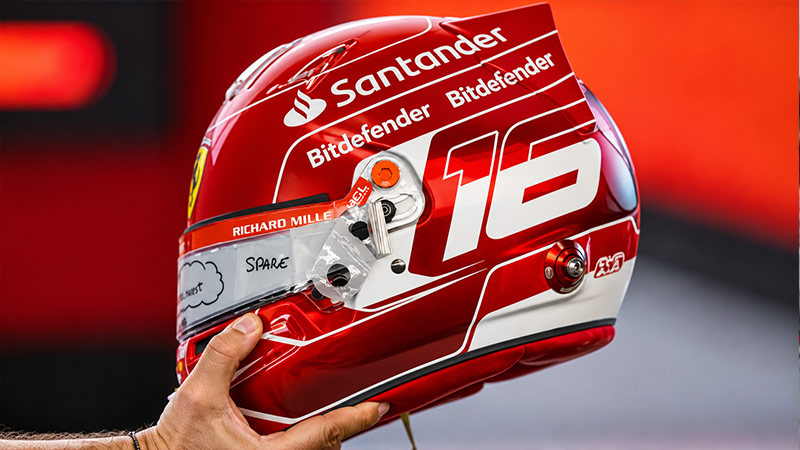
A Formula 1 helmet costs about $4,000 to $7,000 as a bare, FIA-certified shell, and roughly $10,000 to $20,000 once it has been fitted, painted and wired for a specific driver.
That is the price of a decent used car, for an object that weighs about as much as a large bottle of water.
The numbers keep climbing from there. Each driver gets through 12 to 15 helmets over a season. And once a famous driver has worn one in anger, its value can pass $1 million at auction.
This guide breaks down exactly where the money goes: the materials, the FIA testing every model must survive, the hand-building process, the paint and the electronics inside.
You will also see how F1 helmets compare with track-day and road helmets, what fans can realistically buy, and which race-worn helmets have set records.
How Much Does an F1 Helmet Cost? The Quick Answer
The cost of an F1 helmet stacks up in three layers: the certified shell, the driver-specific finishing, and the number of helmets needed each season.
- Base helmet: $4,000 to $7,000. Top-spec FIA 8860-2018 helmets from F1 suppliers sit in this range at US retailers. Bell’s HP7 Evo III lists at about $4,000, Arai’s GP-7SRC ABP at about $4,600, Bell’s HP77 at about $5,000 and Stilo’s ST5 FN Zero ABP at about $6,200.
- Race-ready driver helmet: $10,000 to $20,000 (estimate). A custom-moulded interior, a bespoke paint scheme, specialist visors, radio earpieces and a drinks tube push the price far beyond retail.
- Per driver, per season: roughly $120,000 to $300,000 (estimate). Helmet makers typically supply 12 to 15 helmets to each driver every year.
The twist? Drivers rarely pay for any of it. Helmet brands supply them under sponsorship deals, because a helmet on the F1 grid appears in almost every onboard shot of every race.
Why Are F1 Helmets So Expensive?
An F1 helmet is expensive because it is a hand-built, low-volume, aerospace-grade product that must pass one of the toughest safety standards in sport. Five factors drive the price.
1. Exotic materials
The outer shell is laid up from many layers of carbon fibre composite, combined with aramid fibres (the family that includes Kevlar) and bonded with epoxy resin.
Beneath it sits an energy-absorbing foam liner, then a fire-retardant comfort layer. A strip of Zylon, the same super-fibre used in the cars’ wheel tethers, runs across the top of the visor to stop flying debris.
2. Hand-built in tiny numbers
Building one complete top-spec helmet can take two or three skilled technicians a full day. That caps output at hundreds of helmets a year rather than thousands, so there is no mass-production discount to pass on.
3. Made to measure
Driver helmets are fitted to the millimetre. Makers use 3D head scans and custom-moulded liners so the helmet stays perfectly stable under cornering forces of 5g and more. A loose helmet at 300 km/h is a distraction no driver can afford.
4. Aerodynamics and integration
Every shell is developed in the wind tunnel, with spoilers and air intakes tuned for the cockpit. When a team updates its car, helmets sometimes need modifying too. Inside, makers integrate radio earpieces, a microphone, a drinks tube and the mounting posts for the HANS head-and-neck restraint.
5. Relentless weight saving
Despite all that hardware, a finished F1 helmet weighs only about 1.2 to 1.5 kg. Every gram saved reduces the strain on a driver’s neck over a race of up to two hours, and every gram saved costs money in materials and engineering time.
The FIA 8860-2018 Standard: Safety Testing That Drives the Price
Every helmet on the F1 grid must meet FIA 8860-2018, the governing body’s top-level “advanced helmet” standard. It became mandatory in Formula 1 in 2019 after more than a decade of research carried out with Bell, Stilo, Schuberth and Arai.
These are the headline tests a helmet must pass:
| Test | What the helmet must survive |
|---|---|
| Standard impact | Impact at 9.5 m/s, with peak deceleration on the head no higher than 275g |
| Low-velocity impact | Impact at 6 m/s, with peak deceleration no higher than 200g |
| Low lateral impact | Side impact at 8.5 m/s, with peak deceleration no higher than 275g |
| Advanced ballistic protection | A 225 g metal projectile fired at 250 km/h |
| Shell penetration | A 4 kg impactor dropped onto the shell at 7.7 m/s |
| Visor penetration | A 1.2 g air-rifle pellet must not reach the inside of the helmet |
| Flammability | Exposure to a 790 °C flame, after which the helmet must self-extinguish |
Why the standard adds cost
The 2018 standard lowered the top of the visor opening by 10 mm to make room for extra ballistic protection, and it raised energy-absorption targets by up to 22% for larger sizes. That meant new shell designs, new moulds and new tooling for every manufacturer.
Certification is expensive too. The FIA grants homologation only for the exact model and size tested, and a test house needs a minimum of seven complete helmets for each submission, many of which are destroyed.
Repeat that across every shell size, and the development bill climbs long before a single helmet reaches a driver.
F1 Helmet Cost Breakdown: Where the Money Goes
In a race-ready driver helmet, the certified shell accounts for only about a third to a half of the total bill. The rest goes on finishing work that turns a standard helmet into a personal piece of safety equipment.
Teams and helmet makers do not publish invoices, so the figures below are estimates built from retail pricing and published industry figures.
| Component | Estimated cost (USD) | What it covers |
|---|---|---|
| FIA 8860-2018 ABP base helmet | $4,000–$7,000 | Carbon shell, energy-absorbing liner, standard visor, HANS posts |
| Custom fitting and interior | $1,000–$2,000 | 3D head scan, moulded liner, made-to-measure cheek pads |
| Bespoke paint and livery | $3,000–$8,000 | Design work, masking, multiple paint and lacquer layers, sponsor logos |
| Visors and tear-offs | $500–$1,500 | Clear, tinted and mirrored visors, plus stacks of peel-away strips |
| Electronics and hydration | $1,000–$2,000 | Moulded radio earpieces, microphone, drinks tube |
| Aero parts | $300–$800 | Rear spoilers, top air intakes, ducts |
| Estimated total | $10,000–$20,000 | One race-ready helmet for one driver |
Paint is the most variable line. A simple refresh of a driver’s regular design costs far less than a one-off special for Monaco or a home race, which can involve weeks of design and dozens of hours of hand-masking.
There is also a hidden cost the table cannot show: research and development. Designing a new shell, then certifying it in every size, costs manufacturers far more than any single helmet, and that bill is spread across a very small production run.
How Many Helmets Does an F1 Driver Use Per Season?
A typical F1 driver uses 12 to 15 helmets a season, which pushes the annual helmet bill for one driver into six figures.
Bell, the largest supplier on the grid, has described contracts of 12 to 15 helmets per driver per year. It prepares four helmets for each Grand Prix weekend, including two set up for wet conditions. Drivers need that many for three reasons:
- Special designs. One-off liveries for home races and showcase events such as Monaco, Miami and Las Vegas are often worn for a single weekend. The FIA once limited drivers to one helmet design per season, but scrapped that rule for 2020.
- Changing conditions. Spare helmets carry different visors for bright sun, low light and rain, so a driver can switch quickly between sessions.
- Wear and damage. Any helmet involved in a significant impact is retired, and constant use takes its toll on liners and fittings.
The season maths
Using the estimates above, 12 helmets at $10,000 each comes to $120,000, while 15 helmets at $20,000 each reaches $300,000. Across a 22-driver grid, that puts the sport’s annual helmet bill at roughly $2.6 million to $6.6 million.
Old helmets rarely go to waste. Most end up in drivers’ personal collections, are given to team members and partners, or are auctioned for charity.
Who Makes F1 Helmets, and Who Pays for Them?
Four manufacturers have supplied the modern F1 grid, and drivers almost never pay for their own helmets.
| Maker | Home country | F1-grade model | Typical US retail price |
|---|---|---|---|
| Bell | USA | HP77, HP7 | About $4,000–$5,000 |
| Stilo | Italy | ST5 FN Zero ABP | About $6,200 |
| Arai | Japan | GP-7SRC ABP | About $4,600 |
| Schuberth | Germany | SF series | Made to order |
Bell is the dominant name, supplying helmets to 13 drivers on the grid by its own count in 2025. Lewis Hamilton, Charles Leclerc, Lando Norris and Oscar Piastri all race in Bell’s HP77.
Who picks up the bill?
Helmet brands supply drivers with an agreed number of helmets each season under sponsorship agreements. For the manufacturer, it is some of the best marketing in motorsport: the helmet is on screen in every onboard shot, podium and interview. A driver’s personal partners may also fund special paint designs, which is why one-off helmets often carry extra logos.
Can Fans Buy an F1 Helmet? Replicas, Minis and Race-Worn Helmets
Yes, at almost any budget, but what you get changes dramatically with the price.
- 1:2 scale mini helmets ($160–$230): Officially licensed half-size replicas made by Bell in the same facility as its race helmets. A 2026 Lewis Hamilton Ferrari mini lists at about $190. They are for display only.
- Full-size replicas (about $650–$2,000): Licensed 1:1 copies of a driver’s design. They look the part on a shelf but are not certified for racing.
- A genuine FIA 8860 helmet ($4,000–$7,000): The same homologated models used on the grid, sold through motorsport retailers. The right choice if you race and want top-level protection.
- Race-worn helmets ($100,000 and up): Authenticated helmets that a driver actually wore are now blue-chip collectibles, and prices have soared.
A 1982 Gilles Villeneuve Helmet Holds the F1 Auction Record at $1.25M
These are the highest prices ever paid for race-worn Formula 1 helmets at auction.
| Rank | Driver | Helmet | Auction price (USD) |
|---|---|---|---|
| 1 | Gilles Villeneuve | 1982 San Marino Grand Prix | $1,250,000 |
| 2 | Ayrton Senna | 1992 Belgian Grand Prix | $966,000 |
| 3 | Lewis Hamilton | 2023 season | $387,000 |
| 4 | Charles Leclerc | 2023 Monaco Grand Prix | $335,000 |
| 5 | Ayrton Senna | 1990 season | $184,340 |
Auction results from 2019 to 2026. Prices for euro sales are shown in US dollars.
The record has risen almost sevenfold since 2019, when a 1990 Ayrton Senna helmet set the mark at about $184,000. If you are buying at this level, insist on photo-matching to specific races, a certificate of authenticity and a documented ownership history.
F1 Helmet vs Other Racing and Road Helmets
A race-ready F1 helmet costs roughly 10 to 20 times as much as a quality club racing helmet, and the biggest price jump comes at the FIA 8860 line.
| Helmet type | Certification | Typical price (USD) | Who uses it |
|---|---|---|---|
| F1 driver-spec helmet | FIA 8860-2018 ABP, plus bespoke fit and finish | $10,000–$20,000 (estimate) | Formula 1 drivers |
| Advanced ballistic racing helmet | FIA 8860-2018 ABP | $4,600–$6,900 | Open-cockpit single-seaters, including F1, F2 and F3 |
| Advanced racing helmet | FIA 8860-2018 | $4,000–$4,200 | Professional GT and prototype racing |
| Club racing helmet | Snell SA2020 / FIA 8859-2015 | $850–$1,100 | National racing, track days, amateur series |
| Premium road motorcycle helmet | DOT / ECE 22.06 | $500–$1,000 (estimate) | Road riders |
The step from FIA 8859 to FIA 8860 buys ballistic protection, higher energy absorption and a lighter full-carbon shell. That is why a helmet built for national-level racing costs around $1,000, while its F1-grade sibling costs four times as much before any personalisation.
Conclusion
So, how much does an F1 helmet cost? A bare FIA 8860-2018 helmet runs about $4,000 to $7,000, while a race-ready driver helmet with custom fitting, paint, visors and electronics lands closer to $10,000 to $20,000.
Multiply that by 12 to 15 helmets a season, and one driver’s annual supply can top $120,000, a bill almost always covered by supplier deals rather than the driver.
The price reflects hand-built carbon construction, punishing FIA testing and constant weight-saving work, all aimed at one goal: protecting a human head at more than 300 km/h.