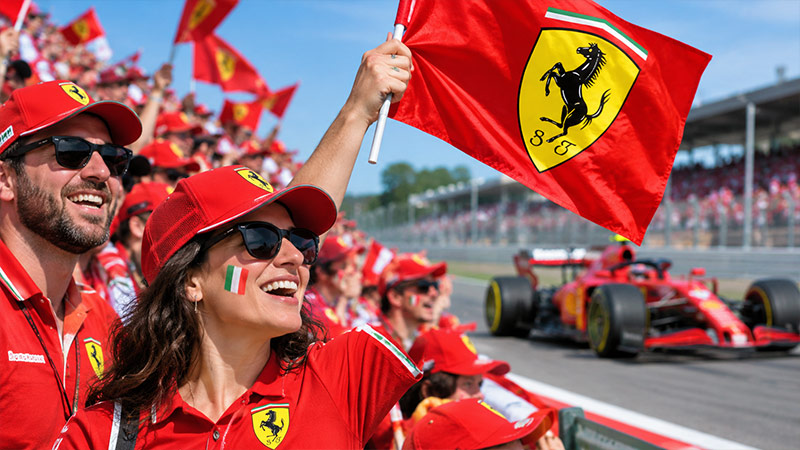
Picture the closing laps at Monza. Every grandstand is a wall of red, Prancing Horse flags snap in the September breeze, and a roar rolls down the main straight before the cars even appear.
Those are the tifosi, and for more than seven decades they have been the emotional heartbeat of Formula 1.
If you have heard a commentator say “the tifosi are on their feet” and wondered what the word really means, this guide is for you.
Below you will find the meaning, the surprising origin, the history, the rituals and the practical tips you need to understand, or even join, the most famous fan base in motorsport.
Quick answer: Tifosi (pronounced tee-FOH-zee) is the Italian word for passionate sports fans. In Formula 1, it refers to the devoted supporters of Scuderia Ferrari, the Italian team that has raced in every season of the world championship since it began in 1950.
What Does Tifosi Mean in F1?
In everyday Italian, tifosi simply means fans: the supporters of any team, club or athlete. In Formula 1, the word has a much narrower meaning.
It almost always refers to the fans of Scuderia Ferrari, so when a broadcaster says the tifosi are celebrating, nobody needs to ask which team they mean.
The word also carries more weight than “fans.” It suggests devotion that borders on obsession, a bond handed down from grandparents to grandchildren, and a belief that Ferrari belongs to the whole of Italy rather than to a company in Maranello.
| Form | Italian word | How to use it in English |
|---|---|---|
| Masculine singular | tifoso | One fan (male, or gender not specified) |
| Feminine singular | tifosa | One female fan |
| Masculine or mixed plural | tifosi | A group of fans; the standard F1 term |
| Feminine plural | tifose | A group of female fans |
How to pronounce it: say tee-FOH-zee, with the stress on the middle syllable. In northern Italy, home to both Maranello and Monza, the “s” sounds like a soft “z.” You will also hear tee-FOH-see in other regions, and both are correct.
Where Does the Word Tifosi Come From?
The word has a surprisingly medical origin. It comes from tifo, the Italian name for typhus. The disease brings a high fever that leaves patients restless, agitated and delirious, and in the early 20th century Italian sportswriters borrowed that image to describe supporters who seemed to lose their senses in the stands. A tifoso, quite literally, is someone “infected” with sporting fever.
The root goes back even further, to the Greek typhos, meaning smoke or stupor: the hazy, dreamlike state a fever creates. Over the decades the medical sense faded from everyday speech, while the sporting sense took over completely.
Today, Italians say fare il tifo, literally “to do the tifo,” when they mean cheering for a team. The word carries no negative tone at all. Calling someone a tifoso is a compliment, and Ferrari fans wear the label with pride.
Why Are Ferrari Fans Called the Tifosi?
Italy has passionate fans for many teams, so why does F1 reserve the word for Ferrari? Four reasons stand out.
- Ferrari is treated as a national institution. Other teams are seen as corporate brands. Ferrari, built by Enzo Ferrari and based in Maranello since 1943, is seen as part of Italian identity, much like a national football side.
- No team has been there longer. Ferrari is the only team to have competed in every Formula 1 world championship season since 1950, and it has started more than 1,000 Grands Prix. Generations of Italians have never known an F1 without it.
- No team has won more. Ferrari holds the records for constructors’ titles (16) and drivers’ titles (15), plus more than 240 Grand Prix wins.
- The red is Italy’s color. Rosso corsa, or “racing red,” was the color assigned to Italian cars in the early days of international motor racing. When a Ferrari passes, fans see their country, not just a car.
Put together, those factors explain why supporting Ferrari feels less like choosing a team and more like belonging to a family.
A Brief History of the Tifosi in Formula 1
The tifosi have lived through golden eras, painful droughts and plenty of drama in between. These are the moments that shaped them.
| Year | Moment | Why it matters to the tifosi |
|---|---|---|
| 1950 | Ferrari enters the first F1 world championship season | The start of an unbroken run that continues today |
| 1951 | José Froilán González wins the British Grand Prix | Ferrari’s first world championship victory |
| 1952–53 | Alberto Ascari wins back-to-back titles | Italy’s last drivers’ champion for 73 years |
| 1975–77 | Niki Lauda wins two titles | Ends an 11-year wait for a Ferrari drivers’ crown |
| 1977–82 | The Gilles Villeneuve years | A fearless driver who never won the title but became a lasting cult hero |
| 2000–04 | Michael Schumacher wins five titles in a row | The most dominant era in Ferrari history |
| 2007–08 | Kimi Räikkönen’s title, then the constructors’ crown | Ferrari’s most recent championships |
| 2019 | Charles Leclerc wins at Monza | Ferrari’s first home win since 2010 |
| 2024 | Leclerc wins at Monza again | A second Monza victory for the new favorite son |
| 2025 | Lewis Hamilton joins Ferrari | A seven-time champion pulls on the red overalls |
| 2026 | Hamilton wins in Barcelona; Leclerc wins the British Grand Prix | Ferrari’s first Grand Prix wins since late 2024 |
The 2026 season added a twist. Kimi Antonelli, a 20-year-old from Bologna, clinched the drivers’ title with Mercedes, becoming Italy’s first world champion since Ascari.
Many tifosi celebrated an Italian champion while still waiting for a red one, proof that their loyalty runs to both country and team.
Monza: The Spiritual Home of the Tifosi
The Autodromo Nazionale Monza, opened in 1922 in a royal park north of Milan, is where the tifosi feel most at home. Nicknamed the “Temple of Speed,” it has hosted the Italian Grand Prix in every world championship season except 1980, when the race moved to Imola.
Monza’s signature moment comes after the checkered flag. Marshals open the gates, and thousands of fans flood onto the main straight to gather beneath a podium that hangs out over the track.
The view from above is a sea of red flags, flares and banners, and it remains one of the most photographed scenes in world sport.
The crowds keep growing. The 2026 weekend set an all-time record:
| Italian Grand Prix weekend | Attendance (3 days) |
|---|---|
| 2026 | 403,666 (record) |
| 2025 | 369,041 |
| 2024 | About 335,000 |
The tifosi are also more international than many people assume. Before the 2026 race, Italy’s tourism minister said more than 64% of ticket holders came from outside Italy, from 69 countries. Local researchers put the event’s economic impact on the region at around €208 million.
The 2026 race itself showed every side of tifosi emotion. Leclerc crashed out on the second lap at Curva Alboreto, the corner most fans still call the Parabolica, and Hamilton finished sixth.
Yet when Antonelli charged from 19th on the grid to win, the crowd erupted for the first Italian to win the Italian Grand Prix since 1966.
Beyond Monza: Imola, Mugello and Maranello
Monza is the cathedral, but the tifosi have other places of pilgrimage.
- Imola: officially the Autodromo Enzo e Dino Ferrari, named after the team’s founder and his late son. It hosted the San Marino and Emilia Romagna Grands Prix, but it was dropped from the 2026 calendar to make way for Madrid. Local leaders have said they are determined to bring F1 back.
- Mugello: a Ferrari-owned circuit in the Tuscan hills. It hosted its first F1 race, the 2020 Tuscan Grand Prix, which was also Ferrari’s 1,000th Grand Prix.
- Maranello: the town where Ferrari has built its cars since 1943. Fans visit the factory gates, the Ferrari Museum and the edge of the Fiorano test track, opened in 1972, hoping to catch a glimpse of a new car on a test day.
What Makes the Tifosi Different From Other F1 Fans?
Every F1 fan base has its own character. What sets the tifosi apart is that they follow a team, not a person, and that loyalty survives driver changes, rule changes and long title droughts.
| Fan group | Main loyalty | Home race | Signature look | What defines them |
|---|---|---|---|---|
| Tifosi | Scuderia Ferrari, the team | Italian Grand Prix, Monza | Red shirts and Prancing Horse flags | Multigenerational loyalty to one team through every era |
| Orange Army | Max Verstappen, the driver | Dutch Grand Prix, Zandvoort | Orange clothing and orange smoke | A movement built around one driver’s career |
| British fans | British drivers across several teams | British Grand Prix, Silverstone | Union flags and their drivers’ team colors | Huge home crowds: 564,000 over the 2026 race weekend |
That devotion has a demanding side. The tifosi, backed by a passionate Italian press, expect wins. Drivers who succeed in red become legends, while those who struggle face intense criticism. Love and pressure come as a package.
Tifosi Traditions and Rituals
Being a tifoso is about more than watching races. It comes with its own customs, many of them decades old.
- Dressing in red: from caps to face paint, red is the uniform. At Monza, entire grandstands turn scarlet.
- Giant flags and homemade banners: Prancing Horse flags, Italian tricolors and hand-painted messages to the drivers appear at every race where Ferrari competes.
- The track invasion: the post-race rush onto the Monza straight is the ritual every tifoso wants to experience at least once.
- Chants and songs: “Forza Ferrari!” and the drivers’ names echo around the circuit all weekend.
- The bells of Maranello: after a Ferrari victory, the bells of the local church ring out across the town, a custom that has lasted for decades.
- Fan clubs: Ferrari’s official fan club network links supporters worldwide, who meet for watch parties, track days and trips to Italy.
- Passing it on: many tifosi attended their first Grand Prix on a parent’s shoulders, and they bring their own children to Monza in turn.
The Tifosi Beyond Formula 1
The word was never exclusive to motorsport, and outside F1 it still applies to any passionate Italian supporter.
- Football: fans of clubs such as Juventus, Inter, Milan and Roma are all tifosi. Their huge choreographed stadium displays, made of flags, cards and banners, are known as tifo, a term now used by football fans worldwide.
- Cycling: roadside crowds at the Giro d’Italia, often painted in the colors of their favorite riders, are cycling tifosi.
- MotoGP: the yellow-clad followers of Valentino Rossi turned Mugello and Misano into some of the loudest venues in motorcycle racing.
- Endurance racing: Ferrari’s hat-trick of Le Mans 24 Hours wins from 2023 to 2025 gave the tifosi a fresh reason to cheer away from F1.
In English-language F1 coverage, though, “the tifosi” almost always means one thing: the people dressed in Ferrari red.
How to Experience the Tifosi for Yourself
Reading about the tifosi is one thing; standing among them is another. Here is how to plan it.
- Plan for early September. The Italian Grand Prix usually runs on the first weekend of September; the 2026 edition was held on September 4–6. The 2026 race sold out, so watch for ticket releases well ahead of time.
- Pick your view. Main straight grandstands put you closest to the podium and the track invasion. General admission is cheaper and lets you roam the park, while the stands at the Ascari chicane and Curva Alboreto offer close-up action.
- Use public transport. Most fans stay in Milan and take the train to Monza, then walk or ride a shuttle into the park. Roads around the circuit jam on race day.
- Arrive early on Sunday. The atmosphere builds for hours before the start, and the best spots fill quickly.
- Stay for the track invasion. Remain near the main straight after the race and follow the marshals’ directions when the gates open.
- Wear red, or at least respect it. Fans of every team are welcome, but cheering for a rival in the middle of a Ferrari grandstand is best done politely.
- Add a day in Maranello. It is an easy trip from Bologna or Modena, and the Ferrari Museum gives you the full story of the team in one visit.
- Can’t travel? Join a fan club. Local Ferrari clubs host watch parties that bring a slice of Monza to your own city.
Common Mistakes When Using the Word Tifosi
Even seasoned fans slip up. Avoid these five errors and you will sound like a true insider.
- Saying “tifosis.” Tifosi is already plural, so it never takes an extra “s.”
- Calling one person “a tifosi.” One fan is a tifoso, or a tifosa if she is female.
- Assuming only Italians qualify. Ferrari supporters from Mumbai to Mexico City proudly call themselves tifosi.
- Treating it as an insult. The word celebrates passion. It is a compliment, not a criticism.
- Mixing up tifo and tifosi. Tifo is the act of cheering, or a choreographed stadium display; the tifosi are the people doing it.
Conclusion
The tifosi meaning in F1 runs far deeper than a dictionary entry. A word that began as a joke about fever now describes millions of people who treat Ferrari as family, faith and national pride rolled into one.
You can see it in the red wall at Monza, hear it in the bells of Maranello and feel it in fans who have stayed loyal through a title drought stretching back to 2008. That loyalty to the badge, not just the driver, is what makes them unique.