The F1 starting grid is set by qualifying, a one-hour knockout session usually held on Saturday.
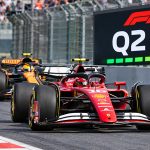
In 2026, the six slowest drivers are eliminated in Q1 (P17 to P22), six more drop out in Q2 (P11 to P16), and the top ten battle for pole position in Q3.
The stewards then apply any grid penalties, such as those for using extra power unit parts, before the FIA publishes the official grid.
Why the Starting Grid Matters So Much
In Formula 1, track position is currency. A car starting at the front runs in clean air, which lets its aerodynamics work at full strength and keeps tyres and brakes cooler.
A car starting further back spends the opening laps in turbulent air, fighting through traffic and risking contact in the first-corner scramble.
The value of a strong grid slot rises sharply at tight circuits. On street tracks such as Monaco and Singapore, overtaking is so difficult that Saturday’s result often shapes Sunday’s podium.
Even at faster venues, a front-row start hands a team more strategic options, because it can react to rivals rather than chase them.
That is why qualifying produces some of the most intense moments of any race weekend. A single lap, measured to the thousandth of a second, can define an entire afternoon.
How F1 Qualifying Works in 2026
Qualifying is a timed, three-stage knockout that lasts one hour. Drivers can complete as many laps as their tyres allow within each stage, and only their single fastest lap counts.
At the end of the first two stages, the slowest cars are eliminated and their grid positions are locked in.
The 2026 season brought two adjustments. Cadillac’s arrival as the 11th team took the field to 22 cars for the first time since 2016, so six drivers, rather than five, are now knocked out at each of the first two stages.
The FIA also added one minute to Q3, balancing it by trimming the break before the shootout from eight minutes to seven.
| Session | Length | Cars on track | Knocked out | Grid places decided |
|---|---|---|---|---|
| Q1 | 18 minutes | 22 | 6 slowest | P17 to P22 |
| Q2 | 15 minutes | 16 | 6 slowest | P11 to P16 |
| Q3 | 13 minutes | 10 | None | P1 to P10 |
A seven-minute break separates each stage, giving teams time to fit fresh tyres, study the data and plan the next run.
Q1: Survive the Cut
All 22 cars take to the track. With six places on the chopping block, the gap between progressing and going home early can be a few hundredths of a second.
Track evolution plays a big role here: as more rubber is laid down, the surface gets faster, so many drivers save their best effort for the final minutes. Get caught in traffic or behind a late yellow flag, and even a front-running car can tumble out.
Q2: The Midfield Squeeze
The 16 survivors return for 15 minutes. This is where the closely matched midfield fights hardest, because a place in Q3 guarantees a top-ten start and a far better shot at points. Positions 11 to 16 are set by the fastest Q2 laps of the drivers who miss the cut.
Q3: The Shootout for Pole
The final ten drivers get 13 minutes to set the fastest lap of the weekend. Most teams plan two flying runs on fresh soft tyres, with the last attempt timed for when the track offers peak grip. The fastest driver claims pole position, P1 on the grid, and the rest line up in order behind.
The Fine Print That Shapes the Order
Raw lap times are only part of the story. Several rules can promote, demote or erase a driver’s effort:
- Track limits: If a driver runs wide beyond the white lines at a monitored corner, that lap time is deleted. A deleted lap in the closing seconds can drop someone several places.
- Yellow and red flags: Drivers must slow for yellow flags, which usually ruins a lap. A red flag stops the session and pauses the clock, but any lap in progress is lost.
- Tie-breaks: If two drivers post identical times, the one who set it first ranks ahead. It sounds unlikely, yet at the 1997 European Grand Prix in Jerez, three drivers recorded exactly the same time to the thousandth of a second.
- The 107% rule: A driver whose best Q1 lap is slower than 107% of the fastest Q1 time may be barred from the race. The stewards can still allow them to start in exceptional circumstances, such as showing competitive pace in practice.
- Tyre freedom: Until 2021, top-ten qualifiers had to start the race on the tyres they used for their best Q2 time. That rule was scrapped from 2022, so every driver now chooses their starting tyres freely.
- Parc fermé: Once a car leaves the pit lane in qualifying, it enters parc fermé conditions. Teams can make only minor changes until the race, so the set-up chosen on Saturday is the set-up raced on Sunday.
Grid Penalties: When the Stopwatch Isn’t the Final Word
The qualifying classification is not the final grid. Penalties regularly reshuffle the order, and this is the part that confuses fans most.
Power Unit Penalties
Every driver has a limited allocation of power unit parts for the season. The all-new 2026 power unit is made up of six elements: the internal combustion engine (ICE), turbocharger (TC), exhaust (EX), kinetic motor generator unit (MGU-K), energy store (ES) and control electronics (CE).
To ease manufacturers into the new engine era, each driver received one extra unit of every element this year, and the FIA has since extended that leeway into 2027 and 2028.
Exceed the limit, and the penalties follow:
- The first time a driver goes over the allocation for an element, they drop 10 grid places.
- Each further extra unit of that element costs another five places.
- If a driver’s total grid penalty exceeds 15 places, they simply start from the back.
These penalties tend to pile up late in the season. At the 2026 United States Grand Prix, for example, Gabriel Bortoleto, Franco Colapinto and Arvid Lindblad all took grid drops, with Colapinto’s 10-place penalty triggered by his fourth control electronics unit of the year.
Teams often take several new parts at once at a track where overtaking is easier, accepting one heavy penalty to avoid repeated smaller ones.
Sporting Penalties
The stewards can also hand out grid drops for driving offences. Common examples include impeding a rival on a fast lap during qualifying, causing a collision in the previous race, or failing to slow under yellow flags.
A penalty earned at one race can carry over to the next event, although old penalties can now lapse: following a rule change, Cadillac’s Valtteri Bottas did not have to serve a five-place drop in Melbourne in 2026 because it had been issued more than 12 months earlier.
Pit Lane Starts
If a team breaks parc fermé rules, for example by changing the car’s set-up or fitting parts the regulations do not permit, the driver must start from the pit lane.
Pit lane starters wait at the end of the pit lane and join the race only once the whole field has passed the pit exit. Some teams choose this route deliberately when a car needs major work after a heavy crash in qualifying.
How Sprint Weekends Change the Picture
Six events on the 2026 calendar, including China, Miami, Canada and Silverstone, use the Sprint format. These weekends have two separate grids: one for the Sprint and one for the Grand Prix.
| Day | What happens |
|---|---|
| Friday | One practice session, then Sprint Qualifying |
| Saturday | The Sprint, then Grand Prix Qualifying |
| Sunday | The Grand Prix |
Sprint Qualifying mirrors the standard knockout but runs faster: SQ1 lasts 12 minutes, SQ2 10 minutes and SQ3 eight minutes, with the same six-car eliminations.
Teams must use new medium tyres in the first two stages and new softs in SQ3, which puts the spotlight on driver skill under pressure.
The Sprint itself is a 100-kilometre race with points for the top eight, from eight for the winner down to one for eighth place. Crucially, the Sprint result has no bearing on the Grand Prix grid.
That grid is set entirely by the regular qualifying session on Saturday afternoon, and teams are allowed to adjust their set-ups between the Sprint and Grand Prix Qualifying.
What Happens When Qualifying Can’t Go Ahead?
Sometimes the weather wins. When heavy rain or a storm makes running unsafe, race control first tries to reschedule.
Qualifying for the 2019 Japanese Grand Prix moved to Sunday morning because of Typhoon Hagibis, and the 2024 São Paulo Grand Prix did the same after torrential rain on Saturday.
If no qualifying can take place at all, the stewards decide how the grid is formed, with practice times the most likely fallback.
It is a rare scenario, but it shows how the regulations are designed to produce a fair grid even when the schedule falls apart.
From Timing Sheet to Official Grid: The Final Step
When qualifying ends, the FIA issues a provisional classification. The stewards then review any incidents, confirm penalties and apply them in the strict order the regulations set out.
Only after this process does the FIA publish the official starting grid, which is the version that counts on race day.
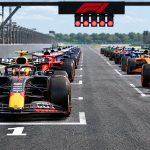
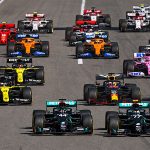
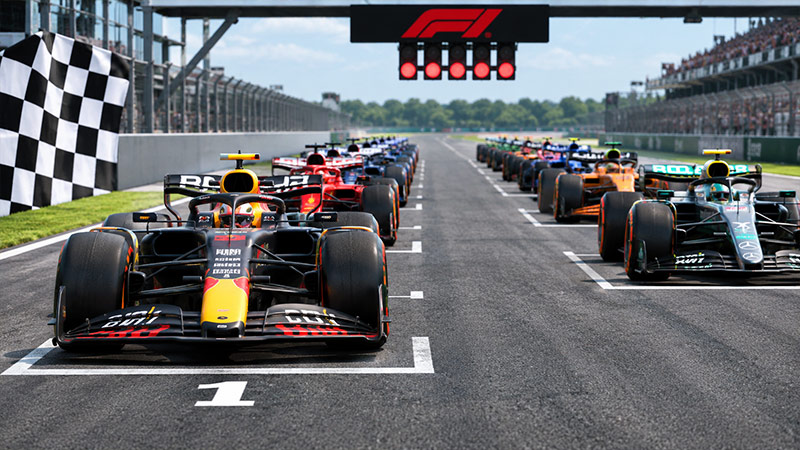
On Sunday, the cars line up in a staggered two-by-two formation, complete a formation lap to warm their tyres and brakes, and return to their grid slots. Then the five red lights come on one by one, go out together, and the race is on.
How to read a grid like an insider:
- Check the official starting grid, not just the qualifying results.
- Look for drivers with grid penalties, since fast cars starting out of position often climb quickly.
- Note any pit lane starters and the reason behind them.
- Compare starting tyre choices, which hint at each team’s race strategy.
- On Sprint weekends, remember that the Sprint and the Grand Prix have separate grids.
Conclusion
The F1 starting grid is far more than a list of lap times. It begins with a three-stage knockout that sorts 22 cars into three bands, then passes through a layer of rules covering tie-breaks, deleted laps, the 107% cut-off and parc fermé.
Finally, the stewards apply power unit and sporting penalties before the official grid is confirmed.
Once you understand these steps, every qualifying session becomes easier to read and more exciting to follow. You will spot the strategy behind a late run, the risk of a penalty and the true value of pole.