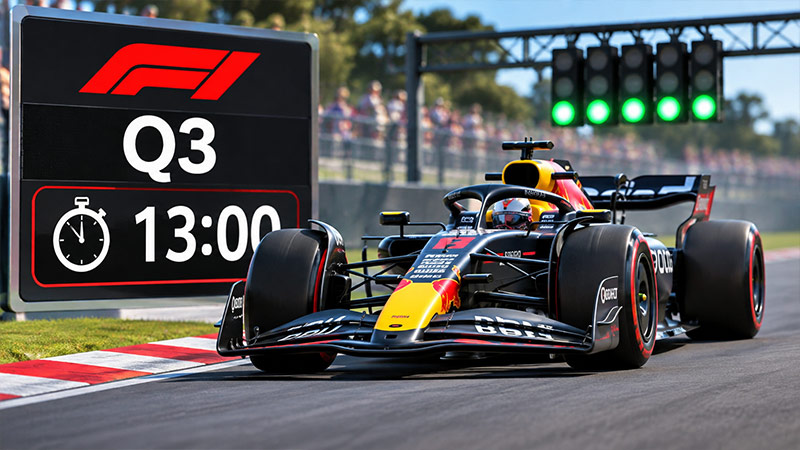
Q3 is the final, 13-minute part of Formula 1 qualifying, where the 10 fastest drivers fight for pole position and the first five rows of the grid.
Every lap counts, and one small mistake can cost a driver several places before the race even starts.
If you have ever watched the timing screen flash purple in the last minute and wondered what the drivers were actually doing, this guide is for you.
We will walk through how Q3 fits into the knockout format, how the session unfolds minute by minute, and why the 2026 rules have made it a test of battery management as much as bravery.
By the end, you will be able to follow Q3 like a strategist on the pit wall.
Q3 at a glance
In short: the 10 drivers who survive Q1 and Q2 get 13 minutes to set their single fastest lap, and that lap decides grid slots one to ten.
| Detail | 2026 rule |
|---|---|
| Cars taking part | 10 |
| Session length | 13 minutes (12 minutes before 2026) |
| Break before Q3 | 7 minutes |
| What it decides | Pole position and grid slots P1 to P10 |
| Tyres | One extra set of softs for every Q3 driver |
| Who takes pole | The fastest single lap; in a tie, the earlier time wins |
| Sprint version (SQ3) | 8 minutes, same 10-car shootout |
Where Q3 fits in the knockout
Q3 is the last of three knockout sessions, and with 22 cars on the 2026 grid, only 10 make it that far.
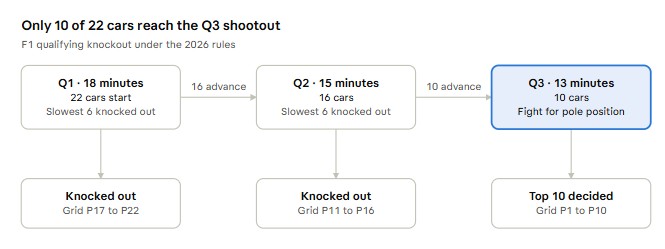
Q1 removes the six slowest drivers and Q2 removes six more, up from five each when the grid had 20 cars. Times from earlier sessions are wiped once a driver moves on, so everyone starts Q3 level and only Q3 laps decide the top 10.
How Q3 unfolds, minute by minute
Most drivers split Q3 into two runs, each built from an out lap, one flying lap and a cool-down lap. The extra minute added for 2026 gives a little breathing room, but there is rarely time for a third genuine attempt.
- The opening run. Cars leave the pit lane early to set a “banker” lap. This time protects the driver if anything goes wrong later in the session.
- The out lap. Drivers warm the tyres and brakes and charge the battery. They cannot crawl around, because race control sets a maximum time for each out lap.
- The push lap. One flat-out lap where every corner, and every bit of stored energy, matters.
- Back to the garage. Teams fit a fresh set of softs, cool the car and study the data to see where time was lost.
- The final run. Most cars head out together in the last few minutes, when the track has the most rubber and grip.
- The chequered flag. A driver who crosses the line before the clock reaches zero may finish that lap. That is why pole so often changes hands in the final 60 seconds.
Pole position goes to whoever sets the fastest single lap. The other nine drivers fill places two to ten in order of their best Q3 times.
Tyre rules and choices in Q3
Every driver who reaches Q3 receives one extra set of the softest tyres, so the top 10 are not punished for making the cut. At a standard Grand Prix, each driver has 13 sets of dry tyres for the whole weekend, typically eight of them softs.
Since 2022, Q3 drivers have also been free to choose their race-start tyres. Before that, the top 10 had to start on the tyres used for their fastest Q2 lap, which forced some awkward compromises.
Warming the tyres is harder in 2026. This year’s tyres are narrower, by 25 mm at the front and 30 mm at the rear, and Pirelli has warned that preparing a qualifying lap is now more complex. At smooth or cool circuits, drivers may have to push on the out lap just to bring the front tyres up to temperature.
The 2026 twist: managing the battery on a Q3 lap
The biggest change to Q3 in 2026 is energy. The new power units split their output almost evenly between the combustion engine and the electric motor, and that motor is about three times more powerful than before, while the battery stayed roughly the same size.
The result is a car that runs short of energy over a single lap. Early in the season, drivers found that the fastest lap was not always the most aggressive one.
Some lifted off the throttle to recharge, and cars sometimes slowed on straights with the pedal flat to the floor, a behaviour known as superclipping.
After strong criticism from drivers, the rules were adjusted from the Miami round in May:
- The most energy a car may recharge on a qualifying lap fell from 8 MJ to 7 MJ, so drivers spend less of the lap harvesting.
- Peak superclipping power rose from 250 kW to 350 kW, so the battery refills faster and the slow phases are shorter.
- The FIA can now set lower energy limits at up to 12 events, up from eight, to suit each circuit.
What this means for you as a viewer: a Q3 lap is now a puzzle. The fastest driver is often the one whose team has found the best plan for deploying energy at that track, not simply the one who brakes latest.
The strategy battle behind the lap
Q3 looks like a solo time trial, but teams make several calls that can swing the result by a few hundredths of a second.
- Track evolution. Grip usually improves as more rubber goes down, so the final run is normally the fastest. Going out last is an advantage, unless rain is on the way.
- Traffic and the pit-lane queue. With 10 cars chasing clean air, teams try to release their driver into a gap. In recent seasons, cars bunched up at the pit exit and some ran out of time to start a lap, which is the main reason Q3 gained an extra minute for 2026.
- The tow. On tracks with long straights, a car running just behind another gains speed from the reduced air resistance. Team-mates sometimes take turns giving each other a slipstream.
- One run or two. A driver can save a set of tyres by skipping the first run, but that leaves no banker lap if something goes wrong.
The 2026 rules add a new wrinkle. A car that is harvesting energy may be much slower on a straight than the car behind it, which makes judging the gap on an out lap harder and riskier.
What can go wrong in Q3?
A perfect lap can still be wiped out. These are the most common ways Q3 goes sideways.
- Red flags. If a crash or debris stops the session, the clock stops too and restarts once the track is clear. From 2026, any lap completed after the red flag first appears is invalid, even if the driver had not yet seen it.
- Yellow flags. A yellow flag forces drivers to slow down, and a lap set under double yellows is deleted. A late incident can ruin the final run for everyone behind it.
- Track limits. Run wide with all four wheels beyond the white line and the lap time is deleted. At some circuits, race control deletes many lap times in a single session.
- Stopping on track. A car that stops on the circuit and has to be recovered takes no further part in that session.
- Grid penalties. Q3 sets the order, but penalties for extra engine parts or rule breaches can push a driver down the grid. Topping Q3 does not always mean starting first.
- Parc fermé. Once qualifying begins, the car’s set-up is largely locked, with only minor changes allowed before the race. A set-up built for one perfect Q3 lap must also survive a full Grand Prix.
Sprint weekends: how SQ3 differs
Six rounds of the 2026 calendar are sprint weekends, and they have two qualifying sessions.
Sprint Qualifying sets the grid for the short sprint race and follows the same knockout pattern with shorter sessions: SQ1 lasts 12 minutes, SQ2 lasts 10 minutes and SQ3 just 8 minutes.
Eight minutes usually allows only one real attempt, so the pressure on a single lap is even higher. Regular qualifying for the Grand Prix then runs as normal, with the full 13-minute Q3.
How to watch Q3 like an insider
A few simple habits make Q3 far easier to read, whether you watch on TV or follow the live timing on your phone.
- Watch the sector colours. Purple means the fastest sector of the session so far; green means a driver’s personal best. A purple first sector early in a lap is a strong hint that pole is in play.
- Track the final-run order. Note who leaves the pit lane last. That driver usually gets the best track conditions.
- Listen for energy talk. In 2026, radio messages about battery use often explain why a driver lost time on a straight.
- Check the gaps, not just the order. Margins in Q3 are tiny, so one tenth of a second can be worth several grid places.
- Wait for the flag. Never assume pole is settled until the last driver has crossed the line.
Conclusion
Q3 is where an F1 weekend comes into focus. Ten drivers, 13 minutes and usually two runs decide pole position and the first five rows of the grid.
In 2026, the challenge runs deeper than bravery under braking. Drivers must warm narrower tyres, manage a battery that can run short on a single lap, and find a clear gap on a busy track. Teams that master all three tend to start at the front.
Now that you know how the session works, every purple sector and last-second improvement will make more sense.