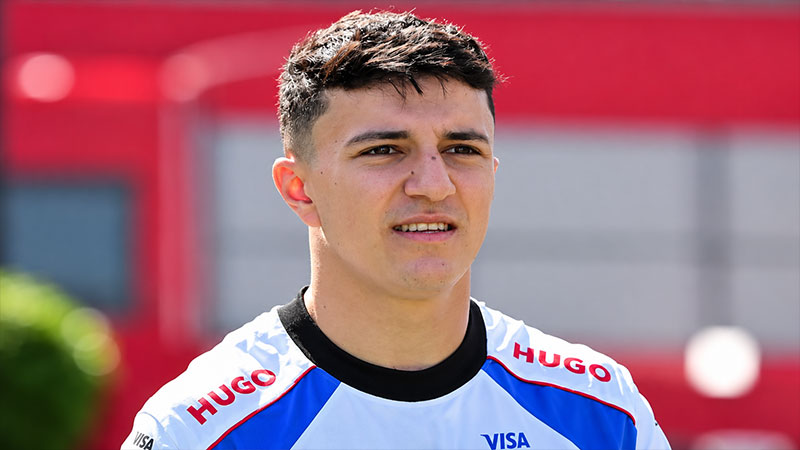
Isack Hadjar is French. He was born in Paris on 28 September 2004, competes on a French racing licence and lines up in Formula 1 under the French flag. He also has Algerian heritage through his family, which is why so many fans ask about his nationality.
That blend of identities has made Hadjar one of the most talked-about young drivers in the sport.
After an impressive rookie season with Racing Bulls in 2025, including a podium at the Dutch Grand Prix, Red Bull promoted him to its senior team for 2026 alongside Max Verstappen. As his profile has grown, so has curiosity about where he comes from.
This guide gives you the clear answer, explains how nationality works in Formula 1, and looks at why Hadjar’s French-Algerian story connects with fans on both sides of the Mediterranean.
Isack Hadjar at a glance
The essentials on Hadjar’s nationality and background, in one place.
| Detail | Answer |
|---|---|
| Nationality | French |
| Heritage | Algerian family roots |
| Date of birth | 28 September 2004 |
| Place of birth | Paris, France |
| Racing licence | French (FFSA) |
| Nickname | “Le Petit Prost” |
| F1 debut | 2025 Australian Grand Prix, Racing Bulls |
| 2026 team | Oracle Red Bull Racing |
| Car number | 6 |
Born in Paris: why Hadjar is French
Hadjar is French by birth and by upbringing. He was born and raised in Paris, learned his craft in French karting, and has represented France at every stage of his career.
French nationality can pass to a child through a French parent, and children born and raised in France can also acquire it under the country’s residence rules.
However it applies in his case, Hadjar’s French nationality has never been in doubt. It is the nationality behind his racing licence, the flag beside his name on the timing screens, and the anthem played when he tops a podium.
Growing up in Paris also shaped his route into the sport. France runs one of Europe’s best-organised motorsport ladders, with the national federation overseeing karting championships and junior single-seater programmes.
That same system helped produce Pierre Gasly and Esteban Ocon, the two French drivers who reached Formula 1 just before him.
Algerian roots: a French-Algerian identity
Hadjar’s family has Algerian origins, and that heritage is the main reason his nationality is so widely searched. Many fans see him as both French and Algerian, and in terms of identity, both descriptions make sense.
The legal picture is more specific. Algerian nationality law follows the principle of descent, so a child born to an Algerian parent is considered Algerian wherever they are born.
In principle, that could make Hadjar eligible for Algerian citizenship. But holding a second nationality and competing for a country are two different things, and on the track Hadjar has always been a French driver.
His story mirrors that of millions of people. France is home to one of the largest Algerian diaspora communities in the world, and many French citizens of Algerian descent carry both identities with ease.
Sport offers famous examples: Zinedine Zidane, born in Marseille to Algerian parents, became a French football icon and a hero to fans in Algeria at the same time.
Why he races under the French flag
In Formula 1, a driver competes under the nationality on their passport, and their FIA licence is normally issued by that country’s national motorsport authority.
Hadjar’s licence comes from the Fédération Française du Sport Automobile (FFSA), so the French tricolour appears next to his name.
Drivers with more than one nationality can choose which country to represent, and the grid has several well-known examples:
- Max Verstappen was born in Belgium to a Dutch father and a Belgian mother, and races as Dutch.
- Alexander Albon was born in London to a British father and a Thai mother, and races under the Thai flag.
- Nico Rosberg was born in Germany, grew up in Monaco and has a Finnish father, yet raced as German.
Hadjar’s choice has been consistent from day one. He came through French karting, raced for the French team R-ace GP in junior single-seaters, and has carried the French flag at every level since.
From Paris karting to Red Bull Racing
Hadjar went from French karting tracks to a Red Bull Racing seat before his 22nd birthday. Joining the Red Bull Junior Team in 2022 gave him the backing to climb the international ladder quickly.
| Year | Series | Team | Milestone |
|---|---|---|---|
| 2026 | Formula 1 | Red Bull Racing | Promoted to the senior team alongside Max Verstappen |
| 2025 | Formula 1 | Racing Bulls | Rookie season; first podium with 3rd at the Dutch Grand Prix |
| 2024 | FIA Formula 2 | Campos Racing | Championship runner-up |
| 2023 | FIA Formula 2 | Hitech | Rookie season in F2 |
| 2022 | FIA Formula 3 | Hitech | Race winner; joined the Red Bull Junior Team |
| 2021 | Formula Regional European Championship | R-ace GP | Front-running season with a French team |
His breakthrough came in 2024. Driving for Campos, he fought Gabriel Bortoleto for the Formula 2 title until the final round in Abu Dhabi and finished second, earning a Formula 1 seat for 2025.
His debut in Melbourne began with heartbreak, a crash on the formation lap that left him in tears, and a comforting hug from Anthony Hamilton, Lewis Hamilton’s father, that went around the world.
Hadjar answered with a mature, consistent rookie year, capped by third place at Zandvoort, and Red Bull rewarded him with a promotion.
“Le Petit Prost”: his place among French F1 drivers
Hadjar’s nickname ties him directly to French racing royalty. “Le Petit Prost” is a nod to Alain Prost, France’s four-time world champion, and to a calm, analytical approach that observers have compared with the man once known as “The Professor.”
He joins a long French tradition in Formula 1. Race winners such as Jacques Laffite, René Arnoux, Didier Pironi, Jean Alesi and Olivier Panis came before him, and Pierre Gasly and Esteban Ocon carried the flag into the modern era. In 2025, Hadjar was one of three French drivers on the grid, alongside Gasly and Ocon.
He also arrives at a moment when French fans are hungry for a new hero. France has not celebrated a world champion since Prost’s final title in 1993, and the French Grand Prix has been missing from the calendar since 2022.
A French driver in a Red Bull gives the home audience a fresh reason to tune in every race weekend.
Why his identity matters to fans worldwide
Hadjar’s background gives him a following that reaches well beyond France. Fans with North African roots, in Europe and across the Maghreb, have embraced his rise as a story they recognise.
For many young people from immigrant families, he sends a clear message: you can carry more than one identity and still reach the very top.
That matters in motorsport, which remains one of the most expensive and least diverse sports in the world. A Red Bull driver with a French-Algerian story stands out in a paddock that has historically looked very similar from one decade to the next.
His appeal also fits where Formula 1 is growing. The sport now races in Bahrain, Saudi Arabia, Qatar and Abu Dhabi, and its audience across the Middle East and North Africa keeps expanding.
A driver who connects with fans in Paris and in Algiers alike is valuable to teams, sponsors and broadcasters chasing that global reach.
Conclusion
Isack Hadjar is French by birth, by racing licence and by sporting allegiance, with Algerian roots that remain an important part of his family story.
Born in Paris in 2004, he climbed the French and European junior ladder, finished runner-up in Formula 2, scored a podium as a Racing Bulls rookie and now drives for Red Bull alongside Max Verstappen.
His journey shows that nationality and heritage can sit comfortably side by side. For France, he is a new hope after a long wait for another world champion.