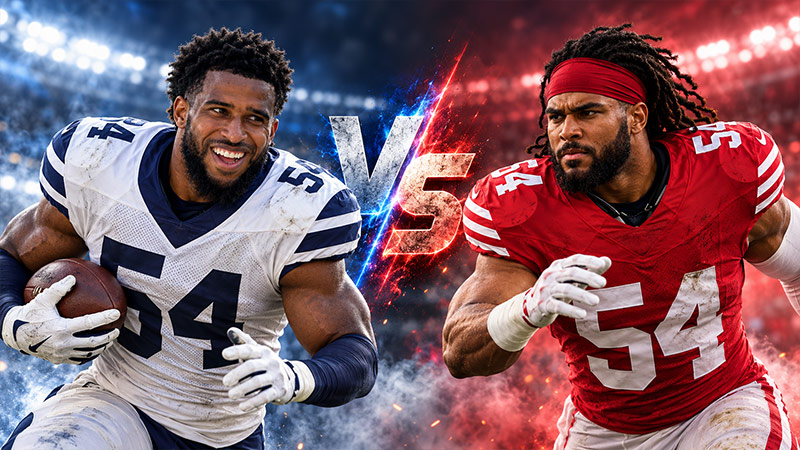
Bobby Wagner has the better career résumé, while Fred Warner gets my vote for coverage versatility. If the question is who has accomplished more, Wagner wins. If you are choosing a linebacker to handle demanding passing-game assignments, Warner has a compelling advantage.
The prime-versus-prime debate is closer. Wagner’s combination of tackling efficiency, recognition, physicality, and sustained excellence makes him my overall choice—but Warner’s ability to influence passing windows keeps the comparison competitive.
That distinction matters because “better” can mean several different things. Comparing career totals answers one question. Comparing each player’s best seasons answers another. Choosing someone to defend a particular offense introduces an entirely different set of priorities.
Here is how the Fred Warner vs. Bobby Wagner debate breaks down, with established achievements separated from judgments about playing style.
Fred Warner vs. Bobby Wagner: The Quick Verdict
Before examining the details, this is my assessment:
| Category | My choice | Main reason |
|---|---|---|
| Career accomplishments | Bobby Wagner | Longer record of elite recognition |
| Coverage versatility | Fred Warner | Range and flexibility against passing concepts |
| Run defense | Bobby Wagner | Recognition, positioning, and sustained execution |
| Tackling | Bobby Wagner | Exceptional peak efficiency alongside high volume |
| Defensive leadership | Too close to separate | Both have carried major communication responsibilities |
| Peak overall performance | Bobby Wagner, narrowly | Complete play across multiple consecutive elite seasons |
| Fit against a pass-heavy offense | Fred Warner | Ability to affect routes and passing windows |
| Overall career ranking | Bobby Wagner | Greater accumulated achievement |
These are analytical judgments, rather than official rankings. In particular, coverage comparisons require context about assignments, opponents, and defensive structure.
For a stable statistical reference, the season comparison below uses 2024, when both players completed 17-game regular seasons. Later injury information appears separately.
Who Has the Better Career?
Wagner has the stronger career argument.
By the end of the 2024 season, he had earned six Associated Press first-team All-Pro selections, five second-team selections, and 10 Pro Bowl selections. He also helped Seattle win Super Bowl XLVIII. Those achievements establish both an exceptional peak and unusual staying power.
Warner’s résumé is outstanding in its own right. He earned four first-team All-Pro selections across his first seven seasons, receiving the honor in 2020, 2022, 2023, and 2024. That is a substantial concentration of elite recognition early in a career.
The distinction is sustained achievement. Warner has built a strong case as one of his generation’s premier linebackers. Wagner has already assembled a longer body of work across different teams and defensive environments.
Career length alone does not establish greatness. A player should not win this debate simply by remaining employed longer. Wagner’s advantage comes from maintaining a high standard throughout that extended career.
Why first-team All-Pro honors matter
First-team All-Pro recognition is especially useful because it identifies a small group of players judged to be the best at their positions in a particular season.
It is still an award, with voting limitations and occasional disagreement. However, repeated selections provide meaningful evidence that a player’s reputation was supported by performance.
Wagner’s six first-team selections give him an advantage over Warner’s four in this category. Warner’s achievement rate makes the debate interesting, but future accomplishments cannot be counted before they happen.
Career verdict: Wagner.
What Do Their Statistics Tell Us?
The cleanest way to illustrate their different contributions is to compare the same completed season.
Their 2024 regular-season production
| Statistic | Fred Warner | Bobby Wagner |
|---|---|---|
| Games started | 17 | 17 |
| Combined tackles | 131 | 132 |
| Sacks | 1.0 | 2.0 |
| Passes defended | 7 | 4 |
| Interceptions | 2 | 0 |
| Forced fumbles | 4 | 1 |
| Fumble recoveries | 0 | 2 |
| AP recognition | First-team All-Pro | Second-team All-Pro |
San Francisco’s season summary documents Warner’s production, while Washington’s review records Wagner’s corresponding totals.
The tackle difference was essentially negligible. Their disruptive plays were distributed differently: Warner produced more interceptions, passes defended, and forced fumbles, while Wagner recorded more sacks and fumble recoveries.
Those differences help explain their contributions, but one season cannot settle a career comparison. Neither can a single statistic.
Why tackle totals need context
A linebacker making 150 tackles is clearly involved in the defense. The total alone does not explain how effectively he played.
Consider two situations:
- A linebacker stops a running back after a one-yard gain on third-and-three.
- A linebacker tackles a receiver after a 16-yard completion on third-and-three.
Both plays can add one tackle to the season total. Their value to the defense is very different.
Tackle opportunities also depend on defensive snaps, opponent play selection, front structure, and the performance of nearby teammates.
That is why the useful questions are where the tackle happened, whether the offense succeeded, and whether the defender fulfilled his assignment.
Pass Coverage: Why Warner Gets the Edge
Coverage is the strongest part of Warner’s argument.
My preference for Warner in this category comes from the range of passing-game problems his skill set can address. He can operate underneath, gain depth into intermediate windows, follow developing routes, and close toward the ball.
For a middle linebacker, those responsibilities demand more than speed. They require coordination between movement and recognition.
Taking away throws without touching the ball
Some of a linebacker’s best coverage plays never appear in a conventional box score.
A quarterback may want to throw a crossing route, only to find the linebacker occupying the passing lane. The quarterback moves to another read, holds the ball, or throws somewhere less favorable.
The linebacker receives no interception and no pass breakup. He still helped determine the play.
Warner’s case is particularly strong when evaluating this kind of influence: how his positioning can discourage throws and allow the defense to protect vulnerable areas.
Coverage versatility matters against modern offenses
Offenses use motion, play-action, and layered routes to force linebackers into difficult decisions.
A defender may need to respect the run, recognize a route developing behind him, and recover enough depth to contest the pass. A small hesitation can open a substantial window.
Warner’s movement skills and awareness make him an attractive choice for those assignments.
However, describing Wagner as merely a run defender would badly weaken the comparison. Prime Wagner also possessed the athleticism and recognition required to operate effectively in coverage.
The reasonable conclusion is a preference for Warner’s coverage versatility—not a claim that Wagner lacked coverage ability.
Coverage verdict: Warner.
Run Defense: Wagner’s Strongest Technical Argument
Wagner gets my vote against the run because of the relationship between his recognition, positioning, and finishing.
Good run defense starts before contact. The linebacker must understand the blocking pattern, identify the likely path, maintain his responsibility, and reach the ball without creating another opening.
Arriving quickly helps. Arriving at the correct location matters more.
Reading the play and staying disciplined
An aggressive linebacker can make an impressive tackle on one snap and abandon a critical gap on the next.
Wagner’s strongest case rests on controlled decision-making. His style combines patience with the ability to commit decisively once the play becomes clear.
His production also remained substantial late in his career. In 2023, he recorded an NFL-leading 183 combined tackles, along with 11 tackles for loss and 3.5 sacks.
Those numbers do not prove every aspect of his run defense. They do demonstrate how heavily he continued to participate in stopping offenses.
Warner remains an excellent option
Warner’s pursuit range gives him a strong answer against outside runs, cutbacks, and plays that force defenders to cover substantial ground.
The difference here is a narrow preference in emphasis. I would choose Wagner to anchor the interior against a physical rushing attack. Warner’s ability to reach plays across the formation remains a major strength.
Run-defense verdict: Wagner.
Tackling: Efficiency Gives Wagner an Advantage
Tackling is one area where Wagner’s peak has unusually persuasive supporting evidence.
Seattle’s account of his 2018 season reported that Pro Football Focus charged him with only one missed tackle. The team also noted that he recorded 138 tackles that year.
That combination matters. Low missed-tackle totals become especially impressive when the defender handles a substantial workload.
Still, charted missed tackles involve judgment. Different providers may classify individual plays differently, so comparisons should use the same methodology.
What makes a dependable tackler?
Reliable tackling involves several connected skills:
- Taking an angle that limits the runner’s options.
- Approaching under control.
- Establishing secure contact.
- Finishing without allowing unnecessary additional yardage.
Wagner’s 2018 performance provides a concrete example of how those qualities can translate into exceptional efficiency.
Warner is also a highly capable tackler. However, Wagner’s combination of peak efficiency and long-term production gives him the stronger argument here.
Tackling verdict: Wagner.
Football IQ and Leadership: A Close Comparison
Both players belong in any serious discussion of defensive intelligence.
A middle linebacker often serves as a central organizer. Responsibilities can include communicating calls, responding to motion, adjusting positioning, and ensuring teammates understand their assignments.
Those duties become more demanding when offenses use tempo or change formations late in the play clock.
Why leadership is difficult to rank
Fans can see a turnover or a tackle for loss. They rarely have complete access to a defense’s communication responsibilities.
A player’s value may include correcting an alignment or identifying a tendency before the snap. Those contributions are real, but they are difficult to measure consistently from outside the team.
For that reason, declaring one player a clearly superior leader would overstate the available evidence.
Wagner’s career longevity strengthens his experience argument. Warner’s central role in San Francisco strengthens his case as an organizer and communicator.
Leadership verdict: Too close to separate confidently.
Prime Fred Warner vs. Prime Bobby Wagner
This is the most competitive version of the debate.
Comparing Warner at his best with Wagner in his mid-30s would distort the question. A fair peak comparison places each player in the period when his physical ability and understanding were working together most effectively.
Wagner’s sustained peak
Wagner earned first-team All-Pro recognition in four consecutive seasons from 2016 through 2019. Seattle identified that streak as a franchise first when his 2019 selection was announced.
His 2016 season included an NFL-leading 167 tackles and 4.5 sacks, illustrating both his involvement and his ability to contribute beyond routine tackling.
The strength of his peak argument is completeness: run defense, tackling, awareness, coverage competence, and consistency across consecutive seasons.
Warner’s peak challenges that standard
Warner’s three consecutive first-team selections from 2022 through 2024 establish a similarly persuasive stretch of elite recognition.
His appeal is particularly strong when the assignment demands coverage flexibility while preserving high-level run support. His 2024 production also demonstrates several ways of disrupting possession, including interceptions and forced fumbles.
My overall preference remains prime Wagner, narrowly. I place substantial weight on his tackling, interior control, and extended run of complete play.
Someone prioritizing coverage above the other responsibilities could reasonably choose Warner.
Peak verdict: Wagner by a small margin, with Warner a defensible alternative.
How Scheme Changes the Answer
The best choice depends partly on what the defense needs.
A defensive front can keep a linebacker clean or expose him to blockers. Coverage calls can ask him to protect a short zone, gain substantial depth, or follow a specific receiver.
Those assignments change both the difficulty of the job and the opportunities to accumulate statistics.
Against a pass-heavy offense
If I needed a linebacker to manage space against crossing routes, play-action, and receiving threats out of the backfield, I would lean toward Warner.
That choice reflects the value I place on his coverage versatility.
It would still depend on the surrounding defense. Asking one linebacker to compensate for several weak coverage positions is different from placing him within an established unit.
Against a physical rushing offense
If the priority were organizing the middle, controlling interior runs, and finishing reliably, I would lean toward prime Wagner.
That does not mean Warner cannot defend physical offenses. It means Wagner’s particular strengths align especially well with the assignment.
Matchup preferences help explain the debate without requiring either player to have a major weakness.
Who Is Better Right Now?
Current ability requires a separate assessment from career ranking.
Recent health, playing status, workload, and performance matter more than achievements earned several years earlier. A current-form verdict should therefore be tied to a specific date and comparable recent evidence.
Warner’s 2025 regular season illustrates the danger of relying on raw totals. He appeared in six games before an ankle injury cut his season short. A full-season total from another player would measure availability as well as performance.
A short return sample also cannot automatically establish whether a player has regained his previous level.
For readers choosing between their established skill sets, Warner is my preference for a coverage-intensive assignment. That is a tactical judgment, rather than a claim that reputation alone establishes who is performing better on a particular week.
Final Verdict: Bobby Wagner Has the Stronger Overall Case
Bobby Wagner is my overall choice, while Fred Warner is my preferred option for the most demanding coverage assignments.
Wagner’s case combines an exceptional peak with a longer record of high-level achievement. His tackling efficiency, run recognition, and repeated first-team All-Pro seasons make the career verdict especially persuasive.
Warner makes the debate close because coverage can determine whether a modern defense survives against sophisticated passing attacks. His versatility gives him a meaningful advantage in that part of the comparison.
For career greatness, choose Wagner. For a coverage-first assignment, lean Warner. For peak overall performance, Wagner earns my vote by a narrow margin.