The greatest NFL quarterbacks have shaped football history through exceptional skill, leadership, and unforgettable performances.
From Johnny Unitas’s pioneering passing game to Joe Montana’s composure and Tom Brady’s championship success, each generation has produced players who raised the standard.
Comparing them requires more than counting touchdowns or Super Bowl rings; consistency, individual awards, postseason performances, and influence on the sport also matter.
Our list of the top 21 best NFL quarterbacks of all time explores the careers, achievements, and playing styles that earned these legends their place in football history.
1. Tom Brady

Tom Brady built an extraordinary NFL career across 23 seasons with the New England Patriots and Tampa Bay Buccaneers.
Selected 199th overall in the 2000 NFL Draft, the Michigan quarterback became the centerpiece of New England’s dynasty after taking over as starter in 2001.
He won 7 Super Bowl championships, earned 5 Super Bowl MVP awards, and collected three regular-season MVP awards. Brady finished with 89,214 regular-season passing yards and 649 touchdown passes, establishing remarkable standards for production and longevity.
His strengths included reading defenses, moving efficiently inside the pocket, and delivering accurate throws in decisive situations.
After winning 6 championships with New England, he added another with Tampa Bay. His sustained excellence, postseason achievements, and adaptability earn him the top spot in this ranking.
2. Joe Montana
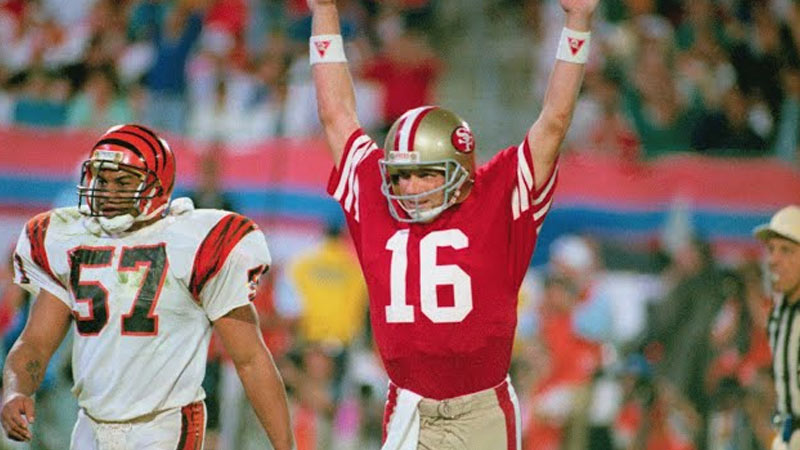
Joe Montana became the defining quarterback of the San Francisco 49ers’ rise during the 1980s.
Drafted from Notre Dame in the third round in 1979, he developed into an exceptionally accurate passer within Bill Walsh’s West Coast offense. Montana led San Francisco to four Super Bowl victories and earned three Super Bowl MVP awards.
Across those four championship games, he threw 11 touchdown passes without an interception. His regular-season achievements included two NFL MVP awards and eight Pro Bowl selections.
Nicknamed “Joe Cool,” Montana earned recognition for staying composed in difficult moments, including the championship-winning drive against Cincinnati in Super Bowl XXIII.
He later helped Kansas City reach an AFC Championship Game. His timing, decision-making, and outstanding championship performances remain central to his place among football’s greatest players.
3. Peyton Manning

Peyton Manning transformed quarterback play through preparation, defensive recognition, and extensive control before the snap.
Selected first overall by the Indianapolis Colts in 1998, the former Tennessee star became the foundation of one of football’s most consistent offenses.
He earned five Associated Press NFL MVP awards and won Super Bowls with both Indianapolis and the Denver Broncos.
His 2013 Denver season produced 5,477 passing yards and 55 touchdown passes, setting NFL single-season records in both categories.
Manning finished his career with 71,940 passing yards and 539 touchdown passes. Although neck problems forced him to miss the 2011 season, he returned to deliver several exceptional years in Denver.
Inducted into the Pro Football Hall of Fame in 2021, Manning left a lasting influence on how quarterbacks manage offensive strategy.
4. Johnny Unitas
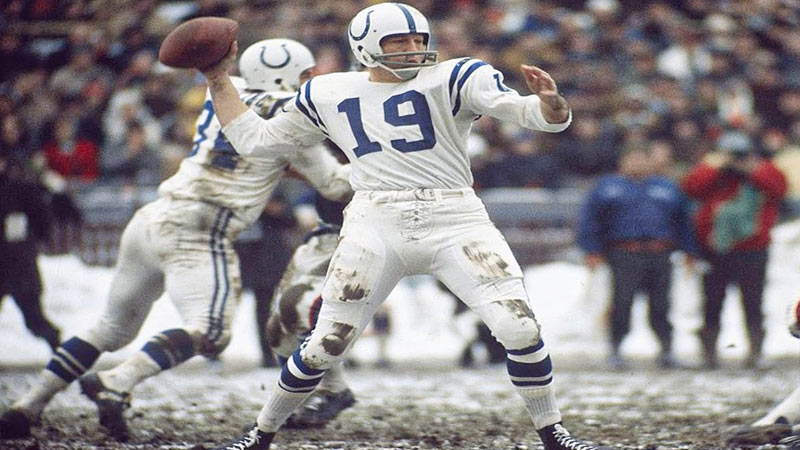
Johnny Unitas helped establish the model for the modern professional quarterback. After being released by the Pittsburgh Steelers, he joined the Baltimore Colts in 1956 and developed into one of football’s most influential players.
Unitas earned three Associated Press NFL MVP awards and helped the Colts win three NFL championships, later adding a Super Bowl V championship.
His leadership in Baltimore’s overtime victory against the New York Giants in the 1958 NFL Championship Game became a landmark moment in the sport’s growth.
Recognized for his strong arm, toughness, and command of the offense, he threw a touchdown pass in 47 consecutive games, a record that stood for decades.
Unitas finished with 40,239 passing yards and 290 touchdown passes. He entered the Pro Football Hall of Fame in 1979.
5. Patrick Mahomes

Patrick Mahomes established an exceptional historical résumé early in his career with the Kansas City Chiefs.
Selected tenth overall in the 2017 NFL Draft after playing at Texas Tech, he spent his rookie season learning behind Alex Smith. In 2018, his first year as the primary starter, Mahomes threw for 5,097 yards and 50 touchdowns and earned the NFL MVP award.
By the conclusion of the 2023 season, he had collected three Super Bowl championships, three Super Bowl MVP awards, and two regular-season MVP awards.
His playing style combines powerful throws, unusual release angles, mobility, and the ability to create opportunities after protection breaks down.
Working with head coach Andy Reid, Mahomes helped make Kansas City a recurring championship contender. Those achievements secure his position among the game’s greatest quarterbacks.
6. Otto Graham
Otto Graham delivered a level of sustained championship success that remains extraordinary in professional football history. Playing for the Cleveland Browns from 1946 through 1955, he guided the team to a league championship game in every season of his career.
Cleveland won seven of those ten appearances: four championships in the All-America Football Conference and three after joining the NFL.
Graham operated head coach Paul Brown’s innovative offense with effective passing, mobility, and strong decision-making.
His success continued when Cleveland moved into the established league, demonstrating that the Browns’ earlier dominance could translate against different competition.
Graham also played professional basketball, reflecting his broader athletic ability. Inducted into the Pro Football Hall of Fame in 1965, he remains an essential figure when comparing quarterback greatness across football’s different eras.
7. Dan Marino
Dan Marino changed expectations for passing production during his 17 seasons with the Miami Dolphins.
Selected 27th overall in the 1983 NFL Draft, the Pittsburgh standout became famous for his exceptionally quick release and ability to deliver powerful, accurate throws from the pocket.
His breakthrough 1984 season produced 5,084 passing yards and 48 touchdown passes, earning him the NFL MVP award and a trip to Super Bowl XIX.
Marino finished his career with 61,361 passing yards and 420 touchdown passes, holding numerous major passing records when he retired. He earned nine Pro Bowl selections and was inducted into the Pro Football Hall of Fame in 2005.
Although Miami never won a championship during his career, his individual excellence and influence on high-volume passing offenses make his historical standing secure.
8. John Elway
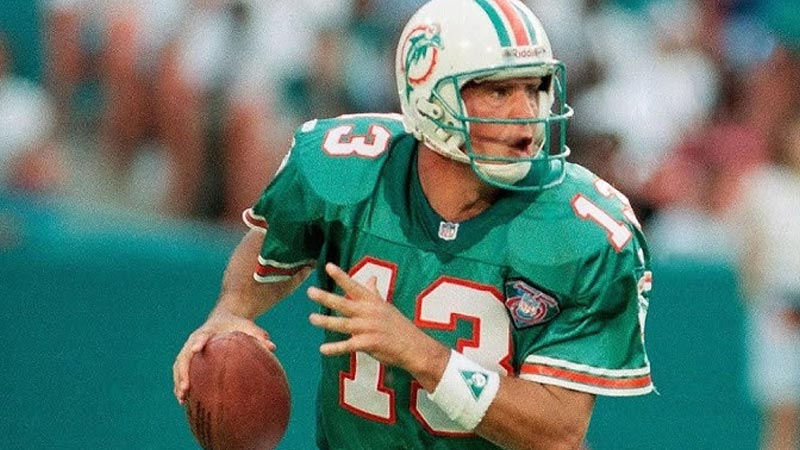
John Elway combined elite arm strength, mobility, and late-game resilience during 16 seasons with the Denver Broncos.
Originally selected first overall by the Baltimore Colts in 1983, the Stanford quarterback was traded to Denver before beginning his NFL career.
He led the Broncos to five Super Bowl appearances and finished by winning consecutive championships in his final two seasons.
Elway earned the 1987 NFL MVP award and was named MVP of Super Bowl XXXIII. His famous 98-yard touchdown march against Cleveland in the 1986 AFC Championship Game became known as “The Drive.”
He retired with 51,475 passing yards, 300 touchdown passes, and 33 rushing touchdowns. Inducted into the Pro Football Hall of Fame in 2004, Elway later helped Denver win another championship as a front-office executive.
9. Aaron Rodgers

Aaron Rodgers established himself as one of football’s most efficient and technically gifted passers during his years with the Green Bay Packers.
Drafted 24th overall in 2005 after playing at California, he spent three seasons behind Brett Favre before becoming the starter in 2008. Rodgers led Green Bay to victory in Super Bowl XLV and earned the game’s MVP award.
His regular-season accomplishments include four Associated Press NFL MVP awards, recognizing outstanding seasons in 2011, 2014, 2020, and 2021.
He became particularly respected for protecting the football while producing difficult throws, including accurate passes outside the pocket. His 2011 passer rating of 122.5 set an NFL single-season record.
Rodgers’ combination of arm talent, mobility, anticipation, and sustained efficiency gives him a strong place in discussions of all-time quarterback excellence.
10. Drew Brees

Drew Brees became one of the most productive and accurate quarterbacks in NFL history through 20 seasons with the San Diego Chargers and New Orleans Saints.
After playing at Purdue, he entered the league as a second-round selection in 2001. His move to New Orleans in 2006 began a partnership with head coach Sean Payton that transformed the franchise.
Brees led the Saints to their first championship in Super Bowl XLIV and earned Super Bowl MVP honors. He retired with 80,358 passing yards and 571 touchdown passes, completing 67.7 percent of his regular-season attempts.
He also recorded five seasons with at least 5,000 passing yards. Despite being shorter than many traditional NFL quarterbacks, Brees excelled through preparation, pocket movement, timing, and precise placement across the field throughout his career.
11. Brett Favre
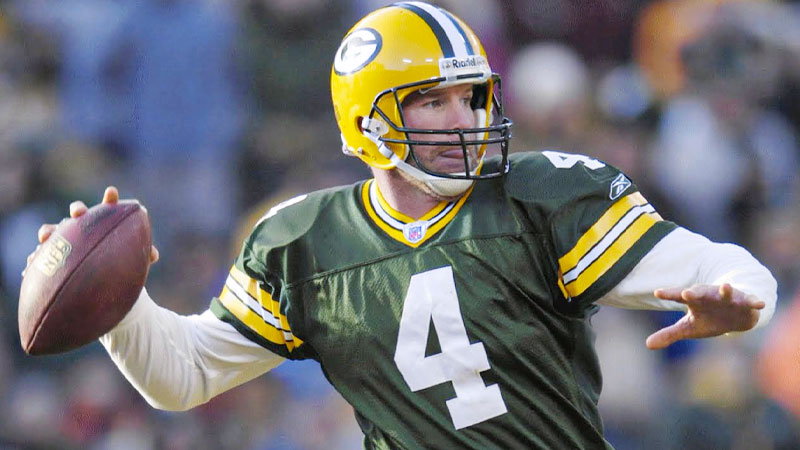
Brett Favre brought powerful throws, improvisation, and exceptional durability to a 20-season NFL career. Drafted by the Atlanta Falcons in 1991, he was traded to the Green Bay Packers the following year and became the central figure in the franchise’s revival.
Favre earned three consecutive Associated Press NFL MVP awards from 1995 through 1997 and led Green Bay to victory in Super Bowl XXXI.
He finished with 71,838 passing yards and 508 touchdown passes, while also setting a remarkable standard with 297 consecutive regular-season starts.
His aggressive approach created spectacular plays but also contributed to a high interception total. Later appearances with the New York Jets and Minnesota Vikings extended his career.
Favre entered the Pro Football Hall of Fame in 2016, recognized for his production, toughness, and influence.
12. Roger Staubach
Roger Staubach became a defining figure in Dallas Cowboys history through leadership, mobility, and success in pressure situations. Before entering the NFL, he won the 1963 Heisman Trophy at the United States Naval Academy and completed his military service.
He joined Dallas in 1969 and eventually led the franchise to four Super Bowl appearances as its starting quarterback, winning two championships. Staubach earned Super Bowl VI MVP honors and received six Pro Bowl selections during his 11-season career.
Known as “Roger the Dodger” and “Captain Comeback,” he could escape defenders while continuing to search for receivers downfield.
His late touchdown pass to Drew Pearson against Minnesota in the 1975 playoffs helped popularize the football term “Hail Mary.” Staubach entered the Pro Football Hall of Fame in 1985.
13. Steve Young
Steve Young combined accurate passing with outstanding running ability to become one of football’s most complete quarterbacks.
After starring at Brigham Young University, he played in the United States Football League and then for the Tampa Bay Buccaneers before joining San Francisco.
Young initially backed up Joe Montana but eventually became the 49ers’ established starter. He won NFL MVP awards in 1992 and 1994 and delivered a spectacular performance in Super Bowl XXIX, throwing six touchdown passes to earn the game’s MVP award.
Young finished his NFL career with 33,124 passing yards, 232 touchdown passes, and 43 rushing touchdowns.
His ability to threaten defenses through both passing and movement helped distinguish him from many contemporaries. He was inducted into the Pro Football Hall of Fame in 2005.
14. Bart Starr
Bart Starr provided the steady quarterback leadership behind the Green Bay Packers’ championship success during the 1960s.
Selected in the 17th round of the 1956 NFL Draft after playing at Alabama, he developed into an exceptionally effective leader under head coach Vince Lombardi.
Starr guided Green Bay to five NFL championships, including victories in the first two Super Bowls, and earned MVP honors in both games.
He also received the Associated Press NFL MVP award in 1966. His famous quarterback sneak secured victory over Dallas in the freezing 1967 NFL Championship Game, remembered as the Ice Bowl.
Starr’s game emphasized accuracy, discipline, and sound decisions within a balanced offense. He spent his entire playing career with Green Bay and entered the Pro Football Hall of Fame in 1977.
15. Fran Tarkenton
Fran Tarkenton helped demonstrate how quarterback mobility could become a central offensive weapon. Selected by the Minnesota Vikings in the third round of the 1961 NFL Draft, the former Georgia standout quickly became known for extending plays through creative scrambling.
He played 18 NFL seasons, dividing his career between Minnesota and the New York Giants before returning to the Vikings. Tarkenton led Minnesota to three Super Bowl appearances and earned the Associated Press NFL MVP award in 1975.
When he retired, he held major NFL career records for passing yards, touchdown passes, and completions. His final totals included 47,003 passing yards, 342 touchdown passes, and 3,674 rushing yards.
Although he never won a Super Bowl, his productivity and influence on mobile quarterback play earned him Hall of Fame induction in 1986.
16. Terry Bradshaw
Terry Bradshaw quarterbacked the Pittsburgh Steelers throughout their championship dynasty of the 1970s. Selected first overall in the 1970 NFL Draft after playing at Louisiana Tech, he overcame early inconsistency to become a decisive postseason performer.
Bradshaw led Pittsburgh to four Super Bowl victories in six seasons and earned MVP honors in Super Bowls XIII and XIV.
He also won the Associated Press NFL MVP award in 1978. His powerful arm allowed the Steelers to attack downfield, particularly through receivers Lynn Swann and John Stallworth.
Across his four Super Bowl appearances, he threw for 932 yards and nine touchdowns. Bradshaw finished his 14-season career with 27,989 passing yards and 212 touchdown passes.
His championship performances and leadership helped earn him induction into the Pro Football Hall of Fame in 1989.
17. Dan Fouts
Dan Fouts became the driving force behind the San Diego Chargers’ influential Air Coryell offense. Drafted from Oregon in the third round in 1973, he spent his entire 15-season NFL career with the franchise.
His development accelerated after head coach Don Coryell introduced an aggressive passing system that emphasized attacking space downfield.
Fouts led the NFL in passing yards for four consecutive seasons from 1979 through 1982 and became the first quarterback to produce three straight 4,000-yard seasons.
He earned six Pro Bowl selections and was named Associated Press Offensive Player of the Year in 1982. Fouts retired with 43,040 passing yards and 254 touchdown passes.
Although he never reached a Super Bowl, his production and role in advancing modern passing concepts secured his Hall of Fame induction in 1993.
18. Kurt Warner

Kurt Warner followed one of the most unusual paths to quarterback greatness. Undrafted after playing at Northern Iowa, he spent time stocking supermarket shelves and developing his game in arena football before establishing himself in the NFL.
His breakthrough came with the St. Louis Rams in 1999, when he became the starter and led their explosive offense to victory in Super Bowl XXXIV.
Warner earned both regular-season MVP and Super Bowl MVP honors that season, then added another league MVP award in 2001.
Later, he revived his career with the Arizona Cardinals and guided them to their first Super Bowl appearance following the 2008 season.
His quick decisions, accuracy, and willingness to throw under pressure defined his best performances. Warner entered the Pro Football Hall of Fame in 2017.
19. Sammy Baugh
Sammy Baugh helped establish the forward pass as a central feature of professional football. After starring at Texas Christian University, he joined Washington in 1937 and immediately helped the franchise win an NFL championship.
He added another championship in 1942 and spent his entire 16-season NFL playing career with the organization. Nicknamed “Slingin’ Sammy,” Baugh excelled through accuracy and passing skill during an era when rushing offenses dominated.
His versatility was equally remarkable: he also played defensive back and served as an outstanding punter.
In 1943, he led the league in defensive interceptions while remaining a major contributor on offense and special teams. Baugh finished with 21,886 passing yards and 187 touchdown passes.
A member of the Pro Football Hall of Fame’s inaugural 1963 class, he remains a foundational quarterback figure.
20. Sid Luckman
Sid Luckman helped reshape NFL offense as the quarterback of George Halas’s Chicago Bears. Selected second overall in the 1939 NFL Draft after playing at Columbia, he became a central figure in the successful development of the T-formation passing attack.
Luckman led Chicago to four NFL championships in 1940, 1941, 1943, and 1946. His 1943 season earned him the league’s MVP award and included a seven-touchdown passing performance against the New York Giants.
He also led the NFL in passing yards and touchdown passes three times each. Luckman’s career totals of 14,686 passing yards and 137 touchdown passes reflect a much less pass-heavy era.
His importance lies in both championship results and his contribution to offensive development. He was inducted into the Pro Football Hall of Fame in 1965.
21. Warren Moon
Warren Moon built an outstanding professional career across Canadian and American football. After playing at Washington, he began with Edmonton in the Canadian Football League and helped the team win five consecutive Grey Cups.
He joined the Houston Oilers in 1984 and became a highly productive NFL passer, particularly within the team’s run-and-shoot offense. Moon earned nine Pro Bowl selections and received the Associated Press Offensive Player of the Year award in 1990.
He later played for Minnesota, Seattle, and Kansas City, finishing his NFL career with 49,325 passing yards and 291 touchdown passes.
Recognized for his strong arm and smooth throwing motion, Moon also broke important barriers for Black quarterbacks. In 2006, he became the first Black quarterback inducted into the Pro Football Hall of Fame.