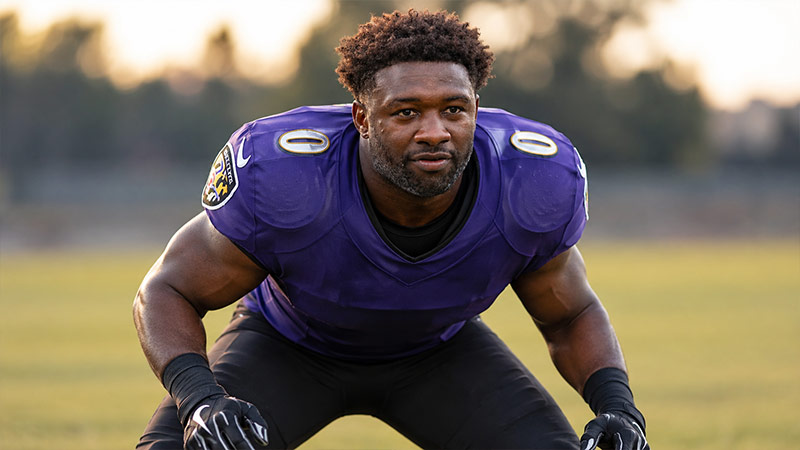
Roquan Smith plays inside linebacker for the Baltimore Ravens. His role is commonly described as a Mike linebacker, meaning he works in the middle of the defense and helps organize the players around him. Baltimore’s official team coverage identifies him as an inside linebacker and highlights his leadership within that position group.
If you have seen Smith called a linebacker, inside linebacker, middle linebacker, or off-ball linebacker, those labels can seem confusing. They describe related parts of his job rather than four separate positions.
The easiest way to understand his role is to watch where he starts a play and what he does after the snap. Smith generally lines up behind the defensive front. From there, he reads the offense, reacts to the ball, defends running lanes, and covers passing areas.
His position demands more than making tackles. An inside linebacker must process a play quickly while staying ready for several possible threats. Here is how that job works and why Smith’s role matters to Baltimore.
Is Roquan Smith an Inside Linebacker or a Middle Linebacker?
Inside linebacker is the most precise general description of Smith’s position with the Ravens. Middle linebacker is also a useful term when discussing his central role.
The difference comes from how defenses arrange their players.
In a traditional 4–3 defense, there are four defensive linemen and three linebackers. The linebacker between the other two is usually called the middle linebacker, or Mike.
In a traditional 3–4 defense, there are three defensive linemen and four linebackers. Two linebackers play inside, while the other two work closer to the outside edges of the formation.
Modern NFL defenses change their personnel and alignments throughout a game. That means Smith may play in fronts that do not look like either textbook setup. His broad position remains inside linebacker, even when his starting location or assignment changes.
These terms help explain the different descriptions:
| Term | What it tells you about Smith’s role |
|---|---|
| Linebacker | His main defensive position group |
| Inside linebacker | He generally operates behind the interior defensive front |
| Middle linebacker | He plays a central role in the defense |
| Mike linebacker | A designation often used for the central linebacker and his assignments |
| Off-ball linebacker | He usually starts behind the line rather than on its edge |
The exact meaning of Mike can vary by team and defensive system. It is best understood as a role within the playbook, rather than a promise that Smith will stand in the same spot on every snap.
What Does a Mike Linebacker Do?
A Mike linebacker helps connect the defensive front with the players covering the pass.
He needs to understand what the offense is showing before the snap. Once the play begins, he must decide whether to attack a running lane, move into coverage, pursue the ball, or rush the quarterback.
That decision often happens in a fraction of a second.
For example, an offense might line up with a tight end beside the tackle and a running back behind the quarterback. The formation could lead to an inside run, an outside run, a pass to the tight end, or a play-action throw.
The linebacker cannot commit simply because one option looks likely. He must read his assigned cues and react while keeping his responsibility intact.
For Smith, the position combines physical work with quick judgment. His central location puts him close to many plays, but being near the ball is only useful if he takes the right path to it.
Where Does Roquan Smith Line Up?
Smith generally begins a play a few yards behind the line of scrimmage, working in the interior of the defense.
His exact alignment depends on several factors:
- The offensive formation.
- The location of the tight end.
- The defensive front.
- The expected run or pass threat.
- The coverage or pressure call.
On one snap, he might line up near the middle of the formation. On another, he could shift toward one side or move closer to the line.
That movement does not necessarily mean he has changed positions. Defenses adjust their alignments to match the offense, disguise a call, or prepare for a specific assignment.
A useful viewing tip is to find Smith before the snap and follow his first few steps. Those steps often reveal whether he is reading a run, dropping into coverage, or attacking on a blitz.
Roquan Smith’s Main Responsibilities
An inside linebacker has several jobs. Smith’s assignment changes from play to play, but these are the core responsibilities associated with his position.
1. Defending the Run
Against a running play, Smith must read the blocking action and protect his assigned area.
Running lanes are often called gaps. Each defender has a responsibility that helps prevent the ball carrier from finding an open path through the front.
A linebacker cannot simply chase the ball without regard for those assignments. Leaving a gap too early can create the opening the offense needs.
Smith’s job may require him to step into a lane, work past a blocker, or follow the runner toward the sideline. The right response depends on the defensive call and how the play develops.
Making the tackle is the visible result. Reading the play and reaching the correct spot are the steps that make it possible.
2. Covering Passes
Inside linebackers also defend passing plays.
In zone coverage, Smith may be responsible for a section of the field. He needs to recognize which receivers enter that area and position himself to limit the quarterback’s options.
In man coverage, his assignment may involve a running back or tight end. Those matchups can test a linebacker’s speed, balance, and ability to react to a route.
Pass defense also includes tackling after a catch. A short completion can become a large gain if the nearest defender takes a poor angle or misses the tackle.
The Ravens have previously described Smith’s work on studying offensive route combinations to improve his pass coverage, showing how much preparation this part of the position requires.
3. Pursuing Plays Across the Field
Not every play stays between the tackles.
A running back may cut outside. A receiver may catch a screen. A quarterback may leave the pocket. In those situations, an inside linebacker must pursue from the middle of the field.
Good pursuit is about taking the right angle as well as moving quickly.
If a defender runs directly toward the ball carrier’s current location, the runner may already be past that spot by the time he arrives. The linebacker must aim for where the play is going while accounting for teammates and blockers.
This is one reason off-ball linebackers need both range and judgment.
4. Blitzing the Quarterback
Smith can rush the quarterback when the defensive call sends him forward.
An inside linebacker blitz often attacks a lane through the interior of the offensive line. The defense may also use movement before the snap to make the protection less certain about where pressure will come from.
However, blitzing is only one part of Smith’s position.
On many passing plays, his assignment is to cover rather than rush. Whether he attacks the quarterback or drops back depends on the call, not simply on whether the offense throws the ball.
5. Helping the Defense Communicate
A central linebacker must understand how his assignment fits with those of the surrounding defenders.
Defenses need clear communication when an offense shifts, sends a player in motion, or changes its formation. Players may need to adjust their alignment or confirm who is responsible for a particular threat.
Smith’s leadership is part of his importance to Baltimore. The Ravens’ 2026 inside linebacker preview specifically describes his performance and leadership as helping set the defensive tone.
That does not mean one player independently chooses every defensive call. Coaches establish the plan, while players communicate and execute it on the field.
How to Judge Smith’s Play at His Position
Tackles are a useful starting point, but they do not explain every part of an inside linebacker’s performance.
A tackle near the line of scrimmage has a different effect from one made after a long gain. Coverage can also help the defense even when the linebacker does not intercept or deflect the pass.
When watching Smith, consider these questions:
- Did he read the play quickly?
- Did he protect the correct running lane?
- Did he avoid or handle the blocker?
- Did he take a useful pursuit angle?
- Did he limit yards after the catch?
- Did he stay with his coverage responsibility?
These details provide a fuller picture than tackle totals alone.
They also help explain why an inside linebacker’s work can be easy to miss. A well-positioned defender may discourage a throw or close a lane without making the final tackle.
Conclusion
Roquan Smith plays inside linebacker for the Baltimore Ravens, with a central role often described as the Mike linebacker. His job includes stopping runs, covering passing lanes, pursuing ball carriers, and helping teammates communicate.
He can also blitz when the defensive call requires pressure on the quarterback. While his alignment changes with different formations, his main role remains the same: protect the middle and react to the offense.
To understand his impact, watch more than his tackle totals. His reads, positioning, coverage, and pursuit show how an inside linebacker helps the defense work together from one play to the next.