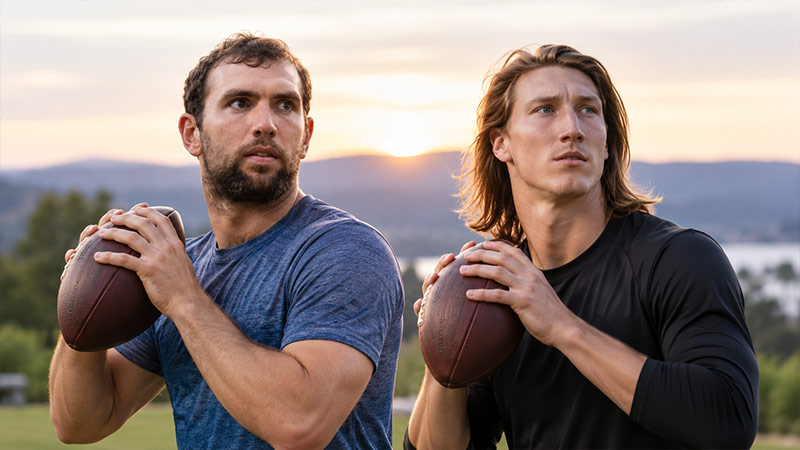
In the modern history of the National Football League, few player evaluations carry as much weight or expectation as the label of a “generational prospect.”
When a college quarterback is designated as a franchise-altering talent, the franchise holding the top overall draft selection faces monumental pressure to convert that scout-driven potential into sustainable success.
Two of the most prominent examples of this phenomenon in the 21st century are Andrew Luck and Trevor Lawrence.
Both quarterbacks entered the league amidst immense national scrutiny, heralded as transcendent talents capable of lifting struggling organizations.
However, their respective career paths, development curves, tactical environments, and long-term durability showcase two vastly different realities of quarterback evaluation in the professional ranks.
The Burden and Prestige of the “Generational” Label
Defining the Generational Benchmark
The term “generational” is frequently used in sports media, yet true consensus prospects appear only once or twice in a decade.
A quarterback earning this title must possess a rare combination of physical traits, mental processing speed, collegiate production, and intangible leadership.
Both Andrew Luck and Trevor Lawrence satisfied every item on that pre-draft checklist, making them undisputed choices for the No. 1 overall pick in their respective draft classes.
High Hype and Organizational Reality
Selecting a generational talent usually means placing a young player into an unstable or rebuilding football environment. The franchise holding the top overall pick is traditionally coming off a disastrous campaign.
How an organization manages, protects, and builds around its prize draft pick often determines whether that player reaches their full potential or suffers from early developmental setbacks.
While Luck and Lawrence both inherited franchises in need of an overhaul, the structural support and strategic systems around them developed in distinctly different ways.
Collegiate Foundations and Prospect Profiles
Andrew Luck: The Gold Standard of Pre-Draft Evaluation
Entering the 2012 NFL Draft, Andrew Luck was widely recognized by talent evaluators as the most complete quarterback prospect since Peyton Manning or John Elway.
During his tenure at Stanford University, Luck demonstrated advanced pre-snap processing, elite pocket awareness, and a rare ability to command a complex pro-style offense.
- System Familiarity: Luck operated within a heavy pro-style system under Jim Harbaugh and David Shaw, frequently making line calls and protection adjustments at the scrimmage line.
- Physical Profile: Standing 6-foot-4 and weighing over 230 pounds, Luck possessed the ideal physical frame to withstand pocket pressure while delivering throws into tight coverage windows.
- Intangible Leadership: Evaluators praised his decision-making under pressure, competitive toughness, and intellectual approach to game preparation.
Trevor Lawrence: The “Can’t-Miss” National Champion
Nine years after Luck entered the league, Trevor Lawrence arrived in the 2021 NFL Draft bearing an equally formidable reputation.
Lawrence captured national attention as a freshman by leading the Clemson Tigers to a national championship victory, establishing a dominant collegiate tenure defined by winning.
- Collegiate Record: Lawrence concluded his starter career at Clemson with a stunning 34–2 record, demonstrating remarkable consistency on the national stage.
- Prototype Traits: Measuring 6-foot-6 with exceptional arm talent, Lawrence combined textbook throwing mechanics with dynamic field movement and open-field running capability.
- Scouting Consensus: NFL draft analysts categorized Lawrence as a “can’t-miss” talent with an exceptionally high physical ceiling, capable of excelling in modern spread-style passing attacks.
Early NFL Years and Organizational Context
Instant Turnaround vs. Systemic Instability
The immediate entry of both players into the NFL highlighted stark differences in early-career organizational results and environment stability.
Andrew Luck (2012):
[2-14 Colts Roster] ---> [Immediate 11-5 Record] ---> [Playoff Appearance]

Trevor Lawrence (2021-2022):
[Urban Meyer Era Instability] ---> [Doug Pederson Stability] ---> [AFC South Title & Playoff Win]
- Andrew Luck’s Immediate Impact: Luck was tasked with replacing Peyton Manning in Indianapolis. He orchestrated a rapid team turnaround, elevating a Colts squad that had finished 2–14 the prior year to an 11–5 record and a postseason berth as a rookie. However, this rapid team success came at a steep physical price, as Luck was forced to compensate for roster holes by absorbing a staggering number of hits and pressure snaps.
- Trevor Lawrence’s Early Obstacles: Lawrence encountered a chaotic rookie environment in 2021 under head coach Urban Meyer. Jacksonville struggled with operational consistency, forcing Lawrence to navigate a difficult adjustment period that limited his initial production. The organization stabilized in 2022 under Doug Pederson, allowing Lawrence to showcase his talent by leading Jacksonville to an AFC South division title and a dramatic comeback victory in the postseason.
Postseason Track Record
Postseason execution remains a key standard for top draft picks. Luck achieved consistent playoff appearances early in his career, taking the Colts to the postseason in each of his first three seasons and ultimately reaching the AFC Championship Game in 2014.
Lawrence secured a division championship and a dramatic playoff comeback victory in his second season, laying a solid foundation as he guides Jacksonville through the 2026 season.
Statistical Breakdown and On-Field Performance
To evaluate their performance accurately, it is essential to look at both volume statistics and efficiency markers across their careers.
Comparative Metric Matrix
| Metric / Honor | Andrew Luck (NFL Career Averages / Totals) | Trevor Lawrence (NFL Career to Date) |
|---|---|---|
| Draft Selection | No. 1 Overall (2012) | No. 1 Overall (2021) |
| Pro Bowl Selections | 4 (2012, 2013, 2014, 2018) | 0 (to date) |
| Passing Yards / Season | ~3,945 yards per year | ~3,600+ yards per year (steady multi-year progression) |
| Passing TDs / Season | ~28.5 TDs per year | ~20+ TDs per year (10 TDs through first 5 games of 2026) |
| Interceptions / Season | ~13.8 INTs per year | Lower-to-moderate turnover rate (improving decision-making) |
| Postseason Achievements | 4 Playoff appearances; 1 AFC Championship Game | 1 AFC South Division Title; 1 Playoff Win |
| Career Status | Retired in 2019 at age 29 (7 seasons) | Active starter (Guiding Jacksonville through 2026) |
Statistical Analysis: Production and Efficiency
- Passing Volume and Scoring: Luck generated higher raw scoring volume, averaging nearly 3,945 passing yards and 28.5 touchdowns per season throughout his seven-year career. Lawrence maintains a consistent passing volume exceeding 3,600 yards and 20+ touchdowns per year, demonstrating ongoing development, highlighted by a fast start in 2026 where he threw 10 touchdowns across the opening five contests.
- Turnover Management: Luck’s aggressive downfield passing style yielded high-scoring numbers but also resulted in an average of 13.8 interceptions annually. By contrast, Lawrence has steadily reduced his turnover output over time, demonstrating improved pre-snap reading and safer ball placement within Jacksonville’s system.
- Accolades vs. Longevity: Luck secured four Pro Bowl selections over his seven seasons, reflecting his high standing among coaches, players, and media during his active playing days. While Lawrence has not yet earned a Pro Bowl selection, his multi-year statistical trajectory shows steady improvement and longevity potential that Luck’s injury-shortened path ultimately lacked.
Tactical Playing Styles, Mechanics, and Longevity
Understanding why Luck’s career ended abruptly while Lawrence continues to build his career requires analyzing their mechanical approaches, offensive schemes, and physical habits.
Core Differences in Mechanics and Strategy
- Luck’s Physicality and Pocket Habits:
- Bracing for Contact: Luck routinely extended plays by holding the ball until the last second, taking hard hits to deliver throws downfield.
- Aggressive Scrambling: Rather than sliding or stepping out of bounds, Luck frequently took on linebackers and defenders directly to gain extra yards, leading to repeated physical impact.
- Offensive Burden: Indianapolis relied heavily on drop-back passing schemes that lacked short-rhythm outlets, exposing Luck to continuous pass-rush pressure behind porous offensive lines.
- Cumulative Toll: The combination of high hit counts and structural injuries eventually led to Luck’s unexpected retirement at age 29 following seven grueling seasons.
- Lawrence’s Modern System Framework:
- Rhythm and Quick Releases: Lawrence operates primarily within modern spread concepts that emphasize quick, rhythmic passing and high-percentage short throws.
- Self-Preservation: While mobile and capable of running when necessary, Lawrence avoids unnecessary collision, preferring to slide or throw the ball away when protection collapses.
- System Structure: Jacksonville’s offensive system utilizes play-action, quick boots, and spread formations to create clean throwing lanes and reduce contact from oncoming pass rushers.
- Long-Term Longevity: By minimizing physical hits and using modern protection techniques, Lawrence is positioned to preserve his health throughout his prime years in Jacksonville.
Conclusion – Lessons from Generational Quarterbacks
The Responsibility of Supporting Elite Quarterback Prospects
Comparing Andrew Luck and Trevor Lawrence offers valuable insights into player development and roster construction in the modern NFL.
Luck’s career stands as both a testament to individual greatness and a warning about the risks of inadequate protection.
Despite possessing top-tier talent and football intelligence, a quarterback cannot single-handedly absorb heavy physical hits without compromising their long-term health and career span.
Lawrence’s Opportunity in Jacksonville
For Trevor Lawrence and the Jacksonville Jaguars, the lesson is clear: long-term success requires combining top-tier physical talent with smart offensive design and reliable pass protection.
By utilizing modern spread mechanics, maintaining rhythm in the passing game, and prioritizing body preservation, Lawrence has established a solid platform to build upon his early division title and playoff victory.
As Lawrence continues through the 2026 season and beyond, he has the potential to fulfill his generational draft label through long-term durability and sustained peak performance—a path that was tragically cut short for Andrew Luck.