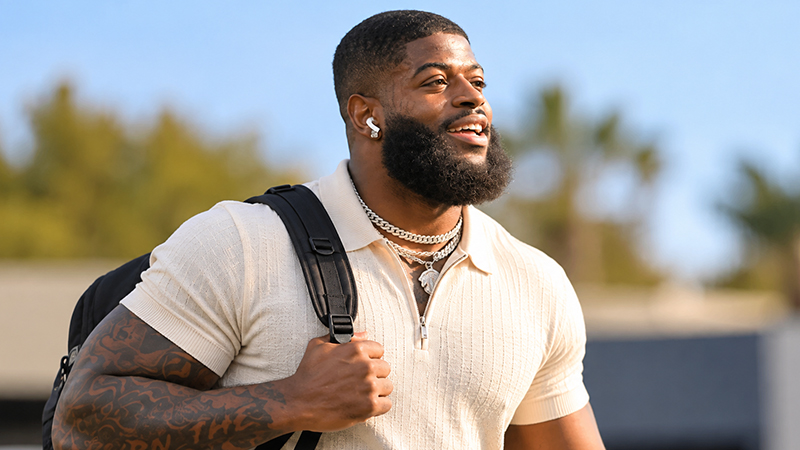
The acquisition and management of first-round talent represent the most critical financial maneuvers for any professional football organization.
When the Cleveland Browns integrated Jared Verse into their defensive rotation, they didn’t just acquire a pass rusher; they inherited a precisely calibrated financial instrument governed by the NFL’s rookie wage scale.
This analysis provides a granular examination of the four-year, $15,134,346 contract that defines Verse’s professional tenure through 2027 and the strategic implications for the Browns’ front office.
The Architecture of the First-Round Rookie Wage Scale
To understand the value Verse brings to Cleveland, one must first understand the rigid structure of the modern NFL Collective Bargaining Agreement (CBA).
Unlike the era of unrestricted rookie spending, today’s first-round picks are signed to slotted contracts where the total value and guarantees are largely predetermined by draft position.
Jared Verse’s contract is a hallmark of this system. Valued at a total of $15,134,346, the deal is 100% fully guaranteed.
In the high-risk environment of professional sports, where “non-guaranteed” portions of contracts often allow teams to move on from players with minimal penalty, Verse’s deal provides him with absolute financial security.
For the team, this represents a significant commitment of “dead cap” resources, meaning the organization is financially tethered to his development and health for the duration of the agreement.
The cornerstone of this agreement is the $7,826,796 signing bonus. From a cash flow perspective, this amount is typically paid upfront or in a very short window following the contract execution.
However, for accounting purposes, the league allows teams to prorate this bonus over the life of the contract to minimize the immediate impact on the salary cap.
The Strategic Pivot: From Los Angeles to Cleveland
The most unique aspect of Jared Verse’s financial narrative is the transition from the Los Angeles Rams to the Cleveland Browns.
Typically, a first-round rookie remains with their drafting team to maximize the “rookie window”—a period where a team can enjoy high-level performance at a below-market cost.
The trade dynamics shifted the responsibility of Verse’s cap hits between the two franchises. While the contract remains a unified document, the timing of the trade dictates which team accounts for which portion of his salary and bonuses.
| Contract Parameter | Financial Metric |
|---|---|
| Total Contract Value | $15,134,346 |
| Fully Guaranteed Amount | $15,134,346 |
| Signing Bonus (Total) | $7,826,796 |
| Average Annual Salary (AAV) | $3,783,587 |
| Contract Duration | 4 Years (2024–2027) |
| Primary Team Option | 5th-Year (2028) |
Yearly Financial Trajectory and Cap Management
Managing the salary cap requires a forward-looking approach to “cap hits”—the amount a player’s salary and prorated bonuses count against the team’s spending limit in a given year.
Verse’s contract is structured to escalate in cost, though it remains remarkably affordable for a starting-caliber edge rusher.
The Rams Era: 2024–2025
In the initial two years of the deal, the Los Angeles Rams handled the primary financial burden. For the 2024 season, the cap hit was a modest $2,750,000, consisting of the base salary and the initial portions of the signing bonus.
By 2025, this figure rises to $3,439,624, which includes a $522,925 guaranteed roster bonus. This “rookie window” is where teams attempt to surround their young talent with expensive veterans, capitalizing on the low cost of the rookie’s contract.
The Cleveland Transition: 2026–2027
As the contract migrates to the Cleveland Browns’ ledger in 2026, the team benefits from a structure that remains highly efficient. In 2026, the projected cap hit is $2,172,210. This is composed of:
- $1,075,000 base salary.
- $1,095,850 roster bonus.
- Additional workout bonuses.
By the final year of the primary deal in 2027, the cap hit is estimated at $2,858,000. This represents the final year of the base rookie salary and associated roster bonuses.
For a franchise like Cleveland, which has significant capital tied up in veteran contracts, having a premier pass rusher count for less than $3 million against the cap in 2027 is a massive competitive advantage.
Detailed Cap Hit and Cash Flow Table
The following table outlines the projected cash flow and team-specific accounting for Jared Verse’s tenure:
| Year | Team | Cap Hit | Primary Salary Components |
|---|---|---|---|
| 2024 | Los Angeles Rams | $2,750,000 | Base Salary + Signing Bonus Proration |
| 2025 | Los Angeles Rams | $3,439,624 | Base Salary + $522,925 Guaranteed Roster Bonus |
| 2026 | Cleveland Browns | $2,172,210 | $1.075M Base + $1.095M Roster Bonus + Workout Bonus |
| 2027 | Cleveland Browns | ~$2,858,000 | Final Rookie Base Salary + Roster Bonus |
| 2028 | Team Option | ~$30,000,000 | Projected Fifth-Year Option (Subject to Escalators) |
The Economic Reality of the Fifth-Year Option
The true “inflection point” of Jared Verse’s contract occurs in 2028. Every first-round contract includes a mandatory team option for a fifth year. This option must be exercised following the player’s third season in the league.
For Verse, the projected cost of this single year is approximately $30,000,000. This represents a nearly 1,000% increase from his 2027 cap hit. Why the massive jump? The fifth-year option is no longer a “rookie” wage; it is a transition into market-level pay.
The value of this option is determined by several performance-based “escalators”:
- Playing Time: Meeting certain snaps-played thresholds.
- Pro Bowl Selections: If Verse earns one or more Pro Bowl nods, the value of the 2028 option increases to match the franchise tag levels for his position.
If Verse performs at an elite level, the Cleveland Browns will face a strategic choice: pay the $30 million for the 2028 season or negotiate a long-term extension that spreads that cost over several years.
Market Context: The Premium on Edge Rushers
To appreciate the value of Verse’s $3.78 million average annual salary, one must look at the broader market for defensive ends and outside linebackers. Elite veteran pass rushers currently command salaries in the range of $25 million to $35 million per year.
By securing Verse on a rookie deal that averages less than $4 million annually through 2027, the Browns are effectively saving over $20 million per year in “market value”.
This “surplus value” is the engine that allows NFL teams to remain competitive under a hard salary cap. It provides the flexibility to afford high-priced talent at other positions, such as quarterback or offensive tackle, while still maintaining a formidable pass rush.
Risk Management and Fully Guaranteed Contracts
The fact that Verse’s contract is fully guaranteed is a testament to the leverage high-first-round picks have in the current CBA.
For the player, it mitigates the risk of career-ending injury or a sudden decline in performance. For the organization, it necessitates a deep trust in the player’s medical profile and work ethic.
In Cleveland’s case, taking on this contract via trade implies a high level of confidence in Verse’s “scheme fit.” Because they cannot easily cut him without incurring a massive cap penalty (due to the guarantees), the Browns have essentially committed to Verse as a cornerstone of their defensive identity for the next several seasons.
Conclusion
Jared Verse’s contract is a masterclass in modern NFL financial planning. It provides the Los Angeles Rams with early-career affordability, and it gives the Cleveland Browns a high-upside asset with manageable cap hits during a critical championship window.
As we move toward 2026 and 2027, the focus will shift from the efficiency of the rookie deal to the looming reality of the 2028 fifth-year option.
Whether Verse remains an affordable “value play” or becomes one of the highest-paid defenders in the league will depend entirely on his performance on the field.
For now, the Cleveland Browns possess one of the most cost-effective defensive assets in professional football—a $15 million investment that could yield the defensive production of a $100 million veteran.