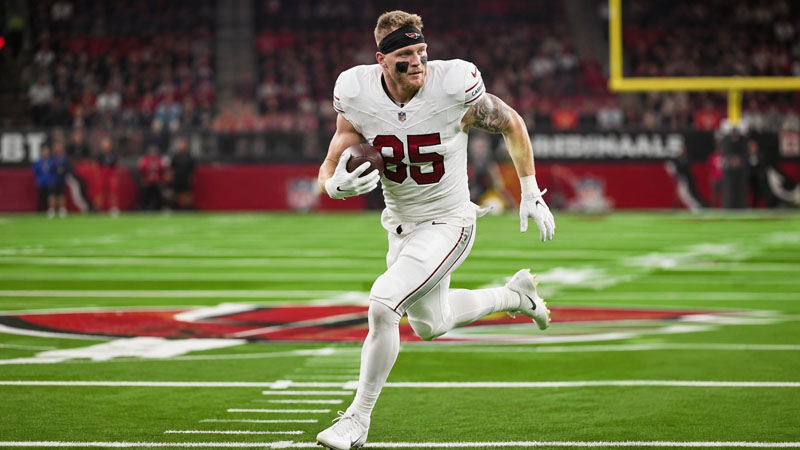
The atmosphere in Fort Collins on March 30, 2022, carried the weight of decades of expectation.
For the Colorado State University (CSU) football program, the Pro Day was not just a routine scouting event; it was a showcase for a player many consider the premier tight end prospect in the nation.
Trey McBride, a local product who rose from the ranks of Fort Morgan, stood at the center of this narrative, looking to cement his status as a certain early-round selection in the upcoming professional draft.
The Physical Profile: Precision and Power
At the professional level, the tight end position has undergone a radical transformation. No longer just an extension of the offensive line, the modern tight end must possess the speed of a wide receiver and the frame of a traditional blocker.
When McBride stepped onto the scales, he provided the foundational data points that professional evaluators require for their models.
Physical Measurement Data
| Attribute | Measurement |
|---|---|
| Height | 6 feet 4 inches |
| Weight | 246 pounds |
| Pro Day Location | Colorado State University |
| Primary Position | Tight End |
These measurements place McBride in a specific tier of athletic prototypes. At 246 pounds, he possesses the requisite mass to hold his own in the “trenches,” yet his height provides the verticality needed to win contested catches against smaller defensive backs.
The Forty-Yard Dash: Exploding the Narrative
The centerpiece of any Pro Day is the 40-yard dash. For a player like McBride, who had already displayed elite production on the field, the sprint was the final “box” to check in his evaluation process.
Entering the day, there were questions regarding his top-end speed—questions that were answered with what observers described as a “blistering” performance.
The data from the sprint was recorded across multiple timers, as is standard practice for professional scouting:
- Official Recorded Time: 4.56 seconds
- CSU Reported Time: 4.54 seconds
- Scout Fast-Clock Estimates: As low as 4.53 seconds
By running a 4.56-second dash at nearly 250 pounds, McBride essentially “took a bazooka” to the final lingering doubts about his athletic ceiling.
In the context of the professional game, this speed allows a tight end to stretch the seam of a defense, forcing safeties to respect the deep ball and creating massive windows for the short-to-intermediate passing game.
Historical Significance for the Rams
McBride’s performance is not just a personal victory; it represents a potential landmark for the CSU program.
The school has a storied history, but it has been several decades since a Ram was selected in the opening round of the professional draft.
- The 1987 Benchmark: The last time Colorado State produced a first-round selection was when Kelly Stouffer was taken in 1987.
- A Local Legacy: Being a native of both Fort Morgan and Fort Collins, McBride carries the pride of the region as he prepares for the next level.
- National Recognition: Widely regarded as the best tight end in the country during his final collegiate season, he has consistently performed under the pressure of being a “marked man” by opposing defenses.
The Underdog Psychology: The “Chip on the Shoulder”
Perhaps the most compelling aspect of McBride’s profile is his mental approach. Despite the accolades and the elite physical testing, he maintains a mindset rooted in his small-town origins. This psychological edge is often what separates talented players from long-term professional starters.
McBride openly admits that he still feels “doubted” by the larger football community. He expressed a belief that he does not always receive the respect his on-field production should command.
This perspective stems from his roots in a small town, where he felt he was “not supposed to be here” in the spotlight of a national draft.
He has vowed to keep this “chip” on his shoulder throughout his entire professional career, using perceived slights as fuel for his training and preparation.
Managing the Professional Transition
The road to the draft is often described as a marathon of physical and mental exhaustion. Between the collegiate season, the postseason showcases, and the individual team workouts, prospects are under constant scrutiny.
McBride has characterized the process as “overwhelming,” citing the constant travel and the pressure of being “pulled this way and that way”.
To manage this, McBride emphasizes two key strategies:
- Maintaining a Consistent Head: He focuses on staying level-headed despite the fluctuating opinions of media and scouts.
- Finding Gratitude: He views the pressure as a privilege, noting that many people would “kill to be in the shoes” he is currently wearing.
- Perspective: He balances the intensity of the workouts with the realization that this is a “once in a lifetime opportunity” that should be enjoyed as much as it is endured.
Professional Interest and the Draft Landscape
The result of his consistent production and his elite Pro Day testing has been a surge in interest from professional organizations.
The draft process involves deep vetting, including interviews and facility visits that allow teams to see how a player fits their specific culture.
- Universal Outreach: McBride has already engaged in discussions with nearly every team in the league.
- Top 30 Visits: These are highly coveted meetings where a team brings a prospect to their headquarters for a full day of evaluation. McBride has already scheduled four of these “Top 30” visits, indicating he is high on the priority list for several organizations.
- Rising Stock: Analysts and insiders agree that his draft stock is actively rising as the draft date approaches.
The Multi-Faceted Impact of CSU’s Pro Day
While McBride was the primary attraction, the Pro Day also highlighted other talents within the program, such as punter Ryan Stonehouse. Both players shared the sentiment of gratitude for the platform provided by Colorado State.
For the scouts in attendance, the day served as a reminder that elite talent can be found outside of the traditional powerhouse conferences, provided the players possess the requisite work ethic and physical tools.
Technical Breakdown: Why the 4.56 Matters
To understand why the 40-yard dash time generated such a reaction, one must look at the comparative data of the tight end position over the last decade. Tight ends who run sub-4.60 seconds often become “mismatch nightmares” in professional schemes.
They are too fast for most linebackers to cover in man-to-man situations and too large for most cornerbacks to jam at the line of scrimmage.
McBride’s time of 4.56 seconds puts him in an elite category of athletes. When combined with his tape—which shows a player capable of high-pointing the ball and making difficult catches in traffic—it creates a profile of a “complete” player who does not need to be taken off the field in specific situations.
Conclusion: A New Era for a Local Star
As the countdown to the professional draft continues, Trey McBride remains a focal point of the evaluation cycle.
He has successfully navigated the most rigorous portions of the pre-draft process, answering questions about his speed, measuring in with ideal size, and demonstrating a professional-grade psychological approach.
For the community in Fort Collins and Fort Morgan, he represents more than just a football player; he is a testament to what can be achieved through consistent effort and a refusal to be defined by one’s “small town” beginnings.
Whether he is the first CSU player taken in the first round since 1987 or a high second-round pick, his impact on the program’s legacy is already secure.
The “chip” on his shoulder may have started in the fields of Colorado, but it is about to be tested on the biggest stages in professional sports.
The transition from a collegiate standout to a professional mainstay is never guaranteed, but with the data points provided at his Pro Day—specifically that 4.56-second dash—McBride has given himself every possible advantage as he enters the next chapter of his career. The dream that once felt “out of reach” is now firmly within his grasp.