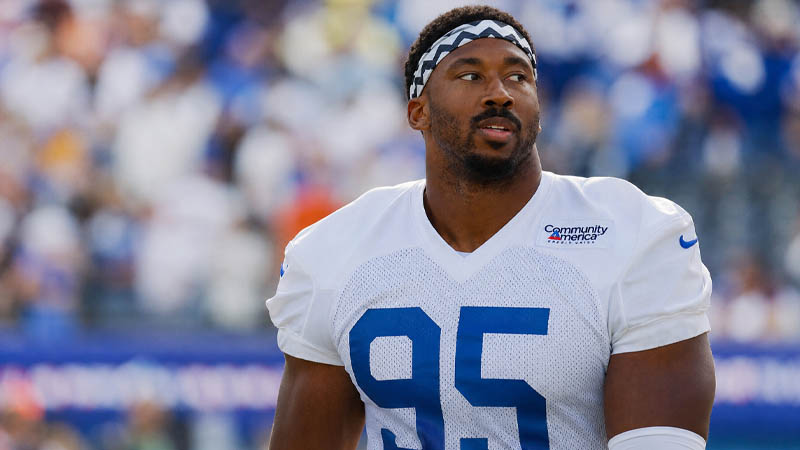
The modern NFL landscape is governed by a delicate balance of salary cap engineering, draft capital valuation, and the pursuit of elite talent.
Every few seasons, a transaction occurs that completely disrupts this equilibrium, rewriting the playbook for how championship windows are constructed and how franchises manage their long-term futures.
The seismic transaction that took place on June 1, 2026—sending superstar defensive end Myles Garrett from the Cleveland Browns to the Los Angeles Rams—is precisely that kind of watershed moment.
Weeks after the deal was finalized, the phrase “Myles Garrett trade” continues to trend across sports media, executive circles, and fan platforms alike.
This is not merely due to the star power of the names involved. Instead, the transaction has captured the football world’s collective attention because it represents a rare, structurally fascinating “win-win” scenario.
It is an exchange where both organizations executed opposed team-building philosophies to perfection.
To understand why this deal has sustained such immense interest and analysis, one must look past the superficial headlines.
We must examine the complex financial engineering, the specific player valuations, the tactical transformations on the field, and the strategic precedent this trade sets for the rest of the league.
The Ledger: Deconstructing the Transaction
At its core, this blockbuster trade is a massive exchange of proven, elite-level performance for high-ceiling youth and future organizational flexibility.
┌──────────────────────────────────────────────────────────────────────────┐
│                      THE BLOCKBUSTER LEDGER                              │
├──────────────────────────────────────┬───────────────────────────────────┤
│       LOS ANGELES RAMS RECEIVE       │     CLEVELAND BROWNS RECEIVE      │
├──────────────────────────────────────┼───────────────────────────────────┤
│                                      │ • Jared Verse (24-year-old Edge)  │
│ • Myles Garrett                      │ • 2027 First-Round Draft Pick     │
│   (Two-time Defensive Player of      │ • 2028 Second-Round Draft Pick    │
│    the Year)                         │ • 2029 Conditional Third-Round    │
│                                      │   Draft Pick                      │
└──────────────────────────────────────┴───────────────────────────────────┘
What the Los Angeles Rams Acquired
In securing Myles Garrett, the Los Angeles Rams obtained a true generational talent. As a two-time Defensive Player of the Year, Garrett represents the pinnacle of modern edge-rushing ability.
He is a defensive chess piece who commands double-teams on virtually every snap, fundamentally altering how opposing offensive coordinators must design their game plans.
For a franchise like the Rams, which has historically shown a willingness to sacrifice future draft assets in pursuit of immediate, elite-level veteran impact, Garrett is the ultimate acquisition.
What the Cleveland Browns Acquired
Conversely, the Cleveland Browns secured a haul designed to sustain their defensive viability while dramatically expanding their draft assets and financial health.
- Jared Verse: The centerpiece of Cleveland’s return is the 24-year-old star pass rusher. Verse represents the ideal modern defensive cornerstone—young, exceptionally talented, and operating on a highly favorable, cost-controlled contract.
- The Draft Capital: In addition to Verse, the Browns secured a premium path for future roster construction: a 2027 first-round pick, a 2028 second-round pick, and a conditional 2029 third-round pick. This collection of assets gives Cleveland the ammunition required to remain highly competitive or maneuver during upcoming drafts.
The Timeline: How the Seemingly Impossible Deal Was Struck
Deals of this magnitude do not materialize overnight. The public may have been stunned by the June 1, 2026 announcement, but the foundation for this trade was laid months in advance through a series of subtle organizational maneuvers and shifting dynamics.
Offseason Speculation and Friction
The trade was preceded by a period of growing speculation regarding Garrett’s long-term future in Cleveland.
Rumors of tension and trade requests from Garrett’s camp had circulated throughout the prior offseason, signaling to the league that the relationship between the star defender and the franchise might be reaching a natural conclusion.
While front offices often publicly dismiss such speculation, behind closed doors, smart organizations begin preparing contingency plans.
The March Contract Adjustment: The Key That Unlocked the Trade
The true catalyst for this transaction was a critical, highly strategic contract adjustment executed in March 2026.
In his original contract structure, Garrett’s cap hit and the resulting dead-money implications would have made a trade functionally impossible for the Browns, while his salary would have overwhelmed the Rams’ cap space.
By adjusting the contract in March, the Browns’ front office created the necessary financial bridge. This adjustment likely involved converting base salary into a signing bonus or restructuring future guarantees.
This maneuver lowered the immediate cap hit for any acquiring team while allowing the Browns to manage the dead-cap acceleration in a way that aligned with their multi-year fiscal planning. Without this financial engineering, one of the biggest trades in modern NFL history would have remained entirely on the drawing board.
The Rams’ Perspective: Hyper-Maximizing a Championship Window
The Los Angeles Rams have long operated under a unique team-building philosophy. While traditional franchises hoard draft picks and prioritize slow, organic depth, the Rams have repeatedly demonstrated that they value elite, blue-chip superstars far above unproven rookies. The acquisition of Myles Garrett is the ultimate manifestation of this strategy.
The Tactical Impact of Myles Garrett
In the modern NFL, a defense’s success is directly tied to its ability to disrupt the opposing quarterback without blitzing. Garrett’s presence on the line of scrimmage completely transforms the Rams’ defensive identity.
- Gravity on the Edge: Garrett draws constant attention. His ability to win one-on-one matchups instantly forces opponents to keep tight ends in to block or assign a running back to chip, thereby reducing the number of targets entering the route.
- Elevating the Secondary: By accelerating the quarterback’s internal clock, Garrett reduces the amount of time the Rams’ secondary must cover opposing receivers. This makes every player in the defensive backfield more effective.
- Versatility: Garrett can line up inside or outside, allowing the defensive staff to create highly favorable matchups against weaker interior offensive linemen during critical third-down situations.
The Super Bowl Equation
By pairing Garrett’s elite pass-rushing capabilities with their existing roster, the Rams immediately vaulted themselves into top-tier Super Bowl contention.
In an NFC landscape where games are frequently decided by thin margins, having a defensive player who can single-handedly secure a turnover or stop a game-winning drive in the final two minutes is invaluable.
The Rams’ front office understands that championship windows are fleeting; they chose to push all their chips to the middle of the table to secure a historic talent.
The Browns’ Perspective: A Masterclass in Asset Management
While Rams fans celebrated the arrival of a future Hall of Famer, football analysts and salary cap experts praised the Cleveland Browns for executing an exceptionally savvy, forward-looking transaction.
The Browns did not simply trade away their best player; they successfully executed a complex transition plan that protects both their present competitiveness and their future flexibility.
┌────────────────────────────────────────────────────────────────────────┐
│               THE VALUE OF THE BROWNS' RETURN                          │
├────────────────────────────────────────────────────────────────────────┤
│ • YOUTH CORNERSTONE: Acquiring Jared Verse (24) ensures Cleveland      │
│   replaces a legendary pass rusher with an elite, rising star.     │
│                                                                        │
│ • COST CONTROL: Verse's contract keeps the Browns' cap healthy,        │
│   avoiding a massive financial bottleneck at a single position.    │
│                                                                        │
│ • DRAFT CAPITAL: Multiple high-round picks (1st, 2nd, and 3rd)         │
│   provide cheap labor and future trade chips through 2029.         │
└────────────────────────────────────────────────────────────────────────┘
Jared Verse: The Ultimate Return Value
To trade a player of Myles Garrett’s caliber, a front office must receive a centerpiece that ensures the defense does not immediately collapse.
In 24-year-old Jared Verse, the Browns secured an exceptional, rising star who has already proven his ability to produce at the professional level.
The primary advantage of Verse lies in the intersection of his talent and his contract status. He is a young, cost-controlled cornerstone.
In an era where elite pass rushers routinely command top-market salaries that restrict a team’s ability to build depth, having a premier edge threat on an affordable deal is one of the greatest competitive advantages in professional sports.
Constructing a Sustainable Future
The additional draft capital—consisting of a 2027 first-round pick, a 2028 second-round pick, and a conditional 2029 third-round pick—gives Cleveland an extraordinary amount of leverage.
- Continuous Injection of Talent: These high-round selections represent multiple opportunities to draft premium positions on cheap, four-year rookie contracts.
- Maneuverability: If the Browns find themselves needing to trade for a quarterback, move up in the draft, or acquire another veteran contributor, this war chest of draft picks provides them with the flexibility to execute almost any move.
- Roster Depth: Highly paid rosters eventually suffer from a lack of depth. By accumulating draft picks, the Browns ensure they can consistently fill middle-tier roster spots with cheap, young talent.
Historical Context: Comparing This Deal to NFL Blockbusters of the Past
To appreciate why the Myles Garrett trade continues to trend and capture the public’s imagination, it is helpful to place it alongside some of the most impactful blockbusters in NFL history.
The Khalil Mack Trade (2018)
When the Oakland Raiders traded Khalil Mack to the Chicago Bears in 2018, the transaction followed a similar dynamic of a star defender seeking a new contract.
However, the Raiders did not receive a proven, high-caliber young player of Jared Verse’s caliber in return; they received draft picks that they ultimately struggled to convert into elite talent.
The Browns’ ability to secure both Verse and multiple premium picks represents a significant evolution in trade negotiations.
The Jalen Ramsey Trade (2019)
The Rams are no strangers to this approach. In 2019, they traded two first-round picks to the Jacksonville Jaguars for corner Jalen Ramsey. That trade, much like the Garrett deal, resulted in an immediate Super Bowl run.
The Rams’ front office operates on the belief that a proven, elite player is always worth more than the statistical probability of a draft pick succeeding. The Garrett transaction reinforces this organizational philosophy on an even grander scale.
The Broader Impact: How This Trade Reshapes the NFL
The ripple effects of the Myles Garrett trade extend far beyond Los Angeles and Cleveland. This transaction offers several profound lessons for front offices across the league.
1. The Power of Proactive Restructuring
The strategic contract adjustment executed in March 2026 demonstrates the importance of forward-thinking cap management. Front offices can no longer afford to react to situations as they arise.
Instead, they must proactively adjust player contracts to create exit or entry doors, even for players they hope to keep. By restructuring Garrett’s deal early, Cleveland preserved its leverage, ensuring they weren’t forced to accept a subpar return under duress.
2. Redefining the “Win-Win” Trade
Historically, trades of this scale were viewed through a binary lens of “winners” and “losers.” The Garrett trade challenges this convention.
By aligning the trade with their respective organizational lifecycles—the Rams in a hyper-aggressive championship window, the Browns in a sustainable, high-value transition phase—both teams achieved their structural goals.
3. The Value of Youth in a Hard-Cap System
As player salaries continue to escalate, the value of a high-performing, 24-year-old player on a cost-controlled contract cannot be overstated.
The Browns’ prioritization of Jared Verse over purely draft-pick-based packages suggests that NFL teams are placing an increasingly high premium on young, transition-ready talent that can immediately fill the void left by departing superstars.
Conclusion: An Unfolding Narrative
The Myles Garrett trade of June 1, 2026, will be analyzed, debated, and referenced by NFL analysts and executives for a generation.
It is a masterclass in modern sports management. The Rams successfully demonstrated their commitment to immediate, elite performance, securing a defensive force capable of carrying them back to the Super Bowl.
Meanwhile, the Browns provided a blueprint for how to transition away from an expensive superstar by prioritizing high-value youth and draft capital.
As the season progresses, every sack by Garrett in Los Angeles and every defensive stop by Verse in Cleveland will be viewed through the lens of this historic transaction.
The periodic commentary and front-office interviews that continue to emerge only serve to highlight the deep, lasting impact of this trade.
In a league where change is the only constant, this deal stands as a monumental testament to the power of strategic planning, financial engineering, and bold decision-making.