In the landscape of professional sports, the National Football League (NFL) stands as a singular model of financial parity and competitive balance.
Unlike other major leagues where financial disparity often dictates the hierarchy of success, the NFL operates under a strictly enforced “hard cap” system.
This mechanism ensures that every franchise, regardless of its market size or local revenue generation, operates under the same financial constraints when building a roster.
As the league approaches the 2026 season with a projected salary cap of $301.2 million per team, understanding the intricate accounting and strategic maneuvers behind these numbers is essential for any serious observer of the game.
The Foundation: Revenue Sharing and the Collective Bargaining Agreement
The NFL salary cap is not a figure pulled from thin air; it is a direct reflection of the league’s massive economic engine.
The specific dollar amount for each season is determined through negotiations outlined in the Collective Bargaining Agreement (CBA) between the NFL and the NFL Players Association (NFLPA). Under the current labor agreement, players receive approximately 48% of the league’s total revenue.
This total revenue includes a vast array of streams: multi-billion-dollar television contracts, ticket sales, and merchandise. One of the league’s most effective parity tools is its revenue-sharing model. For example, profits from jersey sales are spread equally across all 32 teams.
This means that even if a specific team like the Kansas City Chiefs or Philadelphia Eagles dominates the market in a given year, every team in the league benefits from that success. Consequently, the base amount that each team is permitted to spend on player salaries remains identical across the board.
By tying the cap directly to league-wide revenue, the NFL ensures that as the league grows—with national revenue recently surpassing $14 billion—the players’ compensation scales accordingly.
This creates a system where the “ceiling” for spending is uniform, preventing wealthy owners from simply “buying” a championship through unchecked payroll expansion.
Contractual Anatomy: What Counts Against the Cap?
While the headline figure of the salary cap is straightforward, the accounting behind it is a complex discipline involving base salaries, bonuses, and incentives.
At its simplest level, every player on a team’s active roster, injured reserve, and practice squad counts toward the cap.
Base Salaries and Signing Bonuses
A player’s “cap hit” is typically composed of their base salary for that year plus a portion of their signing bonus. Base salaries are paid out weekly or yearly and hit the team’s cap immediately.
However, the NFL allows teams to use “proration” for signing bonuses. When a player receives a large cash payment upfront as a signing bonus, the team is permitted to spread that cap hit over the life of the contract for up to five years.
For instance, if a player signs a four-year contract with a $20 million signing bonus, the team pays the player the full $20 million immediately, but only $5 million counts against the cap in each of the four years.
This allows teams to fit high-value stars under the cap while still providing them with significant immediate liquidity.
Standard NFL contracts are often not fully guaranteed, meaning a player injured in the early years of a deal might not receive the remaining base salary; however, signing bonuses and specific salary guarantees mitigate this risk for the athlete.
Exemptions and Non-Player Expenses
It is important to note that the salary cap applies exclusively to players. The salaries for head coaches, general managers, scouts, and trainers do not count toward the cap limit.
This is one of the few areas where wealthier owners can technically outspend their peers, investing in elite coaching staffs or world-class training facilities without affecting their ability to sign players on the field.
The Mandates: Floors, Hard Caps, and Penalties
The NFL salary cap is often described as a “hard cap,” which differentiates it from the “soft cap” systems seen in the NBA or the luxury tax system in MLB.
In the NFL, the limit is absolute; teams must be cap-compliant by a specific deadline before each league year begins.
The Salary Floor
While the cap sets a ceiling, the league also enforces a “salary floor” to ensure owners do not pocket excessive profits at the expense of player compensation.
Teams are required to spend a minimum percentage of the cap—typically around 89%—over multi-year blocks.
To protect these funds, the league often requires guaranteed money to be held in escrow, ensuring that the cash is available regardless of the owner’s immediate financial situation.
Consequences of Non-Compliance
Failure to stay within the cap limits results in severe disciplinary action. The league has historically issued major fines, sometimes ranging from $10 million to $20 million, for violations.
In addition to financial penalties, teams risk the loss of valuable draft picks, which can cripple a franchise’s ability to build for the future more than a simple fine ever could.
Common causes for violations include disagreements on accounting methods, missed deadlines, or clerical errors.
Strategic Maneuvers: Rollover Space and Dead Money
Professional front offices employ dedicated cap managers to navigate the rules and maximize their spending power. Two of the most critical concepts in this arena are rollover space and dead money.
Rollover Space
One of the more flexible aspects of the cap is the ability to carry over unused space. If a team is $5 million under the cap at the end of a season, they can “roll” that money into the following year’s budget.
This allows rebuilding teams to accumulate cap room, giving them a significant advantage when they are eventually ready to compete for a championship and need to sign expensive free agents.
The Reality of Dead Money
“Dead money” is a term that often haunts fanbases. It refers to guaranteed money that has already been paid to a player or is scheduled to be paid, even if that player is no longer on the roster due to a trade or release.
When a player with a prorated signing bonus is cut, the remaining “un-amortized” portion of that bonus must typically be accounted for on the cap within two league years.
Managing dead money is a vital skill; teams that are reckless with player releases can find themselves with tens of millions of dollars in “dead” space, leaving them with significantly less money to spend on players actually contributing to the team.
For example, if a player with four years of remaining prorated bonus is traded, the original team is still responsible for that money, though they may negotiate with the acquiring team to absorb part of the contract in exchange for different draft compensation.
The Art of the Restructure
To create immediate breathing room, teams often turn to contract restructuring. This process involves taking a player’s upcoming base salary and converting it into a signing bonus. Because signing bonuses are prorated over the life of the contract, the team can reduce the immediate cap hit significantly.
While this provides short-term relief, it is essentially “kicking the can down the road.” By turning current salary into a future cap hit, teams are increasing their potential dead money in later years.
The most successful organizations balance this by only restructuring the contracts of “core” players who they expect to remain on the roster for the duration of the deal.
Competitive Parity: NFL vs. Other Professional Leagues
The primary objective of the salary cap is to create a level playing field where coaching, scouting, and player development—rather than bank accounts—determine success.
This is often contrasted with Major League Baseball, where teams like the Los Angeles Dodgers can theoretically provide “blank checks” to every top-tier free agent, creating a talent monopoly that smaller-market teams struggle to break.
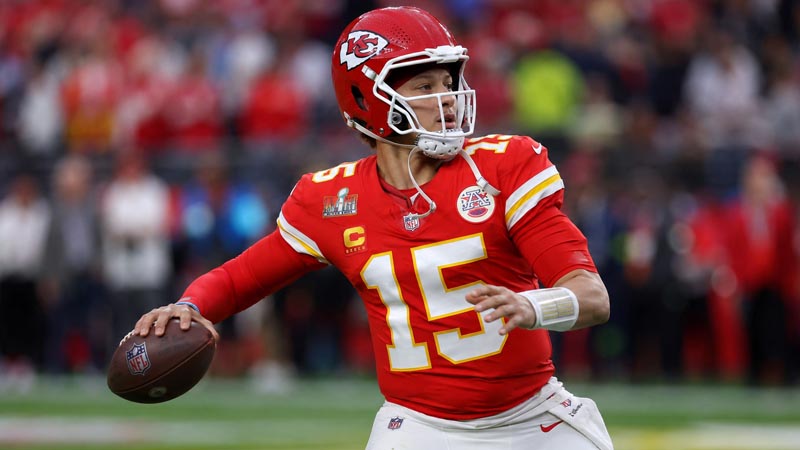
In the NFL, the value of specific positions, particularly the elite quarterback, complicates this parity. A truly elite quarterback like Patrick Mahomes can “carry” a roster and maintain a team’s status as a perennial contender regardless of the surrounding cap constraints.
However, because the quarterback’s salary also hits the cap, the team is eventually forced to make difficult decisions elsewhere on the roster.
In contrast, baseball is a game of depth; even the two best players in the world (such as Shohei Ohtani and Mike Trout during their time together on the Angels) cannot guarantee a winning record if the rest of the roster is lacking. The NFL cap forces every team to find a balance between paying star talent and maintaining a deep, functional roster.
Conclusion: The Future of NFL Financials
As the NFL continues to expand its global reach and revenue streams, the salary cap will likely continue its upward trajectory.
The jump to over $300 million for the 2026 season signals a new era of player compensation, where top quarterbacks may soon command salaries that were previously unimaginable.
Yet, despite the soaring numbers, the fundamental principles of the cap remain unchanged: it is the “Great Equalizer” that ensures the Lombardi Trophy is earned through strategic brilliance rather than financial might.
Whether a team is navigating dead money, mastering the art of the restructure, or managing their rollover space, the salary cap remains the ultimate puzzle for every front office in professional football.