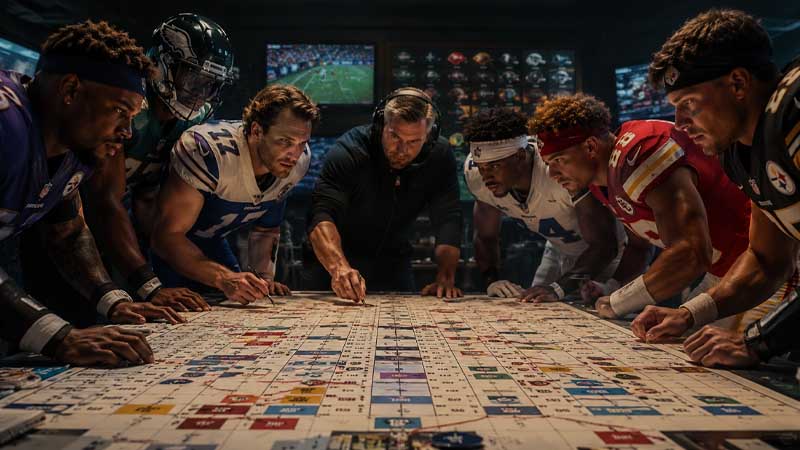
The professional football season is often described as a marathon, but from a strategic and physical perspective, it is more accurately defined as a series of high-impact collisions governed by a complex mathematical algorithm.
Fans frequently wonder why certain teams appear to have a “cakewalk” while others face a “gauntlet.”
The reality is that the league’s scheduling system is a masterpiece of engineered parity, designed to ensure that the margin between victory and defeat remains razor-thin for all thirty-two franchises.
To understand why the schedule is so difficult, one must look past the list of opponents and into the underlying mechanics of standings-based matching, logistical fatigue, and the inherent volatility of professional rosters.
The Mathematical Engine of Parity
The primary reason an NFL schedule feels relentlessly difficult is the built-in parity formula. Unlike other professional leagues where schedules might be more balanced or purely rotational, the NFL utilizes a system that specifically rewards success with a higher level of difficulty the following year.
1. The Standings-Based Tax
If a team wins its division, the scheduling algorithm automatically assigns them a “first-place schedule” for the subsequent season.
This means they are required to play other division winners within their conference, ensuring that the highest-performing teams are constantly tested against elite competition. While this creates compelling television, it places a massive burden on consistent winners.
For instance, the New England Patriots maintained a first-place schedule for nearly two decades, a feat of sustained excellence that many critics overlook when discussing divisional strength.
Conversely, teams in a rebuilding phase receive a “boost” by playing a last-place schedule, which is intended to accelerate their path back to competitiveness.
2. The Rotational Foundation
While three games are determined by the previous year’s standings, fourteen of the seventeen games are rooted in a strict rotational cycle. Every year, a team plays all four teams from another division in its own conference and all four teams from a division in the opposing conference.
This ensures that every team eventually cycles through every opponent, but it also means that if a specific division becomes a “powerhouse,” every team scheduled against it faces a significant disadvantage.
3. The 17th Game Disruption
For years, the 16-game schedule was considered a “flawless” system because it allowed for a perfectly even distribution of team ranks across the league. The addition of a 17th game has introduced a new layer of variance.
This extra game is another standings-based matchup, which means that division winners now face one additional elite opponent that their divisional rivals do not. This has shifted the balance, making the path for top-tier teams even more grueling than in the previous era.
The Myth of “Strength of Schedule”
One of the most significant pitfalls for analysts and fans alike is the reliance on preseason “Strength of Schedule” (SOS) metrics. These metrics are notoriously misleading because they are based on the previous year’s win-loss records.
In the modern era, NFL rosters are highly volatile. Between the emergence of high-impact rookies, the constant churn of free agency, and significant coaching changes, a team that finished 4-13 last year could easily become a 12-win powerhouse the following season.
This volatility means that a game that looked “easy” in April can become a “physical war” by November.
The league is designed so that even the worst teams are not significantly worse than the best, a reality that differentiates the professional game from the collegiate level, where the talent gaps are much wider.
Logistical Warfare: The Invisible Opponent
The difficulty of the schedule is not just about who you play, but when and where you play them. The logistical and physical strain placed on players is a primary factor in the perceived difficulty of a season.
Short Rest and Recovery Windows
The introduction of Thursday Night Football and unusual mid-week holiday games has drastically shortened the recovery window for athletes.
Preparing for a professional football game in four days rather than the standard six is a monumental task that impacts both game planning and physical readiness. These short turnarounds are often cited as some of the most difficult stretches in a player’s career.
The Travel Tax
For teams on either coast, the schedule often includes grueling cross-country flights and consecutive road games. The physical fatigue associated with changing time zones and sleeping in hotels cannot be overstated.
Furthermore, the league’s expansion into international markets—including games in London, Germany, and South America—adds a layer of complexity that can derail a team’s momentum if not managed perfectly.
Divisional Bloodbaths
A team plays its direct divisional rivals twice a year. Because these teams know each other’s tendencies so well, these games often devolve into “physical wars” that take a greater toll on the body than non-divisional matchups. When a division is particularly deep, these six games can define—and sometimes ruin—a season.
Parity or Manufactured Entertainment?
There is an ongoing debate within the football community regarding whether the current scheduling system creates “actual parity” or “fake parity”.
The Argument for “Fake Parity”
Some critics argue that the standings-based system is a form of “smoke and mirrors” designed to keep the standings close and the playoff races exciting for television ratings.
By forcing good teams to play each other and bad teams to play each other, the league effectively “manufactures” a middling record for the majority of the league, which some feel rewards mediocrity and punishes excellence.
This can lead to lopsided Wild Card weekends when a team with a “soft” schedule enters the playoffs against a battle-tested elite squad.
The Argument for “Actual Parity”
Proponents of the system argue that this is precisely what makes the league great. The NFL’s primary goal is entertainment, and the best way to provide that is to ensure games are not lopsided and remain competitive into the fourth quarter.
Unlike the NBA or MLB, where the sheer volume of games can lead to blowouts that feel inconsequential, the NFL’s limited schedule ensures every game feels like a high-stakes event.
The fact that there has been only one repeat champion in twenty-five years suggests that the parity is quite real and that the “best teams rise above” the difficulty of their schedules regardless of the obstacles.
The Psychological Burden of the “Gauntlet”
Beyond the physical and mathematical, there is a psychological element to a difficult schedule. Players and coaches are well aware of the “gauntlet” stretches—those periods where they face three or four playoff contenders in a row, often with travel or short rest mixed in.
Success in the NFL often comes down to momentum management. A difficult schedule can break a team’s spirit if they start poorly, while a “soft” start can provide the confidence needed to overcome elite opponents later in the year.
Strategic Insights for the Modern Fan
For the corporate partner or the dedicated fan, understanding the NFL schedule requires a shift in perspective.
It is not merely a calendar; it is a competitive equalizer. The difficulty is not a flaw in the system; it is the system’s primary feature.
The NFL as a league does not prioritize “fairness” in the traditional sense; it prioritizes entertainment and high-leverage competition.
They want a product where any team can theoretically ascend, even if there is significant momentum to overcome.
This creates an environment where “shitty teams tend to stay shitty” due to internal mismanagement, but the conditions for success are always present if a team can navigate the gauntlet.
Conclusion: Embracing the Grind
The NFL schedule is a masterpiece of modern sports engineering. It balances a rigid rotational foundation with a dynamic, standings-based overlay that ensures the league remains the most competitive in the world.
While the physical toll on players is immense and the logistical hurdles are daunting, these are the very elements that produce the “any given Sunday” drama that defines the sport.
Whether you view the parity as “fake” or “flawless,” one thing is certain: the difficulty of the schedule is the fire that forges champions. In a league where the margin for error is non-existent, the schedule is the ultimate arbiter of greatness.