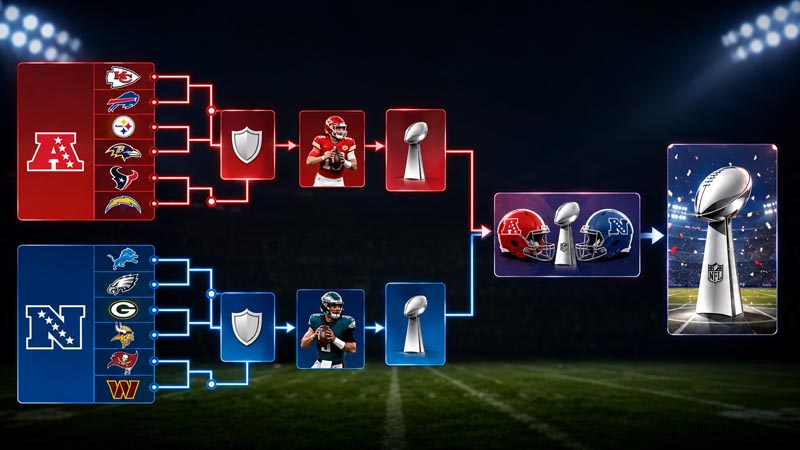
The National Football League represents the pinnacle of professional sports engineering, a system where regular-season performance is meticulously calculated to determine entry into a high-stakes, single-elimination tournament.
Understanding this grid requires more than a casual glance at the standings; it demands an analytical look at seeding hierarchies, re-seeding mechanics, and the specific regulatory framework that governs the road to the Super Bowl.
In 2020, the league underwent a significant structural evolution, expanding the field to include 14 teams—seven from the American Football Conference (AFC) and seven from the National Football Conference (NFC).
This expansion not only increased the volume of postseason inventory but also fundamentally altered the strategic value of the No. 1 seed.
The Foundational Framework: Qualification and Conference Splits
The NFL is divided into two distinct conferences: the AFC and the NFC, each housing 16 teams. Within these conferences, teams are organized into four divisions: East, North, South, and West, with four teams per division.
The postseason is designed to reward both divisional dominance and overall conference excellence.
The Seven-Team Entry Model
Each conference sends seven representatives into the postseason tournament. These seven slots are categorized into two tiers:
- Division Winners (Seeds 1–4): The team in each of the four divisions with the highest winning percentage automatically qualifies for the playoffs. Regardless of how their record compares to teams in other divisions, these four winners are guaranteed the top four seeds in their respective conference.
- Wild Card Teams (Seeds 5–7): The three remaining teams in the conference—those who did not win their division but possess the best overall records—earn “Wild Card” berths. These teams are assigned seeds 5, 6, and 7 based on their performance.
The Strategic Weight of Seeding
Seeding is not merely a numerical label; it dictates home-field advantage and the path of progression. The higher-seeded team—the one with the better numerical rank—always hosts the playoff game at their home stadium.
This provides a significant environmental advantage, often referred to as “home-field advantage,” which remains in effect until the Super Bowl, which is held at a predetermined neutral site.
The Anatomy of the Tournament: A Four-Stage Progression
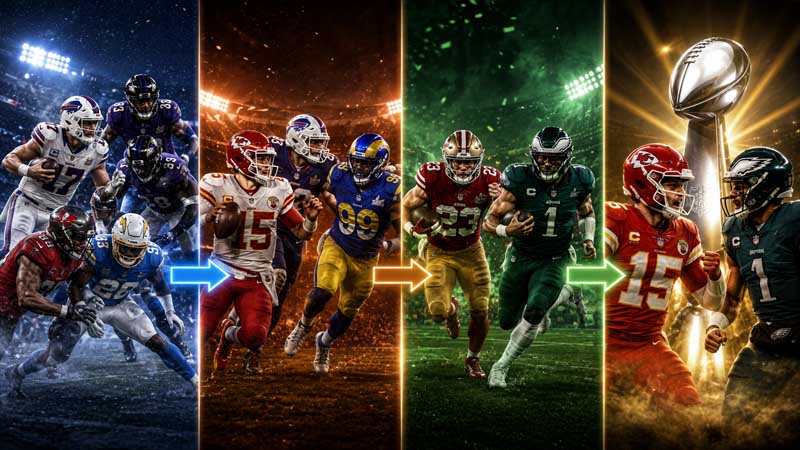
The NFL postseason operates as a single-elimination bracket spanning four rounds: the Wild Card Round, the Divisional Round, the Conference Championships, and the Super Bowl.
Stage 1: The Super Wild Card Round
The opening weekend of the playoffs features six games across both conferences.
- The Bye Week Advantage: The No. 1 seed in each conference is the only team to receive a “bye,” meaning they do not play during the first round and automatically advance to the next stage. This rest period is a critical competitive asset, allowing players to recover while their opponents expend physical and emotional energy.
- The Matchups: The remaining six teams are paired in a high-seed vs. low-seed format:
- The No. 2 seed hosts the No. 7 seed.
- The No. 3 seed hosts the No. 6 seed.
- The No. 4 seed hosts the No. 5 seed.
Stage 2: The Divisional Round and the Re-Seeding Mechanic
One of the most distinctive features of the NFL playoff grid is that it is not a “fixed” bracket. Instead, the league utilizes a re-seeding process after the Wild Card round.
- The Lowest Remaining Seed Rule: The No. 1 seed, coming off their bye week, is matched against the lowest-ranked seed that survived the Wild Card round. For example, if the No. 2, No. 3, and No. 5 seeds all win their opening games, the No. 1 seed would play the No. 5 seed, as it is the lowest remaining numerical rank.
- The Secondary Matchup: The remaining two teams in the conference then face each other. In all instances, the higher seed retains home-field hosting rights.
- Historical Context: The term “Divisional Round” is a legacy designation from the 1970s when only division winners participated in this stage. Today, it is possible for two Wild Card teams to meet in this round, though it remains a rare statistical anomaly.
Stage 3: The Conference Championship Round
The final two teams in each conference battle for the AFC or NFC title. The winner of this game is awarded the conference trophy and earns a spot in the Super Bowl. Again, the team with the higher seed hosts the game.
Stage 4: The Super Bowl
The ultimate conclusion of the season features the AFC Champion versus the NFC Champion. This game is unique because it is played at a neutral location selected years in advance, eliminating the home-field advantage for the higher-seeded team.
The Technical Calculus: Tiebreakers and Standings
In a league characterized by parity, teams often finish the 17-game regular season with identical win-loss records.
To resolve these situations and determine precise seeding, the league employs a rigorous 12-step tiebreaker protocol.
Resolving Ties Within a Division
If two or more teams within the same division are tied, the following hierarchy is applied until the tie is broken:
- Head-to-head record: The win-loss-tie percentage in games between the tied clubs.
- Division record: The percentage of wins within games played against divisional opponents.
- Common games: Performance in games against the same set of opponents.
- Conference record: Performance against all teams within the same conference.
- Strength of Victory: The combined winning percentage of all the opponents a team has defeated.
- Strength of Schedule: The combined winning percentage of all the opponents on a team’s schedule.
- Combined Ranking: Points scored and points allowed compared to other conference teams.
- Net Points: Points scored minus points allowed in common or all games.
- Net Touchdowns: Total touchdowns scored in all games.
- Coin Toss: The final, absolute resolution if all other metrics are equal.
Resolving Wild Card Ties
When teams from different divisions are tied for a Wild Card spot, the process begins by eliminating all but the highest-ranked team in each division using the divisional tiebreakers.
Once one team per division is identified, the league applies a similar 11-step protocol involving head-to-head results, conference records, and strength of victory.
The Postseason Regulation: Overtime Mechanics
One of the most critical departures from regular-season play occurs in the event of a tie at the end of regulation time. In the regular season, a 10-minute overtime period can end in a tie; however, postseason games must continue until a winner is declared.
The “Both Teams Possess” Rule
Under current postseason regulations, both teams are guaranteed at least one possession of the football, even if the team that receives the ball first scores a touchdown.
This rule was implemented to ensure fairness and reduce the impact of the initial coin toss.
- The First Possession: If the first team to possess the ball scores a touchdown, the opposing team is given an opportunity to match that score or take the lead with a two-point conversion.
- Sudden Death Scenarios: If the score remains tied after both teams have had one possession, the game enters a “sudden death” phase where the next score of any kind (field goal, touchdown, or safety) ends the game.
- The Safety Exception: If the team that possesses the ball first commits a safety, the kickoff team is immediately declared the winner.
Clock and Timeout Management in Overtime
- Periods: Postseason overtime consists of 15-minute periods. There are no coaches’ challenges; all reviews are initiated by the replay official.
- Timeouts: Each team is granted three timeouts per half (which consists of two overtime periods).
- Intermissions: There is a three-minute break after regulation and a two-minute break between overtime periods.
- The Third Overtime: If a game reaches a third overtime period, the captain who lost the initial overtime coin toss is given the choice to possess the ball or select which goal line to defend.
Enhanced FAQ: Navigating Postseason Complexities
Why does only one team get a bye week?
Prior to 2020, the top two seeds in each conference received a bye. The move to a 14-team field reduced this to only the No. 1 seed to create a more competitive regular-season finish, as only one team per conference can now earn that week of rest.
Can a team with a losing record make the playoffs?
Yes. Because the four division winners are guaranteed a spot regardless of their record, it is mathematically possible for a team to win a weak division with a losing record and still host a playoff game against a Wild Card team with a much better record.
What happens if a game is still tied after one overtime period?
The game simply continues into another 15-minute period. Unlike the regular season, the clock is not the primary factor; the objective is to reach a conclusive result.
How is the home team determined for the Super Bowl?
The Super Bowl is played at a neutral site. However, for administrative purposes (such as jersey color selection), the home team alternates between the AFC and NFC champion every year.
Is it possible for the No. 7 seed to win the Super Bowl?
Theoretically, yes. While the No. 7 seed is the lowest rank and must play every game on the road, the single-elimination nature of the tournament allows any team that qualifies to potentially reach the championship if they win four consecutive games.
Conclusion: The Ultimate Test of Operational Excellence
The NFL playoff system is a masterpiece of sports logic, balancing the tradition of divisional rivalries with the modern demand for expanded competition.
By utilizing a re-seeding model, the league ensures that the most successful regular-season teams are consistently rewarded with the most favorable matchups.
For organizations, the path is clear: win the division to secure a home game, or strive for the conference’s top spot to earn the invaluable bye week.
As the season transitions from the 17-game marathon to the playoff sprint, these rules form the legal and competitive landscape upon which legacies are built.
Understanding these mechanics is essential for any professional observer looking to grasp the true stakes of the road to the Super Bowl.