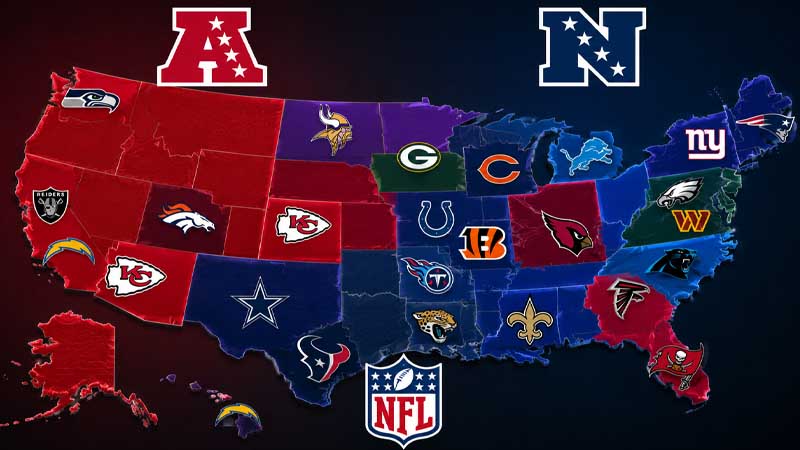
The National Football League (NFL) stands as a paragon of organizational symmetry and logistical precision.
Unlike many global sports leagues that evolved organically or maintain fluid promotion and relegation systems, the NFL is a closed, meticulously engineered ecosystem of 32 teams.
This structure is not merely for aesthetics; it is the fundamental framework that dictates every aspect of the professional football calendar, from the opening kickoff in September to the final whistle of the Super Bowl.
By examining the way these 32 franchises are partitioned into conferences and divisions, we uncover a strategic design intended to balance competitive parity, maximize broadcast revenue, and facilitate regional fan engagement.
The Macro Structure: Two Pillars of Competition

At the highest level of its organizational chart, the league is bisected into two distinct entities: the American Football Conference (AFC) and the National Football Conference (NFC). This binary system creates a balanced landscape where 16 teams reside in each conference.
The parity between these two conferences is the bedrock of the league’s “separate but equal” competitive philosophy.
For the vast majority of the season, teams operate within their own conference “bubble,” competing for internal rankings and postseason berths that eventually culminate in a single representative from each side meeting on neutral ground in the Super Bowl.
League Composition at a Glance
| Component | Quantity | Description |
|---|---|---|
| Total Franchises | 32 | The full roster of professional teams in the league. |
| Conferences | 2 | The AFC and the NFC, each containing 16 teams. |
| Divisions per Conference | 4 | Regional groupings: East, North, South, and West. |
| Teams per Division | 4 | The smallest unit of the league hierarchy. |
The Micro Structure: The Power of Four
While the conferences provide the broad strokes of the league’s identity, the regional divisions provide the texture. Each conference is further subdivided into four smaller groups based on geographic proximity: the East, North, South, and West.
Each of these eight divisions—four in the AFC and four in the NFC—contains exactly four teams. This “4x4x2” grid is widely considered the most efficient mathematical model in professional sports.
It ensures that every team has a clear, localized path to the postseason and creates a “neighborhood” of rivals that interact frequently.
The Strategic Benefits of a 4-Team Division
- Predictability: With only four teams, the math for making the playoffs is simplified. If a team wins its division, it is guaranteed a spot in the postseason.
- Consistency: The small group size allows for a standardized scheduling format where every team faces a comparable level of difficulty within its immediate peer group.
- Narrative Building: Constant interaction between the same four teams fosters deep-seated rivalries that drive television ratings and ticket sales.
Geographic Logic and Logistical Efficiency
The placement of teams into these divisions is not a random exercise. The league uses geography as its primary compass when determining which franchises should be grouped. This approach serves two critical corporate objectives:
- Travel Optimization: By grouping teams in the same region, the league significantly reduces the physical toll on athletes and the operational costs for the organizations. While a team will still travel across the country for certain non-division games, at least three of their away games every year are guaranteed to be within a manageable distance.
- Cultivating Local Rivalries: Geographic proximity is the most natural catalyst for fan passion. When teams from the same state or neighboring regions face off, the stakes feel higher for the local communities, which in turn increases the commercial value of those matchups.
The Engine of the Regular Season: Scheduling Formula
The division of teams into these 4-team clusters is the primary driver of the NFL’s highly structured 17-game regular season.
The scheduling formula is designed to ensure that division rivals are the most significant hurdles a team must clear to achieve success.
- The Double-Round Robin: Every team is required to play the other three members of its division twice a year—once at their home stadium and once at the opponent’s stadium.
- Weighted Importance: Because division records are often used as the primary tiebreaker for playoff seeding, these six games are the most critical on any team’s calendar.
- Non-Division Rotation: Beyond the division games, teams rotate through the rest of the conference and the opposing conference on a multi-year cycle, ensuring that over four years, every team in the league will have played every other team at least once.
The Postseason Gateway: From 32 to 1
The ultimate purpose of the league’s conference and division structure is to filter the 32 teams down to a single champion. The hierarchy dictates a specific “filtering” process through the playoffs.
Postseason Qualifications
- Division Winners: The team with the best record in each of the eight divisions automatically qualifies for the playoffs. These eight teams (four from the AFC and four from the NFC) are rewarded with at least one home game in the opening rounds.
- Wild Card Entries: Beyond the division winners, additional teams from each conference—known as “Wild Cards”—earn entry based on having the next-best records in their conference.
- Conference Brackets: The playoffs are essentially two separate tournaments happening simultaneously. AFC teams only play AFC teams, and NFC teams only play NFC teams.
- The Super Bowl: This is the only game where the conference barrier is officially broken in a competitive setting. The winner of the AFC and the winner of the NFC meet in the championship to determine the league’s top team.
The Modern Division Landscape
To better understand how these teams are categorized in the modern era (this information is external to the provided text but provided for contextual depth), the current alignment reflects the 2002 expansion and realignment.
| Division | Geographic Focus | Competitive Context |
|---|---|---|
| East | Atlantic Coast | Often home to some of the league’s oldest and most valuable franchises. |
| North | Upper Midwest / Great Lakes | Known for “old school” football and cold-weather outdoor stadiums. |
| South | Southeastern US | Often features newer expansion teams and domes. |
| West | Pacific Coast / Rockies | Requires the most travel for visiting teams due to the vast distance between cities. |
The Economics of the Hierarchy
From a corporate perspective, the NFL’s structure is a masterpiece of revenue generation. By dividing the league into two conferences and eight divisions, the league creates multiple “championship” moments throughout the season.
- The Division Race: Fans remain engaged late into the season because winning a 4-team division is often more attainable than having the best record in the entire conference.
- Conference Identity: The AFC and NFC have developed distinct “brand identities” over the decades, allowing for diverse marketing strategies and dedicated fan bases.
- Broadcast Parity: Having two conferences allows the league to split broadcasting rights between major networks, ensuring that games are being shown in every major market simultaneously every Sunday.
Future Outlook: Potential for Expansion
While the 32-team model is currently the gold standard for sports organization, there is constant speculation regarding future growth. Any move to 34 or 36 teams would require a total reimagining of the current division structure.
However, the success of the current 8-division, 4-team model is so profound that the league office would likely prioritize maintaining this symmetry even if new franchises were added.
The genius of the system lies in its balance. It is small enough to feel intimate and local, yet large enough to dominate the national cultural landscape.
Frequently Asked Questions regarding NFL Organization
Why does the NFL use conferences instead of just one big league?
The conference system is a legacy of the merger between the original NFL and the American Football League (AFL).
Today, it serves as a way to organize the large pool of teams into two manageable “leagues” that can be broadcast separately, maximizing exposure and revenue.
Can a team change its division?
While rare, the league has realigned divisions in the past, most notably in 2002 when the league expanded to 32 teams. Changes are typically made to fix geographic outliers (e.g., moving a team from the West to the South to save on travel).
What happens if two teams in the same division have the same record?
The league uses a series of tiebreakers. The first is “Head-to-Head” record (who won the two games they played against each other). The second is the “Division Record” (who performed better against the other three teams in the division).
Is one conference better than the other?
Competitive “power” tends to shift in cycles. There are eras where the NFC dominates in Super Bowl wins, and others where the AFC is considered the superior conference. The 32-team structure ensures that these cycles eventually balance out through the draft and free agency.
Summary of the Professional Football Framework
The NFL’s division into two conferences and eight regional divisions is a strategic masterstroke that balances the needs of the players, the owners, and the fans.
By utilizing geography to dictate placement and symmetry to dictate the schedule, the league has created a product that is both easy to follow and infinitely complex in its strategic depth.
- 32 teams provide the scale.
- 2 conferences provide the overarching rivalry.
- 8 divisions provide the local intensity.
- 1 Super Bowl provides the ultimate resolution.
This hierarchy ensures that every game—no matter how early in the season—is part of a larger, interconnected journey toward the championship.
For the fan, it provides a clear map of the season; for the organizations, it provides a stable and profitable business model that remains the envy of the sporting world.