As the sporting world turned its attention to the pregame arrivals for Super Bowl LX on February 8, 2026, a singular visual narrative completely dominated the conversation.
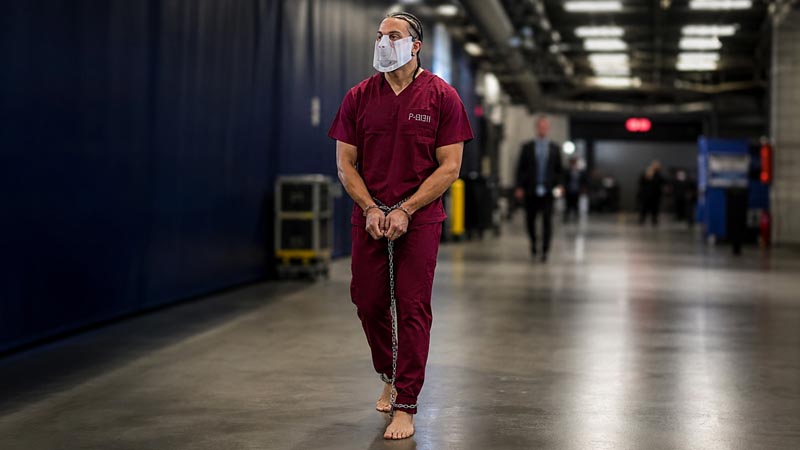
New England Patriots wide receiver Mack Hollins emerged from the team transport wearing heavy steel shackles, metallic handcuffs, a distinctive maroon prison-style jumpsuit, and a rigid, Hannibal Lecter-style facial mask.
The immediate reaction across digital platforms was a mixture of shock, confusion, and urgent inquiry.
Questions instantly flooded search engines: Has an active player been detained on the morning of the championship game? What are the legal implications for the New England Patriots?
To address the most critical question immediately: Mack Hollins was not arrested.
Instead, this dramatic presentation was a meticulously planned, highly theatrical pregame arrival stunt. It was designed to send a deliberate psychological message and establish an uncompromising competitive posture before the player ever put on his pads.
Deconstructing the Visual Elements
Every piece of Hollins’ ensemble carried specific cultural and institutional meaning, transforming a brief walk through the stadium tunnel into a complex piece of performance art.
The Maroon Jumpsuit and “Range 13”
The centerpiece of the attire was a maroon, industrial-style prison jumpsuit. Stenciled clearly across the fabric was the label “Range 13”.
For institutional historians and criminal justice analysts, this detail was a direct reference to one of the most secure environments in the United States: the ultra-high-security wing within the Administrative Maximum Facility (ADX) in Florence, Colorado—commonly known as the ADX Florence supermax prison.
ADX Florence is designed for the absolute isolation of those deemed most challenging to manage. By evoking “Range 13,” Hollins was utilizing a powerful metaphor of extreme confinement, mental resilience, and absolute focus under pressure.
In the context of a championship game, the reference suggests a mindset of total isolation from external distractions, media speculation, and opponent noise. It signaled a player who had metaphorically locked himself into a state of singular, uninterrupted concentration.
Handcuffs, Shackles, and the Mask
The inclusion of heavy metallic handcuffs and leg shackles added physical gravity to the performance.
To further intensify the imagery, Hollins wore a hard, ventilated facial mask reminiscent of the iconic restraint mask worn by the fictional character Hannibal Lecter.
This visual communicated a sense of restrained intensity—the idea of a competitor whose athletic power is so intense that it must be kept under literal lock and key until the whistle blows.
The Unconventional Barefoot Element
While the shackles and jumpsuit evoked the cold reality of a federal penitentiary, Hollins added a deeply personal, contrasting detail: he walked across the cold, industrial concrete of the stadium tunnel completely barefoot.
Unlike the rest of the outfit, this was not merely a prop. Walking barefoot is a well-documented personal lifestyle preference that Hollins maintains in his daily life.
By incorporating this habit into an otherwise highly structured theatrical stunt, he bridged the gap between public performance and personal authenticity.
It served as a grounding mechanism, keeping him physically connected to the earth beneath him even while projecting a highly stylized persona to the cameras.
The Coach Mike Vrabel Connection and the “Road Warrior” Motif
While the individual elements of Hollins’ outfit pointed toward themes of isolation and mental confinement, a key prop in his hands shifted the narrative from a personal display to a unified team philosophy.
The Symbolic High School Jersey
Throughout his shackled walk, Hollins carried a vintage high school football jersey belonging to New England Patriots head coach Mike Vrabel. The jersey featured the word “Warriors” emblazoned boldly across the front chest.
This prop was not chosen at random. By carrying his head coach’s historic high school uniform, Hollins established a direct line of continuity between the coaching staff’s personal football legacy and the active roster.
It was an act of profound respect and alignment, demonstrating that the players were fully receptive to the identity and standards established by their leadership.
Translating the “Road Warrior” Philosophy
The word “Warriors” served as a literal representation of the Patriots’ season-long “road warrior” motif.
Throughout their campaign, the team had embraced an “us against the world” mentality, viewing away games and hostile stadiums not as disadvantages, but as opportunities to demonstrate superior psychological toughness.
In this context, the shackled arrival became the ultimate extension of this philosophy. The imagery suggested that the team had arrived in enemy territory not as guests, but as a unit prepared to endure the harshest conditions, break through any self-imposed or external limitations, and secure victory through sheer, disciplined force.
It transformed the pregame walk from a simple fashion runway into a physical manifestation of a unified team culture.
The Evolution of the NFL Tunnel Walk
To fully appreciate the significance of Hollins’ Super Bowl LX stunt, one must look at the broader cultural evolution of professional sports arrivals.
Over the past decade, the pregame tunnel walk has transformed from a routine walk from the bus to the locker room into one of the most valuable marketing and branding spaces in professional sports.
Inspired by international fashion weeks, athletes began using this brief window to showcase high-fashion designs, luxury tailoring, and streetwear collaborations.
However, Hollins represents a distinct counter-movement within this culture. Armed with a long, established history of eccentric, attention-grabbing pregame tunnel walks and highly unconventional personal habits, Hollins has consistently rejected traditional fashion in favor of conceptual performance art.
By substituting a designer suit with a supermax prison jumpsuit, Hollins subverted the expectation of luxury.
He demonstrated that the pregame walk can be used for deep, psychological preparation and collective team motivation rather than simple commercial self-promotion. It is a shift from aesthetic presentation to raw, competitive narrative.
The Tactical Execution
An essential detail of this event is how Hollins managed the transition from the world of theatrical performance to the realities of professional football.
Despite the elaborate nature of the restraints, the handcuffs, and the heavy jumpsuit, the performance was strictly confined to the pregame arrival. Upon reaching the locker room, Hollins shed the shackles, removed the mask, and discarded the prison jumpsuit.
He transitioned back into standard New England Patriots athletic gear to participate in normal pregame warmups with his teammates.
This swift transition underscores the high level of professionalism involved. The stunt was a powerful mental primer, but it was never allowed to interfere with the physical preparation, flexibility work, and systemic focus required to perform at the highest level of professional sports.
Once the psychological message was delivered to the world, the focus returned entirely to tactical execution on the field.
Summary: The Power of Strategic Theatricality in Modern Sports
Mack Hollins’ shackled arrival at Super Bowl LX stands as a masterclass in modern sports branding and team psychology.
By combining personal eccentricity with a deep-seated team-first philosophy, he captured the attention of a global audience while reinforcing the New England Patriots’ “road warrior” mentality.
It proved that in the high-stakes arena of championship sports, the battle for psychological dominance begins long before the opening kickoff.