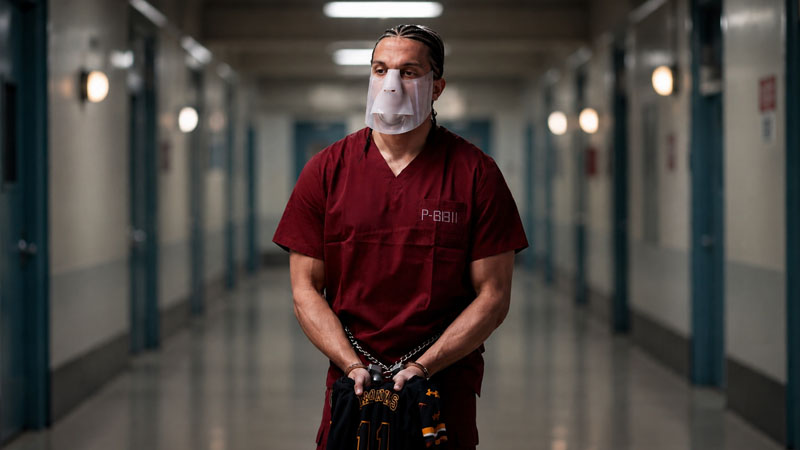
Hours before Super Bowl LX, social media erupted after a shocking image appeared to show New England Patriots wide receiver Mack Hollins arriving at Levi’s Stadium in handcuffs, leg shackles, a restrictive mask, and a bright prison-style jumpsuit.
Fans immediately feared the star receiver had been arrested just before the championship game.
However, Hollins was not arrested. The bizarre scene was instead an elaborate theatrical pregame entrance designed to attract attention and spark conversation.
Known for his unconventional style, Hollins turned his arrival into a dramatic performance that pushed the boundaries of NFL pregame fashion.
Rather than signaling legal trouble, the spectacle was a calculated statement, blending entertainment, personality, and competitive mentality while creating one of the most memorable player entrances of the season.
The Viral Explosion: Why the Handcuff Rumors Took Over the Internet
The rapid spread of rumors surrounding Mack Hollins’ supposed arrest illustrates how quickly provocative images can outrun context.
When Hollins arrived at Levi’s Stadium wearing handcuffs, leg restraints, and a prison-style jumpsuit, spectators and media immediately captured and shared the unusual scene online.
Without instant clarification from the Patriots or NFL, the images were quickly accompanied by speculation about legal trouble, disciplinary issues, or security concerns.
Fans began searching frantically for answers, wondering whether Hollins would even be allowed to play in Super Bowl LX.
Yet, those familiar with Hollins’ eccentric personality understood that something more creative was happening. His unconventional game-day arrivals are well known, making this dramatic entrance another example of his distinctive pregame style.
Deciphering the Spectacle: The Meaning Behind the Costume Elements
To fully comprehend the impact of Hollins’s entrance, one must look closely at the individual elements of his costume. Each piece of his attire was chosen to project a specific image of extreme containment, intensity, and personal identity.
The Heavy Restraints and Face Mask
By arriving in metal handcuffs and leg shackles, Hollins created an immediate sense of high security and lockdown. This visual was further intensified by a face mask reminiscent of the iconic Hannibal Lecter character from cinema.
The combination of these items signaled a state of dangerous, hyper-focused intensity—projecting the image of an individual so volatile and powerful that he required physical containment until the moment he stepped onto the field.
The “Range 13” Jumpsuit
The prison uniform worn by Hollins was not a generic costume; it was distinctly labeled with the words “Range 13”.
Within high-security correctional facilities, a “Range” designation often refers to specialized, maximum-security confinement units designed for the most secure operations.
This attention to detail added a gritty, institutional realism to the display, reinforcing the concept of a competitor locked into a mindset of absolute focus.
The Barefoot Walk
Perhaps the most striking contrast in the entire presentation was Hollins’s decision to walk across the stadium’s concrete floor completely barefoot. While the upper half of his body was bound in heavy, structured restraints, his feet were entirely exposed.
This detail was not a random creative choice, but rather a direct reflection of his personal lifestyle. Hollins is widely known across the league for his genuine aversion to wearing shoes when he is not actively on the field.
Incorporating his barefoot habit into the stunt added an authentic, personal signature to an otherwise highly theatrical character.
The Transition to Game Mode
While the costume was elaborate, it was strictly temporary. Hollins maintained the persona for his initial entrance into Levi’s Stadium, but he removed the entire outfit—handcuffs, shackles, mask, and jumpsuit—well before the team’s official pregame warmups commenced.
This swift transition demonstrated that while he is highly willing to participate in game-day theater, his ultimate priority remains his physical readiness and performance on the gridiron.
The Coaching Connection: Vrabel, the Warriors, and Team Chemistry
Critics often argue that extravagant athlete arrivals are selfish displays aimed at gaining social media attention.
However, Mack Hollins’ Super Bowl LX entrance connected directly to the Patriots’ team identity and head coach Mike Vrabel.
Amid the chains and shackles, Hollins carried Vrabel’s high school “Warriors” football jersey as a meaningful tribute.
The gesture reflected New England’s “road warriors” mentality during their championship run, linking Vrabel’s personal football history with the team’s competitive mindset.
What initially appeared to be a bizarre stunt became a powerful display of respect, unity, and commitment.
Hollins showed that his eccentric entrance was about more than personal attention—it reinforced the team’s message of embracing adversity, toughness, and a warrior mentality together.
The Legacy of Stadium Tunnel Walks: From Fashion Runways to Performance Art
To fully appreciate why Hollins’s pregame display resonated so deeply, it is helpful to look at the broader cultural evolution of professional sports arrivals.
For decades, the path from the team bus to the locker room was completely private. Players arrived wearing simple team-issued sweatsuits or standard business attire.
However, with the rise of digital media, camera crews began filming these short walks, turning the stadium tunnel into a valuable piece of cultural real estate.
Today, these arrival tunnels function as high-profile runways where athletes showcase luxury fashion, promote designer brands, and express their personal style.
Hollins, however, has taken this trend in an entirely different direction. Rather than using the tunnel to showcase expensive streetwear or luxury tailoring, he has transformed it into a stage for conceptual performance art.
His history of bizarre arrival traditions has established him as one of the league’s most unpredictable and entertaining personalities.
By using his arrival to tell a story, pay tribute to his coach, and rally his teammates around a shared mantra, Hollins has demonstrated that the pregame walk can be utilized for team-building and psychological preparation just as much as it is used for personal branding.
Conclusion: The New Era of Athlete Expression
The pregame tunnel walk is no longer just a physical transition from the bus to the locker room; it is a powerful communication platform.
Through his dramatic, barefoot, and shackled arrival at Super Bowl LX, Mack Hollins proved that he understands how to command a crowd long before kickoff.
While his shocking attire initially left the internet in suspense, the reality behind the handcuffs reveals a competitor who is deeply aligned with his coach, fiercely committed to his team’s identity, and completely comfortable in his own barefoot steps.
Hollins successfully walked the thin line between viral spectacle and team solidarity, proving that in the modern entertainment landscape of professional sports, the pregame theater can be just as compelling as the game itself.