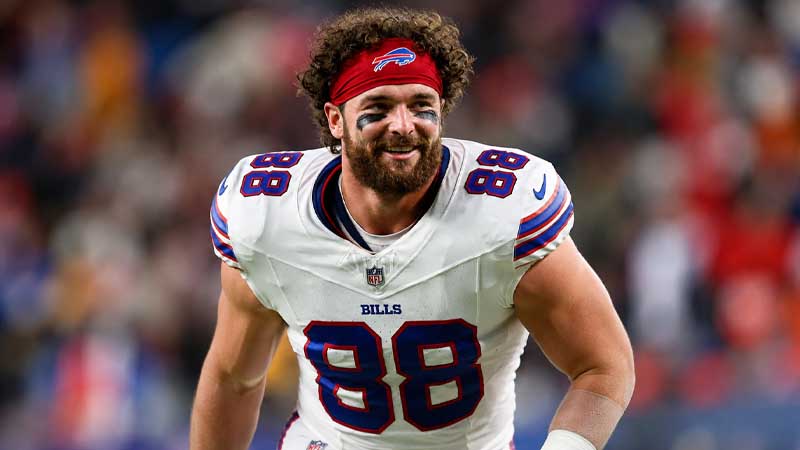
In the modern landscape of professional football, few offenses command as much attention from analysts and enthusiasts as the Buffalo Bills.
With a high-powered passing attack led by an elite quarterback, every skill position player on the roster is scrutinized for their potential to contribute to a winning roster.
Among these players, Dawson Knox occupies a unique and often misunderstood position. Once the primary focal point of the team’s tight end sets, Knox has seen his role undergo a fundamental shift following recent personnel acquisitions.
For those evaluating his potential performance in competitive formats, the central question remains: Is Dawson Knox a viable selection for your roster?
To answer this, one must look beyond the name and deep into the mechanics of the Buffalo offensive scheme, target distribution patterns, and the specific niches where a player of his profile might still provide value.
The Fundamental Shift: Understanding the Hierarchy
The most critical factor in assessing any player’s potential is their place in the “pecking order.” In Buffalo, that order has seen a definitive change.
Dawson Knox currently serves as the clear second tight end on the depth chart, positioned behind Dalton Kincaid.
This is not merely a nominal designation; it represents a functional shift in how the team utilizes its tight ends in the passing game.
When a player is relegated to a secondary role at their position, their path to consistent production becomes significantly more difficult.
In the case of the Buffalo offense, the primary tight end is often treated as a major receiving weapon, while the secondary tight end—Knox—is frequently asked to take on more traditional roles, including blocking and specialized packages.
This creates a ceiling on his involvement that is difficult to overcome without external factors, such as injuries to teammates.
Analyzing the Target Volume Vacuum
In any format that rewards receiving production, targets are the primary currency. Without a consistent volume of passes thrown in their direction, a player’s ability to generate points is severely hampered.
This is the primary hurdle for Knox. Because he splits snaps and routes with Dalton Kincaid, his weekly target volume is inherently low.
When a player is on the field for only a portion of the passing plays, and even then is often the third or fourth option in the progression, the statistical “floor” drops dangerously low. For Knox, this lack of volume means that many weeks may end with minimal statistical output.
In standard formats where consistency is the hallmark of a championship-caliber roster, this unpredictability makes him a difficult player to trust in a starting lineup.
The Volatility of Touchdown Dependency
Because Knox lacks a high volume of catches and yardage, his value is almost entirely dependent on his ability to find the end zone.
While he remains a capable threat near the goal line, relying on touchdowns is one of the most volatile strategies in roster management.
Touchdown dependency means that a player’s performance is binary: either they score and provide a “boom” week, or they fail to score and become a liability.
In the Buffalo offense, while the scoring opportunities are frequent, they are also distributed among a wide array of talented receivers and a quarterback who is himself a prolific runner in the red zone.
This further dilutes the probability of Knox scoring every week. While he offers value primarily near the goal line, he does not provide enough consistent yardage to be considered a reliable weekly contributor.
The “Handcuff” Philosophy in the Tight End Room
One of the more nuanced strategies in roster management is the concept of the “handcuff”—a player who holds little value on their own but becomes a top-tier asset if the starter ahead of them is sidelined.
While this strategy is commonly applied to running backs, it is rarely discussed at the tight end position. However, Knox presents a unique case for this approach.
Currently, Knox is viewed as an injury handcuff for Dalton Kincaid. Should Kincaid be forced to miss time, Knox would likely step back into a primary role within a high-scoring offense, instantly elevating his value from a peripheral figure to a primary target.
For managers in very deep formats or those who already roster Kincaid and wish to ensure their investment, this “handcuff” potential is perhaps the most compelling reason to keep Knox on a radar.
Valuation and Opportunity Cost
When making any roster decision, one must consider the cost of acquisition. According to current market trends, Knox is often available very late in selection processes, typically falling outside the top 30 players at his position.
From a strategic standpoint, an acquisition cost this low means there is virtually no risk involved. However, the “opportunity cost”—the value of the player you didn’t take instead—must still be weighed.
Even a “free” player takes up a roster spot that could be used on a high-upside rookie or a player in a more favorable target environment. For the majority of standard formats, Knox’s current outlook does not justify this roster spot.
Strategic Breakdowns by Format
The viability of Dawson Knox changes significantly depending on the specific rules and depth of the environment in which you are competing.
1. Standard Redraft Leagues
In traditional formats with limited roster spots and standard scoring, Knox is generally not considered a good pick.
The lack of a yardage floor and the extreme touchdown dependency make him too risky to start, and there are typically better options available on the waiver wire who have a clearer path to targets.
2. Deep Formats and TE Premium
In environments where 14 or 16 teams are competing, or in “Tight End Premium” formats where the position receives more points per reception, Knox’s value increases slightly.
In these deep formats, any player with a consistent role on a top-tier offense is worth a roster spot. His presence in the red zone at least gives him a “puncher’s chance” at relevance in a given week.
3. Best Ball Strategies
In “Best Ball” formats—where the computer automatically selects your highest-scoring players each week—Knox becomes a more interesting peripheral piece.
Because you don’t have to predict when his touchdowns will come, you can benefit from his “boom” weeks without suffering the consequences of his “bust” weeks.
Pairing him with his quarterback in a “stack” can also be a viable late-round strategy to maximize scoring during Buffalo’s high-output games.
The Buffalo Offensive Ecosystem
To fully understand Knox’s role, one must consider the philosophy of the Buffalo coaching staff.
The team has increasingly moved toward “12 personnel” (one running back, two tight ends) to create defensive mismatches. However, the way they use these two tight ends is asymmetrical.
While Kincaid is often used as a “move” tight end—essentially a large wide receiver—Knox is often tasked with the “dirty work.”
This includes staying in to block on long-developing pass plays or acting as a lead blocker in the run game.
While these roles are essential for the Buffalo Bills to win football games, they do not translate into the statistical categories that benefit a fantasy roster.
This discrepancy between “real-world value” and “fantasy value” is at the heart of why Knox is a difficult player to project.
Final Verdict: The Professional Recommendation
In the final analysis, Dawson Knox remains a talented athlete playing in a premier offensive system. However, talent and environment are only two pieces of the puzzle; the third, and most important, is role.
Currently, Knox lacks the necessary role to be a consistent contributor to most rosters. He serves as a clear second-string option with low weekly volume. Unless you are competing in an exceptionally deep format or are looking for a specific “handcuff” strategy for Dalton Kincaid, your resources are likely better spent elsewhere.
For the 2024 season and beyond, view Knox as a specialized asset rather than a cornerstone. He is a player who provides value to the Buffalo Bills’ pursuit of a championship, but whose path to individual statistical dominance is currently blocked by a shifting offensive philosophy and rising stars within his own locker room.
Strategic Takeaway:
- Avoid in standard redraft formats.
- Target only in deep leagues (14+ teams) or as a direct insurance policy for Dalton Kincaid.
- Monitor the Buffalo injury report; Knox is one of the most valuable “contingency” players at the tight end position.